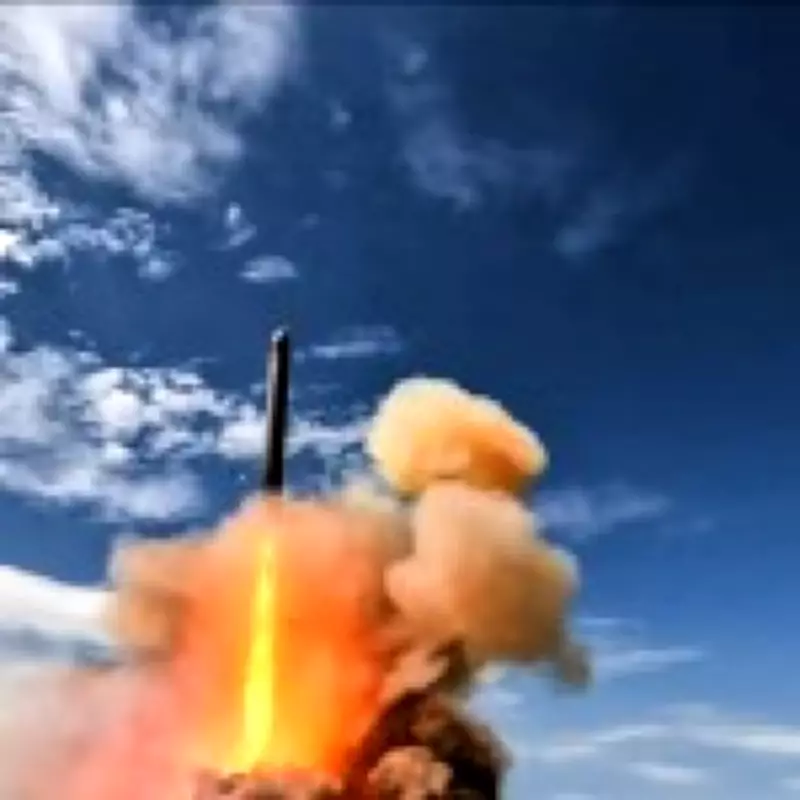
Russian President Vladimir Putin announced on Tuesday that Russia had successfully test-launched the Sarmat intercontinental ballistic missile, which he described as 'the most powerful missile in the world'. The missile, known in the West as 'Satan II', is designed to deliver nuclear warheads at speeds five times faster than sound.
Putin's Statement on the Test
Speaking after the launch, Putin emphasized that Russia was compelled to bolster its strategic security amid shifting global dynamics. 'We were forced to consider ensuring our strategic security in the face of the new reality and the need to maintain a strategic balance of power and parity,' he said. The Russian president confirmed that the missile would enter combat service by the end of the year.
Technical Specifications
According to state-owned news agency RIA Novosti, the Satan II has an estimated range of over 21,700 miles, enabling it to strike targets across the globe. Colonel-General Sergei Karakayev, head of Russia's Strategic Missile Forces, reported that the test was conducted at 11:15 a.m. local time at a military range. 'The launch was successful, and the mission was accomplished,' he told Interfax. The missile is slated for initial deployment in Krasnoyarsk, approximately 2,000 miles east of Moscow.
Reactions from Russian Analysts
Russian defence analysts welcomed the test as a strategic milestone. Igor Korotchenko, director of the Center for Analysis of the World Arms Trade, told TASS that the missile gives Moscow the capability to 'put an end' to adversaries, but only in the event of a nuclear missile attack on Russia or full-scale military operations against the country. The successful launch marks a long-awaited milestone for Putin, who first unveiled the Sarmat in 2018, claiming it could evade American missile defences—a notion dismissed by experts at the time as bluffing.
Background and Previous Tests
In 2022, the Russian Ministry of Defence claimed the missile had been successfully tested, describing it as the first step in building a 'shield' around Russia. Vladimir Degtyar, general designer of JSC Makeyev State Rocket Center, which manufactures the Sarmat, stated: 'The Sarmat will strengthen the combat potential of the Armed Forces over the next 40-50 years, reliably ensuring Russia’s security from external threats. And in today’s geopolitical conditions, it is our reliable shield, the main factor of nuclear deterrence, and a guarantee of maintaining peace.'
However, the missile's development has faced setbacks. A test launch in 2024 ended in failure when the missile exploded in its silo, creating a 200-foot-wide crater in northwestern Russia. Despite this, the Kremlin remains confident in the weapon's capabilities.