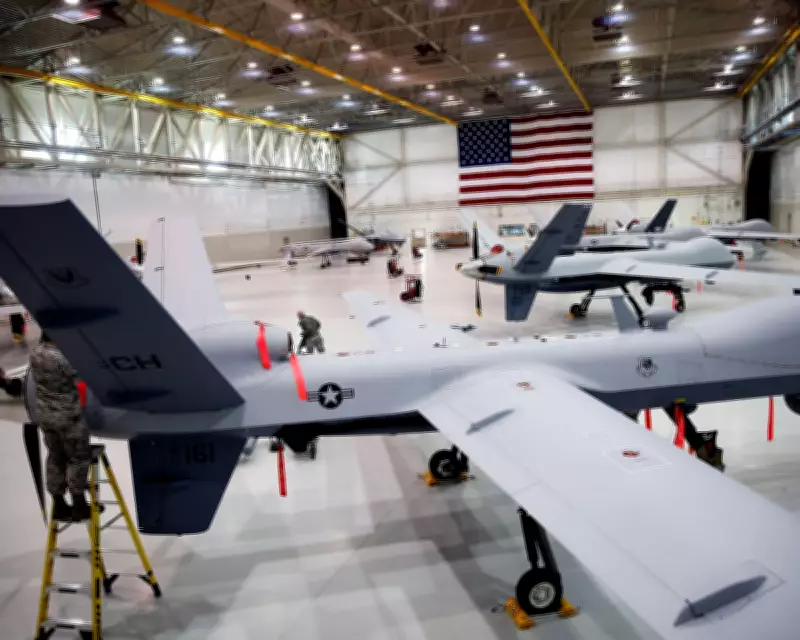
Pentagon Requests $54 Billion for AI-Powered Autonomous Drone Warfare Program
According to recently released budget documents, the Pentagon is seeking a monumental increase in funding for autonomous drone warfare, with a request exceeding $54 billion for its 2027 budget. This represents a staggering 24,000% increase compared to last year's allocation, signaling a dramatic pivot toward artificial intelligence-powered military operations.
The Defense Autonomous Warfare Group, a newly established department within the Pentagon, would receive this substantial funding. Budget overview documents describe the money as dedicated to "autonomous and remotely operated systems across air, land, and above and below the sea," including specific programs like "Drone Dominance."
Unprecedented Commitment to Autonomous Warfare
Former CIA director David Petraeus characterized this budget request as "the largest single commitment to autonomous warfare in history" in a recent opinion piece. To provide context, the $54 billion amount surpasses half of the United Kingdom's entire annual defense budget.
The newly formed Defense Autonomous Warfare Group has absorbed a previous Biden-era initiative focused on acquiring low-cost drones for potential combat scenarios in the Pacific region. While specific allocation details remain unclear, U.S. officials have indicated the group will collaborate with private sector entities to test various autonomous drone systems with the ultimate goal of integrating these technologies into military operations.
Experts Express Concerns About Risks
Despite the substantial funding request, Petraeus and other security experts have raised significant concerns about military and AI industry preparedness for the risks associated with autonomous warfare. Jeffrey Ladish, director of Palisade Research and former security researcher at Anthropic, warned that "every AI company should be pretty worried about the future of AI weapons."
Ladish further explained that autonomous systems could fundamentally alter military confrontation dynamics, potentially making events like coups easier to execute and more frequent occurrences. Peter Wallich, a former UK AI Security Institute official who currently advises MIT's AI Risk Initiative, highlighted vulnerabilities in even the most advanced systems, noting that "every frontier AI system the UK AI Security Institute tested in December had exploitable safeguard failures."
Industry Perspectives and Technological Evolution
Olaf Hichwa, co-founder and chief technology officer of U.S. drone manufacturer Neros Technologies, expressed optimism about the funding, viewing it as a positive response to rapidly evolving battlefield technologies demonstrated in conflicts like Ukraine. "What I'm excited for is that the Pentagon seems to be taking battlefield feedback seriously from Ukraine and from Centcom and around the world," Hichwa stated.
However, Hichwa emphasized the importance of prioritizing proven innovations over impressive demonstrations, expressing hope that the Defense Autonomous Warfare Group would distinguish between "cool demo technology" and "useful, battlefield-ready technology."
Strategic Considerations and Alternative Viewpoints
The funding request emerges amid ongoing U.S. efforts to separate portions of its defense technology ecosystem from China, following comprehensive bans on Chinese-made drones and components implemented last December. This substantial allocation could benefit numerous U.S. drone technology companies, including established entities like Anduril and emerging startups such as Neros, Skydio, and Powerus.
Some experts have questioned whether alternative approaches might prove more effective. Kristofer Harrison, a former State Department Russia specialist, suggested the funding "seems like a slush fund for Anduril" and proposed that collaborating with Ukrainian drone producers, who manufacture cheaper drones in greater volumes, might represent a more efficient investment strategy.
Petraeus's opinion piece further highlighted that the United States currently lacks established military doctrine for deploying autonomous formations like drone swarms, and military leaders would require substantial training to effectively manage and direct such systems. The Pentagon has been engaged in a months-long dispute with AI company Anthropic, which attempted to prohibit military use of its models for mass surveillance or fully autonomous lethal weapons, though budget documents reiterate commitment to obtaining "the latest models from the top American frontier AI labs" for Department of Defense applications.