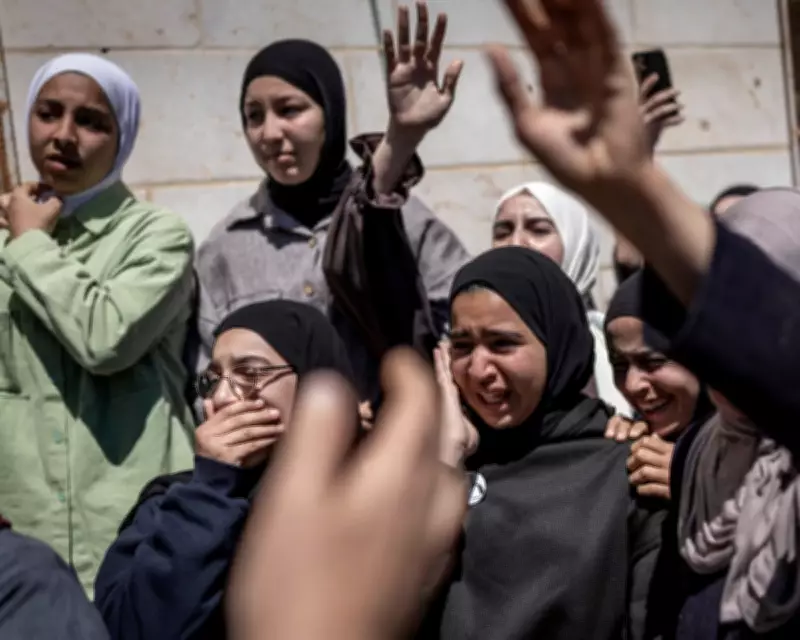
Palestinian Boy, 14, Among Two Killed in Settler Attack Near West Bank School
Family and friends gathered to mourn the death of Aws al-Naasan, a 14-year-old Palestinian boy, during his funeral in al-Mughayyir, north-east of Ramallah, on Wednesday. The tragic event underscores a violent incident that has shocked the local community.
Details of the Attack in al-Mughayyir
According to local officials and witnesses, Israeli settlers entered the village of al-Mughayyir and opened fire near a school, first targeting students and then shooting at those who arrived to help. The Palestinian health ministry confirmed that Aws al-Naasan, 14, and Jihad Abu Naim, 32, were killed in the attack, with three others wounded. Jihad Abu Naim was a parent at the school who rushed to the scene after hearing gunfire and was shot, as reported by the headteacher, Abu-Assaf.
Footage reviewed by media outlets shows a settler in military fatigues, identified by activists as someone with a history of attacks on the village, advancing slowly toward al-Mughayyir before crouching and firing at least eight rounds in the direction of the school. Videos from outside the school depict blood splattered across the street, with gunshots ringing out as men and boys run frantically, calling for help. Injured children and adults, including one man with an exposed, bloodied torso, were carried away from the scene.
Witness Accounts and Military Response
A witness, Kathem al-Haj Ahmed, 57, told Reuters that the settlers arrived first, attacking the village school. He described the reality in al-Mughayyir, stating, "This is our reality in al-Mughayyer village; they aim to displace us, and both the army and the settlers are exchanging roles among them." The Israel Defense Forces (IDF) reported that troops were sent to al-Mughayyir after reports of stones thrown at an Israeli vehicle carrying civilians and a reservist, who exited the car and opened fire at what the military termed "suspects." The IDF said soldiers later intervened to break up what it called a violent clash.
A military source informed the Guardian that a reservist had been suspended from reserve duty pending a criminal investigation by military police, with his weapon confiscated. This incident in al-Mughayyir, located about 15.5 miles north-east of Ramallah, is part of a broader pattern of violence in the West Bank.
Broader Context of Violence Against Palestinians
Human rights groups have described a surge in violence against Palestinians by Israeli settlers and soldiers. In a separate incident on Monday, activists reported that settlers used a bulldozer to demolish a school in Hammamat al-Maleh, near Tayasir in the north of the Jordan valley. Additionally, community leaders stated that settlers from the Karmiel settlement placed razor wire near Umm al-Khair in the South Hebron hills, blocking the route used by children to reach school.
Khaleel Alhathaleen, head of Umm al-Khair's village council, noted that the closure obstructed students' movement and disrupted their education. After more than 40 days of school closures during recent conflicts, children returned last week to find their path fenced off. When they attempted to pass, residents said soldiers fired teargas and stun grenades, frightening many children from returning to school.
Statistical Overview and Legal Implications
The expansion of West Bank settlements has accelerated under the Israeli government of Benjamin Netanyahu, with approximately 700,000 settlers now living among about 2.7 million Palestinians. The Palestinian health ministry reports that 1,152 Palestinians, including 239 children, have been killed in the West Bank since October 7, 2023, with more than 11,800 injured. A Guardian analysis of legal data and public records revealed that Israel has not prosecuted any Israeli citizen for killing Palestinian civilians in the occupied West Bank since the start of this decade.
In related news, on Tuesday, at least seven Palestinians were killed in Israeli attacks in Gaza, including four near Khan Younis, as reported by local media. This ongoing violence highlights the tense and dangerous environment faced by Palestinians in the region.