NATO Chief Reveals Trump's Disappointment Over Allies' Iran War Stance
NATO Secretary General Mark Rutte has publicly stated that former US President Donald Trump was "clearly disappointed" by the refusal of American allies to participate in the war against Iran. This revelation came following a private, closed-door meeting between Rutte and Trump in Washington on Wednesday, highlighting ongoing tensions within the transatlantic military alliance.
Frank Discussions Amid Delicate Ceasefire
The high-stakes meeting occurred at a particularly sensitive time, less than twenty-four hours after the United States and Iran agreed to a fragile two-week ceasefire. This temporary agreement includes provisions for opening the Strait of Hormuz, a critical global oil chokepoint. The ceasefire was brokered after Trump issued stark warnings, threatening to target Iran's civilian infrastructure and declaring that "a whole civilization will die" if Tehran failed to ensure safe passage through the strait by a Tuesday evening deadline.
Speaking exclusively to CNN after the meeting, Rutte declined to confirm whether Trump explicitly reiterated his threat to withdraw the US from NATO over the Iran conflict. However, he characterized their conversation as a "very frank, very open" dialogue between what he described as "two good friends." Rutte emphasized, "He clearly told me what he thought of what happened over the last couple of weeks," while avoiding specific questions about potential US departure from the alliance, calling the situation "a nuanced picture."
Escalating Criticism and Legislative Barriers
Prior to the meeting, Trump had intensified his long-standing criticism of the 77-year-old NATO alliance, labeling it a "paper tiger" and suggesting the US might consider leaving. This frustration stemmed from member countries ignoring his calls for military assistance to help reopen the Strait of Hormuz, whose closure has driven global oil prices sharply higher.
In a Truth Social post following the meeting, Trump wrote, "NATO WASN'T THERE WHEN WE NEEDED THEM, AND THEY WON'T BE THERE IF WE NEED THEM AGAIN. REMEMBER GREENLAND, THAT BIG, POORLY RUN, PIECE OF ICE!!!" This reference to Greenland connects to his earlier statements that his latest frustrations with NATO "began" with their opposition to his desired takeover of the territory.
White House Press Secretary Karoline Leavitt acknowledged on Wednesday that Trump had indeed discussed leaving NATO, noting it was a topic for his meeting with Rutte. However, a significant legal barrier exists: Congress passed a law in 2023 that prevents any US president from unilaterally withdrawing from NATO without congressional approval. This legislation was championed by Trump's current Secretary of State, Marco Rubio, who was then a senator from Florida.
Alliance Foundations and Current Strains
The core commitment of NATO's 32 member countries is a mutual defense agreement where an attack on one is considered an attack on all. This principle has only been invoked once, in 2001, to support the United States following the September 11 terrorist attacks. Despite this history, Trump has repeatedly complained during the Iran war that NATO has demonstrated it will not stand with the US.
Republican Senator Mitch McConnell issued a statement before the meeting, urging Trump to be "clear and consistent" and emphasizing that it is not in America's interest to "spend more time nursing grudges with allies who share our interests than deterring adversaries who threaten us." McConnell highlighted NATO allies' contributions in Afghanistan and Iraq following 9/11.
Broader Diplomatic Context and Regional Actions
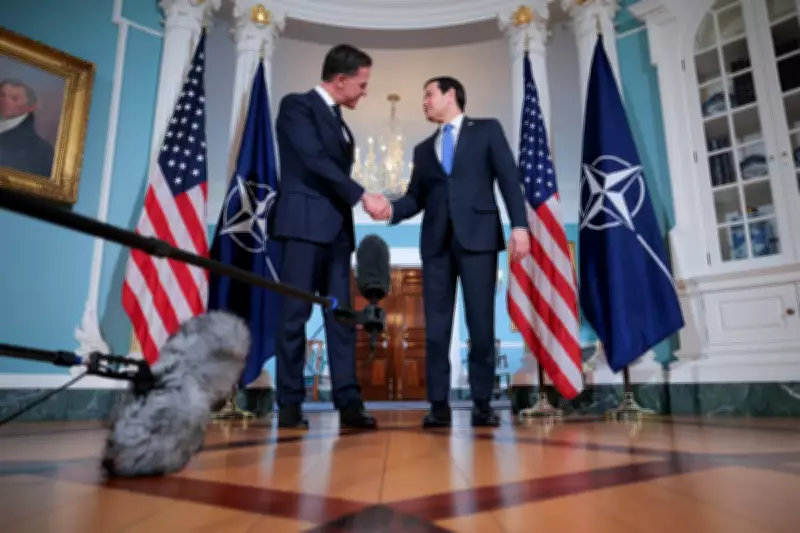
Secretary of State Marco Rubio met separately with Rutte on Wednesday morning at the State Department. Their discussions covered the Iran war, US efforts to negotiate an end to the Russia-Ukraine conflict, and increasing coordination and burden-sharing with NATO allies. The alliance has faced significant strain over the past year due to Trump's reduction of US military support for Ukraine and his threats regarding Greenland.
Trump's pressure on NATO intensified after the Iran war began in late February. He insisted that securing the Strait of Hormuz was not solely America's responsibility but that of countries dependent on its oil flow, stating bluntly, "Go to the strait and just take it." His anger was further fueled as NATO allies like Spain and France restricted US use of their airspace or military facilities during the conflict, though they agreed to help with an international coalition to reopen the strait post-conflict.
British Prime Minister Keir Starmer, a particular source of frustration for Trump, is scheduled to travel to the Gulf to support the ceasefire. The UK has been actively developing a post-conflict security plan for the Strait of Hormuz, underscoring the complex diplomatic and military coordination efforts ongoing amidst these tensions.