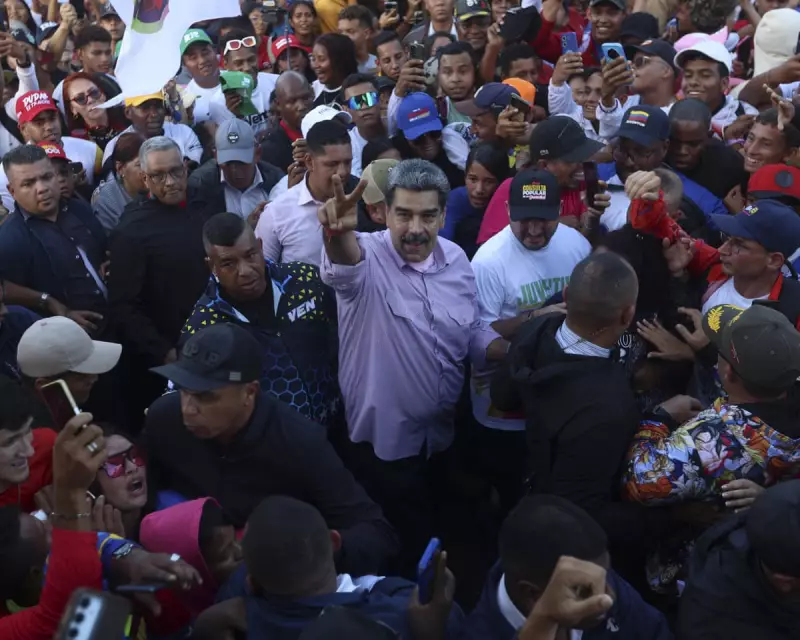
Venezuela's authoritarian leader, Nicolás Maduro, has issued a stark warning to former US President Donald Trump, urging him to avoid plunging America into an Afghanistan-style 'forever war' as tensions escalate in the Caribbean region.
Military Buildup and Defiant Words
The situation intensified dramatically with the arrival of the world's largest aircraft carrier, USS Gerald R Ford, in the region. Speaking to CNN outside the Miraflores presidential palace in Caracas, the 62-year-old Venezuelan president made an emotional appeal for peace rather than conflict.
'No more forever wars. No more unjust wars. No more Libya. No more Afghanistan. Long live peace,' Maduro declared late on Thursday while pushing through crowds to reach a pro-government rally.
Hours after Maduro's speech, Trump's defence secretary, Pete Hegseth, significantly raised the stakes by announcing Operation Southern Spear. Hegseth vowed to purge the Americas of what he termed 'narco-terrorists' and protect the Western Hemisphere, which he described as 'America's neighborhood'.
The Real Motives Behind the Deployment
While officially presented as part of the Trump administration's 'war on drugs' targeting Latin American cartels flooding the US with cocaine and fentanyl, many observers question this justification. Venezuela is not a cocaine producer - production occurs almost entirely in Bolivia, Colombia and Peru - nor is it part of the fentanyl smuggling network focused on Mexico.
This has led to widespread speculation that Trump's deployment - the largest in the region since the 1989 invasion of Panama - represents a political crusade designed to achieve what he failed to accomplish during his first term: overthrowing Maduro.
The timing of Hegseth's announcement raised additional questions, coming ten months after US Naval Forces Southern Command first declared the impending operation. The original plan described using robotic and autonomous systems to monitor illicit trafficking in the Caribbean.
Preparations for Conflict
As tensions mount, CBS News reported that senior military officials had presented Trump with options for potential operations in Venezuela, including strikes on land, though sources emphasised no final decision had been made.
Venezuela's response has been characteristically defiant. Foreign Minister Yván Gil sent a clear message to what he called 'the North American empire': 'Don't you dare [attack]. We are ready.'
Reuters revealed that Maduro's regime has prepared detailed plans for a guerrilla-style response to any US assault. These reportedly involve small military units at more than 280 locations carrying out sabotage and guerrilla tactics to repel foreign forces.
A second strategy, described as 'anarchisation', would see pro-regime groups including intelligence services sowing chaos in Caracas to make Venezuela ungovernable for any occupying forces.
The situation remains dangerously volatile as both sides continue their military posturing and rhetorical exchanges, with the Caribbean region witnessing its most significant US military presence in decades.