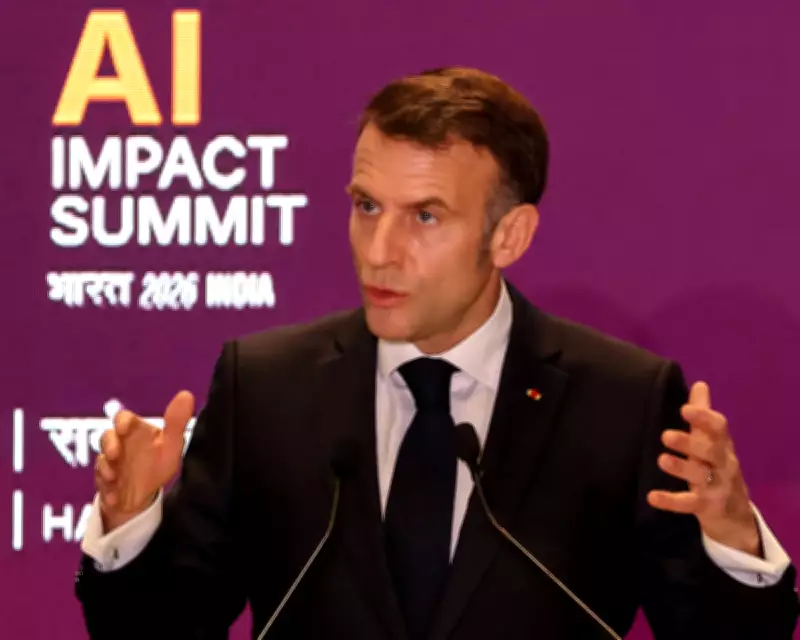
Macron Defends EU AI Rules and Vows Crackdown on Child Digital Abuse
French President Emmanuel Macron has robustly defended Europe's approach to artificial intelligence regulation while pledging a major crackdown on child digital abuse during France's presidency of the G7. Speaking at the AI Impact Summit in Delhi, Macron directly addressed criticism from the United States regarding European regulatory efforts, emphasizing that Europe maintains a balanced approach between innovation and safety.
Global Leaders Unite on Child Protection Concerns
The summit witnessed remarkable consensus among world leaders regarding the urgent need to protect children from AI-related harms. United Nations Secretary General António Guterres echoed Macron's concerns, telling delegates that "no child should be a test subject for unregulated AI." Guterres emphasized that "the future of AI cannot be decided by a few countries or left to the whims of a few billionaires" and insisted that "AI must belong to everyone."
These interventions followed global outrage over Elon Musk's Grok chatbot being used to generate tens of thousands of sexualized images of children. Research published this month by UNICEF and Interpol across eleven countries revealed alarming statistics: at least 1.2 million children reported having their images manipulated into sexually explicit deepfakes in the past year alone. In some nations, one in twenty-five children had been affected—the equivalent of one child in every classroom.
Macron's Direct Response to US Criticism
Macron specifically addressed criticism from the White House's senior AI adviser, Sriram Krishnan, who renewed the Trump administration's objections to AI regulation and singled out the EU's AI Act. Krishnan told delegates he would continue to "rant" against legislation he deemed not "conducive to an entrepreneur who wants to build innovative technology."
"Opposite to what some misinformed friends have been saying," Macron responded, "Europe is not blindly focused on regulation. Europe is a space for innovation and investment, but it is a safe space, and safe spaces win in the long run." The French president emphasized that "there is no reason our children should be exposed online to what is legally forbidden in the real world."
Concrete Measures and International Perspectives
Macron announced specific measures France will implement, including "embarking on a process to ban social networks for children under fifteen years old." He called for platforms, governments, and regulators to work collaboratively to make the internet and social media safer spaces for young people.
Indian Prime Minister Narendra Modi contributed significantly to the discussion, stating it was "imperative that AI is child safe and family-guided." Modi likened the emergence of AI to the discovery of fire, calling it a "profound transformation in human history." He emphasized the need for "established levels of authenticity for content within the digital world" so people can distinguish between authentic content and AI-generated material.
Broader Concerns About AI Concentration and Openness
The summit highlighted growing concerns about the concentration of AI power in a handful of companies. Currently, the most advanced AI models remain largely controlled by approximately four US companies and several Chinese rivals. Dario Amodei, co-chief executive of Anthropic, expressed concern about "the autonomous behavior of AI models, their potential for misuse by individuals and governments, and their potential for economic displacement."
Modi presented an alternative vision, leveraging India's 1.4 billion population as a massive growth market while advocating against AI monopolies. "We must prevent an AI monopoly," Modi stated. "Many nations consider AI to be a strategic asset, and therefore it is developed confidentially and its availability is carefully managed. However, our nation India holds a different perspective. We believe that technology will only truly benefit the world when it is shared and when open source code becomes available."
Notable Absences and Industry Presence
The summit attracted numerous tech executives, including Sam Altman, chief executive of OpenAI, whose company faces a legal challenge from the family of a sixteen-year-old who took his own life after discussing suicide with ChatGPT. Notably, Bill Gates had been scheduled to speak but withdrew at the last minute amid renewed scrutiny of his past links to convicted child sex offender Jeffrey Epstein.
India is actively positioning itself as the world's third AI power behind the United States and China. This week, Google announced a substantial $15 billion investment in data centers and subsea cables linking India to the US and other countries, signaling the nation's growing importance in the global AI landscape.
The Delhi summit revealed deepening international divisions regarding AI governance while demonstrating remarkable unity on the need to protect vulnerable populations, particularly children, from emerging digital threats. As AI technology advances rapidly, the tension between innovation and regulation continues to shape global policy discussions.