
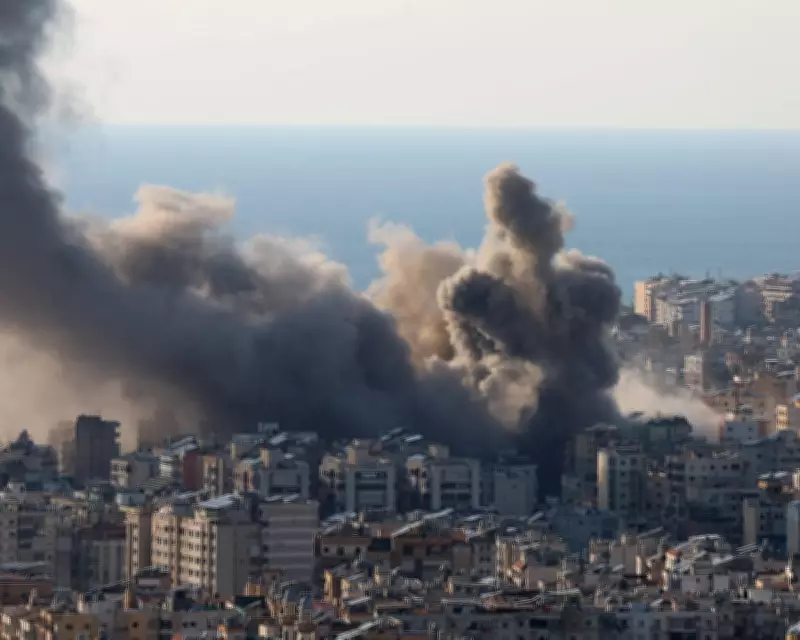
Leaked US Assessment Highlights Israeli Concerns Over Hezbollah Threat
A confidential US embassy cable, leaked to the Guardian, reveals that Israeli officials expressed significant doubts about the ability of Lebanon and Syria to disarm Hezbollah just before Israel launched a series of airstrikes on Beirut's southern suburbs. The document, dated 27 February, was sent to Washington as a background briefing for US Secretary of State Marco Rubio ahead of a planned trip to Israel, which was subsequently cancelled.
Israeli Skepticism on Lebanese and Syrian Capabilities
According to the cable, Israeli authorities informed Washington that Hezbollah was rapidly rebuilding its military capabilities, outpacing efforts by the Lebanese armed forces to degrade them. The assessment stated that neither Beirut nor Damascus could be trusted to contain the threat along Israel's northern borders. This skepticism was echoed in a statement from the office of Israeli Prime Minister Benjamin Netanyahu, which described recent Lebanese army moves to take over security in southern Lebanon as "an encouraging beginning, but they are far from sufficient."
The cable further detailed Israeli concerns about Syria's new leadership, questioning President Ahmed al-Sharaa's ability and willingness to control his security forces. Additionally, it highlighted "grave" alarm over Turkish military entrenchment in Syria, warning that this could create a strategic threat to Israel. The document noted that Turkish officials had "repeatedly incited against Israel in Syria" despite maintaining de-confliction agreements with Israeli security officials.
Context of US-Israeli Strikes and Regional Fallout
The embassy cable was dispatched one day before joint US-Israeli airstrikes targeted Iran, resulting in the death of Supreme Leader Ayatollah Ali Khamenei and triggering retaliatory strikes across the region. Three days after the cable was sent, Israel initiated a wave of airstrikes against Hezbollah-dominated areas in southern Beirut. Within 72 hours of the Iran strikes, Hezbollah launched rockets into northern Israel for the first time since a 2024 ceasefire, prompting an emergency cabinet meeting in Lebanon where Prime Minister Nawaf Salam demanded Hezbollah disarm.
The cable also addressed ongoing Iranian funding to Hezbollah "through Turkey and elsewhere," despite the November 2024 ceasefire. It indicated that the Israel Defense Forces had already resumed military attacks on Hezbollah as a result. The ceasefire, brokered after months of cross-border exchanges, was under strain prior to the Iran strikes, with Israeli forces maintaining five military outposts north of a UN-demarcated blue line inside Lebanese territory.
Diplomatic Controversy Involving US Ambassador
The cable was authored under the auspices of US Ambassador to Israel Mike Huckabee, a self-avowed Christian Zionist. Days earlier, Huckabee had told journalist Tucker Carlson that it would be "fine" if Israel seized territory stretching from the Nile to the Euphrates, encompassing Lebanon, Syria, Jordan, and parts of Iraq and Saudi Arabia. These remarks sparked a diplomatic scandal, drawing condemnation from 14 governments and leading the embassy to clarify that "US policy has not changed." Huckabee further commented that if Israel "ended up getting attacked by all these places and they win that war and they take that land, OK, that's a whole other discussion."
This leaked assessment underscores the complex geopolitical dynamics in the Middle East, highlighting Israeli security concerns and the challenges of containing Hezbollah's influence amid regional tensions.




