
Israel Conducts Daylight Airstrikes on Tehran with Reported US Coordination
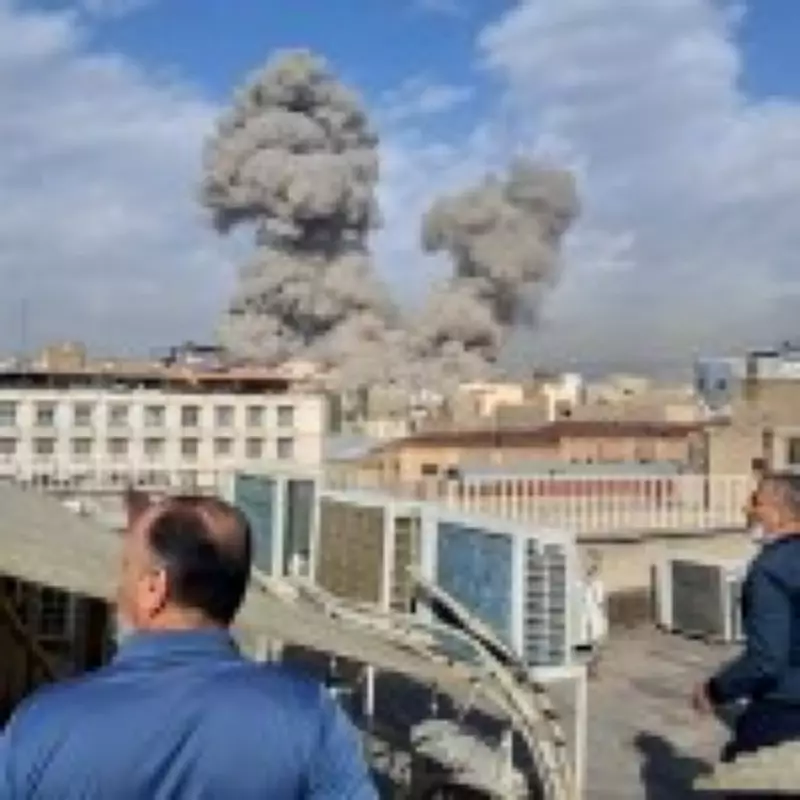
Israel has executed a series of military attacks across Iran's capital city, Tehran, in a bold daylight operation today. According to multiple sources, the United States may have participated in this coordinated assault, marking a significant escalation in the ongoing regional conflict. Thick clouds of smoke were observed billowing from numerous buildings in central Tehran following the airstrikes, which reverberated through the densely populated metropolis of approximately 9.7 million residents.
Unconfirmed Reports of American Involvement in the Military Operation
The precise extent of the alleged US involvement remains unclear at this time. However, an anonymous official speaking to the Associated Press news agency has claimed that American forces are actively participating in the attacks. An Israeli military official corroborated this information in a statement to Reuters, confirming that this morning's operation was coordinated with the United States. The White House has notably declined to comment on these reports, adding to the uncertainty surrounding the situation.
Targets Include Proximity to Supreme Leader's Office and Military Sites
One of the Israeli strikes reportedly landed near the office of Iran's supreme leader, Ayatollah Ali Khamenei. It is currently unknown whether the 86-year-old leader was present at the time of the attack. Additionally, unconfirmed explosions have been reported at potential military bases and missile sites in several locations, including Chabahar and Konarak along the Gulf of Oman, as well as in Ilam near Iran's border with Iraq. Khamenei has not made a public appearance in weeks as regional tensions have intensified following a series of reciprocal threats between Iran and US President Donald Trump.
Israeli Defense Minister Cites Threat Removal as Justification
Israel's Defence Minister, Israel Katz, stated that the attack was carried out 'to remove threats,' although he did not specify the nature of these threats. In response to the escalating situation, Israel has taken precautionary measures by shutting down its airspace and issuing an alarm to residents, urging them 'to prepare the public for the possibility of missiles being launched toward the state of Israel.' US Ambassador to Israel Huckabee has advised American nationals in the country to stay near shelters and 'take immediate action at the sound of alerts or sirens.'
Background of Escalating Tensions and Failed Nuclear Talks
This military action follows the apparent unraveling of recent nuclear negotiations between Tehran and Washington. President Trump utilized his Board of Peace speech last week to threaten Iran with potential military action, demanding that the country shut down its nuclear program or risk 'bad things.' He issued Tehran a 10-day deadline on February 19, which has now passed. In the preceding week, Iran conducted military drills in the strategically vital Strait of Hormuz, a key shipping lane in the Red Sea.
Recent Military Preparations and Regional Deployments
Iran has also undertaken significant defensive measures, including burying tunnel entrances at a nuclear site previously bombed by the US during Israel's 12-day war with Iran last year. The country has fortified tunnel entrances near another site and repaired missile bases in anticipation of potential attacks. In recent days, military aircraft were positioned in Bahrain, the UAE, Jordan, and Greece, while naval assets were deployed in the Red Sea, Arabian Sea, and near the Strait of Hormuz. Last month, the US moved the USS Abraham Lincoln and several guided missile destroyers into the region, capable of launching attacks from the sea.
The situation remains highly volatile, with no clear indication yet whether Iran plans to retaliate against these strikes. The international community is closely monitoring developments as this conflict threatens to further destabilize an already tense region.




