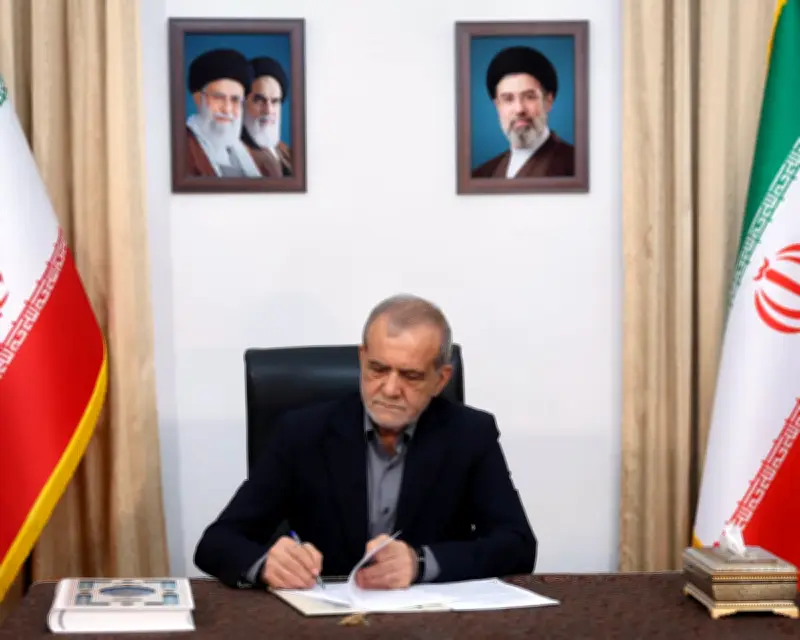
Iran's 110-day war with the United States has concluded with a memorandum of understanding signed by President Masoud Pezeshkian, but the ideological lessons drawn by the new leadership will determine whether negotiations culminate in a verifiable nuclear agreement. Such an outcome could reshape the Middle East and usher in a new era for Iran's economy.
Leadership Dynamics and Internal Struggles
The vacuum created by the invisibility of Iran's injured supreme leader, Mojtaba Khamenei, has made this moment an interregnum. On Thursday, Khamenei published a letter opposing the deal in principle but deferring to President Pezeshkian after receiving undertakings that he would not accept excessive US demands. Khamenei stated that the rights of the country and the axis of resistance must be protected, positioning himself to avoid blame if elected politicians falter in dealings with the West.
His public intervention, on the eve of now-cancelled talks in Switzerland, may influence the charged debate inside the US administration about Iran's younger leadership. On Friday, Donald Trump accused the Iranian leadership of being “very dishonourable people who don’t deal in good faith,” aligning with CIA Director John Ratcliffe's warning that a significant gap separates public positions from private statements. Ratcliffe concluded, “Intelligence indicates that Iranian intentions do not align with the commitments made in the agreement,” according to a source close to the discussions.
War's Impact on Strategic Thinking
Few Iranians deny that the Strait of Hormuz was decisive in proving the US could no longer impose global order unilaterally. Hardline editor Payam Fazlinejad noted, “History has also shown America that geography sometimes takes revenge on technology; part of the source of power lies in geographical straits, not in heavy military equipment. Iran has come to understand that it possesses a greater deterrent power than a nuclear weapon.” However, Fazlinejad urged the leadership to break the cycle of war, negotiations, and protests, telling Pezeshkian, “The country cannot afford a new miscalculation and must restore stability.”
Trump, at the G7 summit in Évian-les-Bains, embraced Iran's leadership, describing them as “the most rational group we have ever dealt with … They are not radicalised. They are looking to help their country.” JD Vance added that the US had never been so close to the Iranian leadership, with senior figures and even IRGC officials acknowledging that the previous approach to the US was a mistake.
Hardline Opposition and Internal Debate
In reality, the hardline Paydari Front, opposed to engagement with the West, has denigrated the deal. This group, linked to former nuclear negotiator Saeed Jalili and prominent in parliament, described the deal as a catastrophe and said ending the blockade was premature. Many members appeared at street rallies and on TV to denounce the negotiating team. Jalili's brother Vahid, who runs state broadcaster Irib, has provided a platform for critics, leading Pezeshkian to express frustration. Critics claim Irib suppresses diverse opinion, akin to an inverted Fox News.
The internal battle mirrors arguments from 2015 when Iran signed the nuclear deal. Then-foreign minister Javad Zarif became a target of vitriol for dealing with the “Great Satan.” Trump's 2018 withdrawal undermined the faction favoring opening to Western markets. Advocates of negotiation have had to overcome the argument that the US cannot be trusted. Currently, Trump's inability to control Israel in Lebanon weakens the negotiations in Tehran.
Hardliners Retreat, Deal Advocates Win
Despite Khamenei's intervention, hardliners appear to have retreated. Advocates of the deal won both the argument and a power struggle. Mohammad Bagher Ghalibaf, the conservative speaker of Iran's parliament and former IRGC member, is a high-profile beneficiary of the war. Ghalibaf suggested a vote at the supreme national security council on whether to accept the deal, with army members allowed to vote. Only one person opposed, reportedly Saeed Jalili. Key figures concede the memorandum does not require parliament's approval.
In a long interview, Ghalibaf justified negotiation and concessions, stating, “My job is not diplomacy. I am a fighter. But with the spirit and culture of a fighter I pursue diplomatic work. Our goal was to relieve the pressure and fire on the people. If this negotiation had not taken place, would such an event have just happened just by firing a missile? No. Our armed forces, compared to an enemy armed to the teeth, can wipe the floor with them, but could this have been possible without the support of the people? Never.”
Future Behavior: Authoritarianism, Pro-China Stance
Experts say early clues indicate the new leadership will be more authoritarian, more pro-China, and more willing to listen to the IRGC. Preparations for Ali Khamenei's funeral hardly suggest Iran is morphing into a secular regime. On the nuclear front, a deal is available since the US has abandoned previous red lines. However, Kelsey Davenport of the Arms Control Association warned that discussions about the UN nuclear inspectorate's verification role and Iran's willingness to accept intrusive inspections are still to be tested. Strict timelines for Iran to report to the IAEA are needed.
Ghalibaf emphasized shifting focus to inflation and currency markets, saying, “We must take over the frontline from the launcher kids and relieve the people from economic pressure. The criterion of success is shifting from repelling external threats to improving the economy.” One approach is balancing relations between West and East. Ghalibaf, appointed special envoy to China, emphasized a balanced approach.
Sina Toossi of the Centre for International Policy noted that Iran previously treated China transactionally, seeking accommodation with the West and using China as leverage. “Xi Jinping visited Tehran in January 2016, the same month the JCPoA was signed. During his visit, China and Iran signed a comprehensive strategic partnership agreement, but Iran gave all the contracts to European countries.” Esfandyar Batmanghelidj added, “Chinese business leaders and officials felt jilted. It was a strategic error by Iran not to prioritise relations with China. Ghalibaf is signalling he’s not about to make the same mistake.” Since 2018, US sanctions have made Chinese investment in Iran nearly impossible.
Public Sentiment and Unresolved Problems
Iranians who hoped for Trump's promise that “help is on its way” feel abandoned. One said, “When you go in a taxi, to the stores, [or] talk to friends, no one is happy with the deal. We did not expect this in March. We did not want a Xi, or an Iranian Putin.” The internal battle over the deal and the public's desire for normality remain unresolved challenges for the new leadership.