
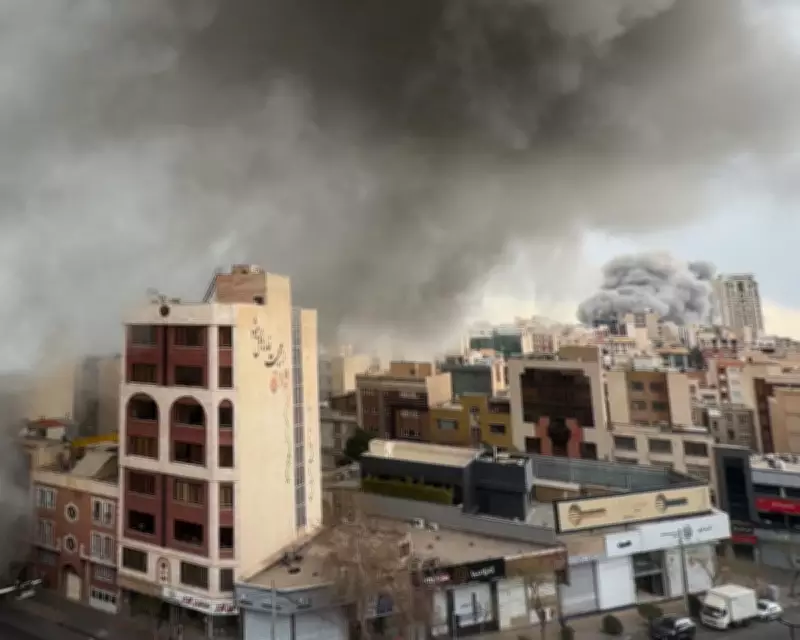
Regional Conflict Erupts as Iran Retaliates Against US-Israeli Strikes
A military campaign initiated by the United States and Israel against Iran has rapidly escalated into a widespread regional conflict, with Tehran launching retaliatory strikes across multiple Middle Eastern nations. The conflict began on Saturday with coordinated attacks that resulted in the death of Iran's Supreme Leader Ali Khamenei, among other significant casualties.
Initial US-Israeli Military Operations
On Saturday, Israel announced the commencement of Operation Lion's Roar, described by an Israeli military official as an effort to degrade the Iranian regime's capabilities. This operation was conducted in tandem with the US-led Operation Epic Fury. Over the weekend and into Monday, strikes targeted key security and political locations in Tehran, including Khamenei's residence, as well as ballistic missile caches throughout Iran.
An Israeli military official stated that this campaign is far more extensive than previous US-Israeli attacks during last summer's 12-day war. Israel claims to have eliminated at least 40 senior Iranian commanders on the first day alone. According to the Iranian Red Crescent Society, the US-Israeli strikes have killed at least 555 people in Iran so far.
One of the most devastating incidents occurred in Minab, located in the southern Hormozgan province, where a strike on a girls' school resulted in approximately 165 fatalities and at least 95 injuries. This event represents the worst mass casualty occurrence of the campaign to date. Iranian authorities have advised citizens to evacuate major urban centers for safety, noting that many security institutions are situated within residential areas, increasing the risk to civilians.
Iran's Retaliatory Strikes Across the Region
Despite suffering significant losses in its senior military and political leadership, Iran has responded with forceful retaliation across the Middle East. Tehran launched ballistic missile attacks toward Israel, resulting in one death and multiple injuries in Tel Aviv on Saturday night, followed by another strike in Beit Shemesh on Sunday that killed eight people and wounded 20 others.
Iran's retaliation has extended beyond previous conflict boundaries, directly targeting Gulf nations allied with Washington. Strikes have hit luxury hotels in Dubai and Bahrain, as well as airports in Dubai, Kuwait, and Bahrain. Photographic evidence shows substantial damage to buildings in Bahrain and smoke rising from Dubai's Palm Jumeirah island.
Additional Iranian attacks targeted a port facility in Oman and a ship northwest of Muscat, with the Iranian military issuing radio warnings to vessels attempting to navigate the Strait of Hormuz. Saudi Arabia's Ras Tanura oil refinery also faced drone attacks, though defensive systems successfully intercepted the incoming aircraft.
Expansion of the Conflict to Lebanon and Europe
The conflict expanded dramatically on Monday when Hezbollah, Iran's ally in Lebanon, launched missile strikes into Israel in response to Khamenei's killing. Israel retaliated with extensive strikes on Lebanon, resulting in at least 31 deaths and 149 injuries according to Lebanese health authorities.
In a significant escalation marking the first strike reaching US allies in Europe, a drone attack targeted Britain's Akrotiri airbase in Cyprus. The Cypriot government reported that two additional drones were intercepted while en route to the base.
The chaotic nature of the conflict was further highlighted when Kuwaiti defenses mistakenly shot down three American F-15E Strike Eagles. All six pilots successfully ejected and are reported to be in stable condition. Additionally, US Central Command has confirmed that three US service members have been killed during military operations against Iran, though specific details were not provided.
Disruption to Travel and Global Markets
The widespread strikes across Gulf nations have created substantial disruption to regional travel, with major transportation hubs in Dubai and Qatar forced to close. Numerous flights throughout the region have been canceled or delayed, with no clear timeline for when airspace above Gulf countries will reopen.
Global financial markets have experienced significant volatility in response to the escalating conflict, with oil prices surging dramatically following the effective closure of the Strait of Hormuz. This critical maritime passage, which facilitates a substantial portion of global trade between Gulf states and Iran, has become a focal point of the conflict's economic impact.




