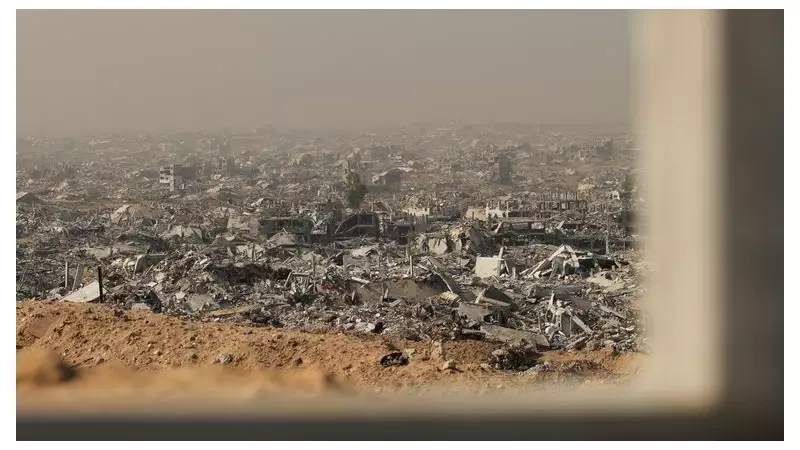
A Controlled Glimpse into a Shattered Land
From a mound of earth at the edge of an Israeli military camp, the view is one of almost total desolation. In front of me, a six-storey building has collapsed in on itself, its floors piled into a tomb of concrete and dust. A wild dog picks its way through the wreckage, while the persistent buzz of a military drone fills the air, punctuated by the distant rattle of machine gun fire.
This is Shuja'iyya, in the north of Gaza. Not long ago, this was a bustling town of around 100,000 people, a community proud of a history stretching back 850 years. Now, it is a patchwork of dust and misery, a wasteland where the skeletons of buildings are all that remain.
The Yellow Line: A New Border Amidst the Rubble
I am standing on the Israeli side of the new division that splits the Gaza Strip. It is known as the Yellow Line, although no physical line runs its entire length. Instead, a series of concrete blocks are being gradually put into place, starting from the edges. A tall red and white mast several hundred metres away marks the line's location, a stark visual cue in the barren landscape.
The Israeli military, which invited and controlled this visit for a group of journalists including Sky News, now controls the land on this side. It is home to a very small number of Gazans. On the other side of the Yellow Line, however, lies the vast majority of the territory's two million-strong population, where control is still held by Hamas.
This highly controlled visit offered no access to Palestinians or other areas of Gaza. Under Israeli military censorship laws, all our material was reviewed by military personnel before publication, though Sky News maintained full editorial control over the report.
Life Amidst the Ruins and the Stalemate of Peace
The war that created this devastation began on 7 October 2023, when more than 1,200 people, mostly civilians, were killed in a surprise attack by Hamas militants. In the two years since, more than 68,000 people have been killed in Gaza as a result of Israeli military action.
Now, an uneasy ceasefire hangs over the territory, the result of a peace plan drawn up by US President Donald Trump's team and now endorsed by the United Nations. The plan proposes a stabilisation force to enter Gaza to protect civilians and ensure aid delivery, but critical details—who the troops will be, their mandate, or whether they will disarm Hamas—remain unknown.
For now, Gaza is starkly divided: one half under a strictly-enforced peace but with almost no residents, and the other where millions try to survive amid post-war chaos.
On the other side of the Yellow Line, our colleagues met those trying to live in this reality. They encountered Iman Hasoneh, 48, who, ground down by pain, has returned with her family to the rubble of her Shuja'iyya home after fleeing and finding nowhere else to go. Her husband suffers from internal bleeding, and her children are exhausted.
"Our home collapsed, and it was a miracle we escaped," she says. "I'm giving up. One day they will just announce that we have all been killed. We are on the edge of the Yellow Line, and there is so much suffering." When asked about the peace plan, she expressed a weary scepticism: "They are giving us an anaesthetic to numb the pain."
Above her, the same drone we heard from the Israeli camp buzzes, a constant reminder of the division that defines life and death in the new Gaza.