
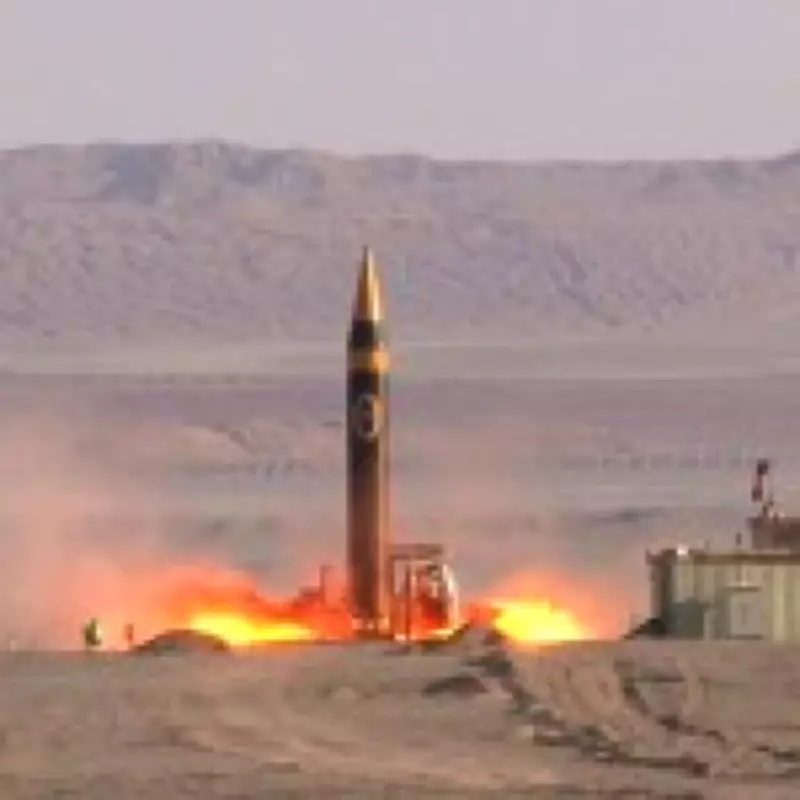
Security Experts Challenge Israeli Claims About Iranian Missile Capabilities
International relations specialists have characterized Israeli warnings about Iranian missiles reaching London as significantly "exaggerated" amid escalating regional tensions. The Israeli Defence Forces recently announced that Tehran had launched its first long-range missile since the conflict began, claiming these weapons could now potentially target European capitals including London, Paris, and Berlin.
Military Claims Versus Expert Analysis
The Israeli military asserted that Iranian missiles possess an approximate range of 4,000 kilometers, theoretically placing numerous European, Asian, and African nations within striking distance. This warning specifically referenced the Diego Garcia military base—located approximately 2,360 miles from Iran—which hosts critical US and UK military assets including long-range bombers and naval vessels.
However, Dr. Bamo Nouri, Senior Lecturer in International Relations at the University of West London, advised treating these Israeli assessments with substantial "caution." He explained that the Diego Garcia strike demonstrates "a calibrated extension of range tied to a specific military target" rather than indicating imminent plans to attack the UK mainland.
The Distinction Between Capability and Intent
Dr. Nouri emphasized a crucial distinction that Western officials should recognize: "Capability should not be conflated with intent." While the strike raises legitimate questions about Iran's previously stated 2,000-mile missile range limitations, the actual danger lies not in immediate attacks on London but in how competing strategic narratives might dangerously expand the conflict.
"The real danger here is not that Iran is about to strike London," Dr. Nouri clarified, "but that competing strategic narratives around this event could escalate the conflict far beyond its current scope." He warned that some Western narratives might amplify the strike as evidence of broader Iranian threats to Europe, potentially justifying deeper UK and NATO combat involvement.
European Diplomatic Positioning Crucial
Dr. Katayoun Shahandeh, Lecturer and Senior Teaching Fellow at SOAS, University of London, acknowledged that the Diego Garcia incident reveals Iran's expanding military capabilities and willingness to demonstrate strength beyond its immediate region. This naturally prompts questions about potential implications for European security.
However, Dr. Shahandeh stressed that demonstrating capability differs substantially from proving "an imminent or credible direct threat to the British capital." She noted that Iran likely recognizes it cannot simultaneously confront the entire world, making European governments' diplomatic positions critically important.
"Several have gone out of their way to distance themselves from Trump's war," she observed, "stressing that they were not the ones who initiated this conflict and that their priority remains de-escalation, regional stability, and defensive protection rather than offensive participation."
Dr. Shahandeh concluded that European emphasis on defense, restraint, and diplomatic distance from the conflict's origins reduces the likelihood that Iran would treat Europe as its next direct theater of operations.
UK Government Response and Political Reactions
Housing Secretary Steve Reed recently affirmed that the British military remains "perfectly capable" of protecting the nation, though he declined to specify how close Iranian missiles came to striking the Diego Garcia base during the recent attack. "We have the finest military in the world," he stated during a BBC interview. "We are perfectly capable of protecting this country."
The government has not disclosed precise details regarding the timing of the missile launches or their proximity to hitting targets at the joint US-UK facility. Foreign Secretary Yvette Cooper condemned Iran's actions while emphasizing that the UK would avoid being drawn into broader conflict, supporting only defensive measures and seeking swift resolution.
Conservative leader Kemi Badenoch challenged Prime Minister Keir Starmer to provide greater transparency, accusing him of "dithering and delaying" on the Iran conflict and criticizing the government for allowing media reports rather than official channels to inform the public about the Diego Garcia attack.
Military Outcomes and Strategic Implications
Reports indicate that one missile targeting Diego Garcia was successfully intercepted by a US warship, while another failed during flight. This incident has intensified debates about Middle Eastern conflict spillover and appropriate European responses.
Security analysts universally emphasize that while Iran's demonstrated missile range warrants attention and monitoring, current evidence does not support alarmist predictions of imminent attacks on London or other European capitals. The prevailing expert consensus maintains that diplomatic restraint and clear distinction between defensive and offensive postures offer the most prudent path toward containing regional tensions.




