
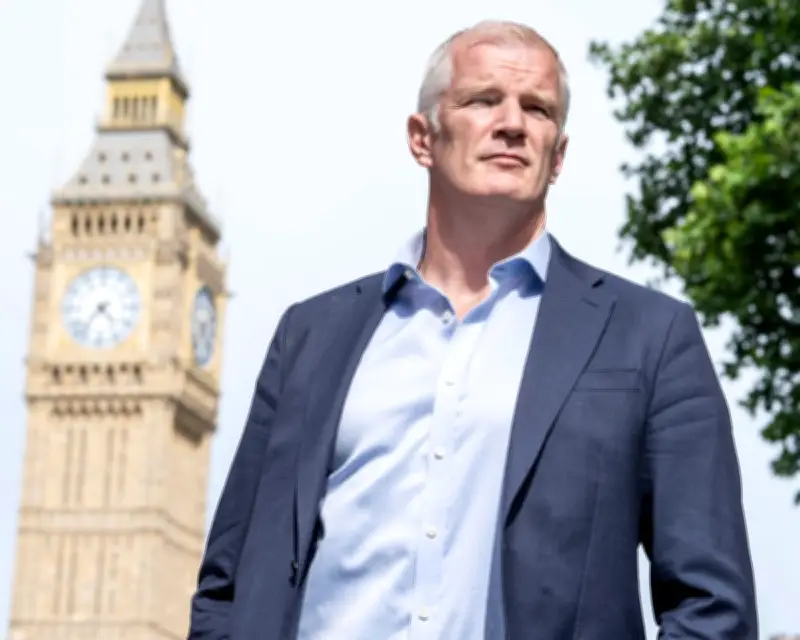
Al Carns, the former armed forces minister who resigned last week, has described the Ministry of Defence (MoD) as suffering from 'unbelievable' waste and inefficiency, stating that every time he would 'turn a stone over' he would get another shock.
In an interview with the Guardian, Carns expressed anger at the unwillingness to confront the sunk costs of legacy programmes and suggested that mismanaged projects, such as tank investments, should be scrapped in favour of new technology.
Carns, a former special forces soldier, said the Labour government had 'one chance' to change and seek new leadership but was scathing about the current situation. 'I don't think we could have got this more wrong – but we're in it now. My goodness, make the change once if you're going to, get on with it and get the country back on track,' he said.
He resigned after John Healey stepped down as defence secretary last Thursday. Carns has been widely discussed as a potential leadership candidate but said he was more interested in sparking a policy debate than becoming prime minister. 'If we get that policy debate wrong, we are not going to win in two-and-a-half years' time. And we're going to hand the country to a potentially far-right party that will split the nation apart,' he warned.
The 46-year-old said he fundamentally disagreed with the direction of the defence investment plan (Dip) and had resigned not to support Healey but to make his own public interventions. Healey argued that the Treasury was unwilling to adequately fund defence and the prime minister could not force through tough decisions.
Carns said he had some sympathies with the criticisms of the Dip but had only been allowed to see the plans a fortnight ago. 'I looked at it and I was like, no, no, no, no,' he said. 'I ran out of road of where people will either listen to me or enact a change that I need.'
Despite his time at the MoD before becoming an MP, Carns was shocked at the inefficiency. 'It is unbelievable. You turn a stone over and get another shock – how has that been allowed to go on? And you turn another stone over, and it is just layers of bureaucracy which now cost us more than the product you're getting itself. I can't describe the level of inefficiency in the system that we've been left with and we're trying to unpeel. But it's actually exceptionally difficult to do.'
He described the current investment plan, which new defence secretary Dan Jarvis has said he will publish before July's Nato summit, as 'a typical example of the machine' and criticised the MoD for continuing to spend large sums on legacy programmes that were becoming obsolete due to the difficulty of confronting sunk costs.
'Take tanks for example – 100 to 200 tanks isn't the most useful way of spending our money,' he said. 'They were ordered ages ago, and if you cancel them now, that's sunk cost … that's cost us £700m. Well, I think these are the difficult discussions we have to make – the cost of running them is in the hundreds of millions, and so I would rather take that chunk of money … and put it into those innovative systems that we need to buy.'
Government sources have indicated that Jarvis will be given an opportunity to 'reprioritise' aspects of the Dip. But Carns said root-and-branch changes were needed. 'We have the fifth biggest defence budget in the world. Do you think we get a good bang for buck? We need to completely and utterly overhaul our procurement. We need to make sure a large proportion of the resource and money is spent this side of 2030, to make sure that if we get caught in a geographical confrontation, we're ready.'
Carns said any new leader or party in government would face the same challenges. Asked if there was appetite to change from the current leadership, Carns said: 'No.'
He acknowledged the difficulty of discussing defence spending with the public, who expect a Labour government to invest in the NHS, schools and jobs. 'I go back to my constituency and say, what's the biggest problem you've got today? It's cost of living. They can't get an appointment with the NHS. They don't mention security at all.'
He said any new leader had to reframe the conversation around national resilience, alongside policies on improving mental health, youth unemployment and prison reoffending. 'The end state must be a stronger and more effective nation. This is about leadership and prioritisation. At the moment what I see is a lot of money going into unpackaged initiatives, thousands of announcements.'
Carns expressed deep concern about how the instability at the top of government and the potential leadership vacuum was being viewed by the UK's enemies. 'Moscow is probably rubbing its belly. I think it looks at the social division that we're having in the UK and the amplification through social media as success for its propaganda campaign.'
He said he intended to spark a policy debate rather than enhance his own leadership credentials. Asked if he wanted to be prime minister, Carns said: 'I think anyone who wants to have that job doesn't understand that job. This isn't about ego, this is obviously about service.'
However, he said he did not regret swapping his military career for frontline politics. 'I did have a bit of a moment the other day when I was walking home from parliament. I loved my job. It was my passion. It was all I wanted to do when I was young. I looked back at it and said, was it worth it leaving the military, a really good career? And have I delivered enough to justify that impact on my life? And I came to a conclusion, absolutely. I've delivered more change in this job and nudged the system further than I would ever have done within my last job.'




