The Day Terror Came to Tapalpa: El Mencho's Final Stand and the Aftermath
Just two days before one of the world's most powerful drug lords met his violent end, the Tapalpa Country Club in Mexico's Jalisco state posted an Instagram advertisement inviting visitors to "inhale peace [and] exhale stress" in their romantic private cabins. The irony would prove chilling when, on Sunday morning, Mexican special forces descended on this picturesque tourist town to confront the cartel boss known as "El Mencho" in what became his final battle.
A Coordinated Military Operation with International Support
According to multiple reports, Mexican forces tracked Nemesio Rubén Oseguera Cervantes, better known as El Mencho, to a lodge in the gated Tapalpa Country Club community where he had been hiding with a girlfriend. The operation reportedly involved CIA intelligence and a U.S. Predator drone, culminating in a helicopter-borne assault that began around 7 a.m. on Sunday.
A nearby restaurateur witnessed four truckloads of cartel fighters racing to the scene approximately an hour after the military operation began. "They were going into battle," the witness described, recounting a ferocious five-hour shootout that echoed through the pine forests surrounding Tapalpa. Videos circulating on social media captured the intensity of the conflict, with explosions rocking the area as El Mencho and two bodyguards attempted to flee into the surrounding woodland.
Cartel Retaliation Spreads Chaos Across Mexico
As the firefight raged, members of El Mencho's Jalisco New Generation cartel (CJNG) launched coordinated attacks across Mexico in what appeared to be a desperate attempt to distract security forces and facilitate their leader's escape. The violence quickly spread to at least 20 of Mexico's 32 states, with major tourist destinations including Guadalajara and Puerto Vallarta brought to a standstill.
In Tapalpa itself, cartel members torched two convenience stores at the town's entrance and used excavators to carve meter-wide trenches in the winding roads leading to their boss's safe house. They felled trees, doused cars and lorries in petrol, and set them ablaze to block access routes. The strategy ultimately failed when Mexico's defense ministry announced Sunday afternoon that the 59-year-old cartel leader had died in a helicopter en route to hospital after being wounded in the firefight.
A Landscape Scarred by Violence
Four days after the operation, evidence of the day's terror remained visible throughout the region. Driving south from Guadalajara through cartel-controlled fields of agave, blueberries, and avocado, reporters encountered a bullet-riddled police station, charred vehicle remains, and the smoldering carcass of a supermarket surrounded by red police tape marked "Danger."
In the quaint dragon fruit farming village of Techaluta de Montenegro at the foot of the mountain where El Mencho was killed, a local supermarket had been firebombed, its carbonized facade contrasting starkly with the cyan blue sky. Further along the 30-mile ascent to Tapalpa, cartel lookouts monitored the few motorists brave enough to approach the scene of their leader's death.
Unsecured Crime Scenes and Narco Culture
Remarkably, neither of El Mencho's Tapalpa hideouts—including the chalet where he made his final stand—remained guarded by security forces in the days following the operation. Journalists who infiltrated the unguarded Tapalpa Country Club compound discovered what they claimed was one of the drug lord's abodes, finding medicine to manage the kidney disease he reportedly suffered from and a handwritten summary of Psalm 91, a sacred text popular among Latin American drug traffickers.
At another nearby cluster of chalets called La Loma, where El Mencho's security detail reportedly stayed, police found a room displaying the stuffed heads of three animals—a zebra, a gazelle, and a deer—on a wall. The approach road was scattered with bullet casings and partially blocked by two burned-out vehicles, possibly those seen racing toward the area as traffickers attempted to rescue their chief.
Political Reactions and Future Implications
Former U.S. President Donald Trump claimed credit for the operation on Tuesday, boasting that "we've ... taken down one of the most sinister cartel kingpins of all." However, John Feeley, a former top U.S. diplomat in Mexico City, expressed skepticism about any lasting impact, noting that he first heard El Mencho's name about 15 years ago at the start of his ultra-violent rise.
"If anyone thinks Mexican drug traffickers are going to stop operating because of what happened ... I think they are delusional," Feeley warned, suggesting that the drug lord's demise could spark deadly inter or intra-cartel wars in Mexico's most notoriously violent states including Michoacán, Jalisco, and Guerrero.
A Town Attempting to Return to Normalcy
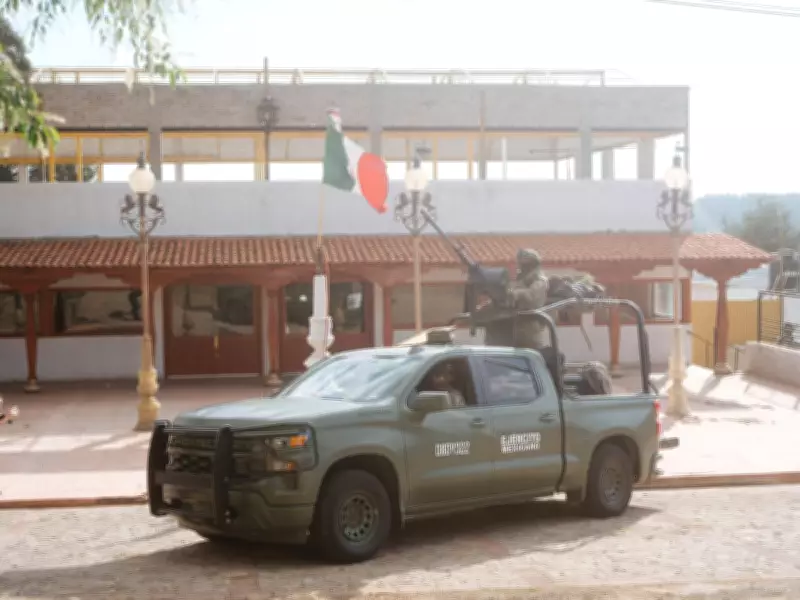
As government troops provided security to construction workers tasked with clearing and rebuilding damaged roads on Wednesday afternoon, the restaurateur who witnessed the initial attack expressed hope that Tapalpa's newfound notoriety as the death place of Mexico's most feared man would not deter tourists. "We invite them to come, taking precautions of course," he said, before adding optimistically: "Here in the centre of town nothing happened at all."
Meanwhile, a forest fire that locals said was sparked by Sunday's gunbattle continued to consume the woodland where El Mencho's life came to an end—a fitting metaphor for the destructive legacy of a criminal empire that, despite its leader's death, continues to cast a long shadow over Mexico.