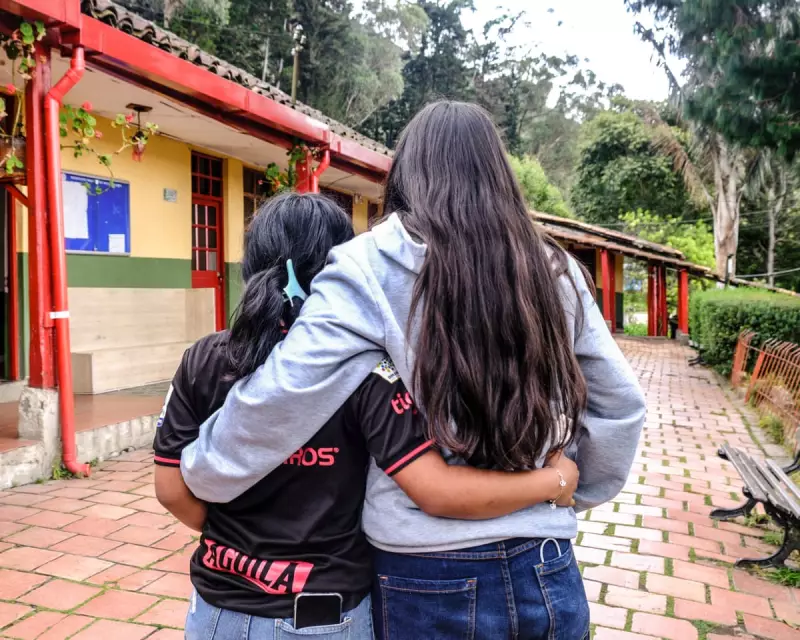
In the remote villages of Colombia's Norte de Santander region, a silent crisis is unfolding as armed groups systematically target children for recruitment. What begins with promises of mobile phones and motorcycles often ends in violence, exploitation and lost childhoods.
The Disappearing Children
Ana* was just 14 when her world began to collapse around her. In spring last year, her friends started vanishing one by one from their village in north-west Colombia. Armed militias had begun circulating through the community, offering tempting incentives to young people facing poverty and limited opportunities.
"They began taking all of the young people, the boys and the girls, my friends from school," Ana recalls. "I was so scared, I had to shut myself away." The situation escalated rapidly when former classmates who had joined the groups returned to pressure others into enlisting.
One particularly chilling incident involved Ana's friend who ended a relationship with a boyfriend who had joined an armed group. "They tied her up and took her," Ana says quietly. Faced with similar threats, Ana stopped leaving her house, abandoned her education, and eventually fled with her mother to a nearby city.
A Growing National Crisis
The problem extends far beyond Ana's village. According to government watchdog figures, documented cases of child recruitment surged from a few dozen in 2021 to more than 600 in 2024. Experts warn this number represents just the tip of the iceberg, as many families remain too frightened to report disappearances.
Juanita Goebertus, Americas director at Human Rights Watch, explains how recruitment tactics have evolved. "In the past, armed groups would simply seize children from schools. Today, they rely more on persuasion – through social media, by romanticising life with a weapon, by making young people feel they belong."
The driving force behind this intensified recruitment is the battle for control over territory crucial to Colombia's drug trade, including coca fields, illegal mining operations and arms routes. Remote, marginalised communities prove most vulnerable to these pressures.
Life Inside the Armed Groups
Juan's story illustrates how economic desperation leads children into the arms of these groups. Recruited at 15, he says his family's financial situation left him with little choice. "I turned to them to help my family," he explains, "but they made me do bad things."
Initially tasked with selling cocaine and acting as an informant, Juan quickly discovered that attempting to leave meant certain death. He witnessed the execution of another child who tried to escape. "I was already involved, so there was nothing else I could do. I had to do everything they said," he says.
The work escalated to violent raids, including an attack on a police checkpoint where an officer was shot. For this, Juan received payment of just 1,500 pesos (approximately 30p). "I couldn't stop thinking about it," he recalls. "It was terrible."
Scott Campbell, representative in Colombia of the UN high commissioner for human rights, confirms that children are increasingly used as "frontline fighters to protect the older, more experienced members." This tactic results in what he describes as "very ugly percentages of child victims among the dead after fighting between the armed groups."
Sexual Violence and Community Control
The exploitation extends beyond combat roles. Elizabeth Dickinson, an analyst at the International Crisis Group, notes that "taking minors is not just about amassing troops. It also crushes community resistance and keeps families quiet."
Sexual violence represents another harrowing aspect of this crisis. Women who escaped sexual slavery by armed groups in Catatumbo reported seeing girls as young as 11 held in cages and subjected to repeated rape.
This month, Colombia's human rights ombudsman Iris Marín revealed that seven children had been killed in an airstrike on a rebel group in the south of the country, with the minors being used as "human shields."
A Safe Haven in Bogotá
For Ana, Juan and Andrea* – who was persuaded to join by her boyfriend and best friend – escape became possible through the Benposta school in Bogotá. Run by the organisation Benposta Nación de Muchachos, this institution has offered refuge, education and counselling to children displaced or targeted by armed groups for more than 50 years.
Currently, 87 children live at the school, with new arrivals – some as young as 10 – continuing to seek sanctuary. The programme provides not just safety but the opportunity to rebuild shattered lives and dreams.
Andrea managed to escape after her mother discovered her involvement. "She started crying. I was already feeling sick, I was already scared," Andrea remembers. After months of counselling, she now hopes to train as a psychologist.
Juan escaped after a year with the armed group when a former teacher intervened to help him leave. He now dreams of becoming a professional footballer. "I'm living a new life," he says with cautious optimism.
Ana, now 15, has been at Benposta for a year and has caught up on the education she missed during her self-imposed isolation. Her perspective reflects hard-won wisdom: "War doesn't lead to anything good." She focuses now on completing her studies and building a future far from the violence that claimed her childhood friends.
*Names have been changed to protect identities