Ceasefire Teeters on Brink as Israel Assaults Lebanon and Iran Disrupts Oil Flow
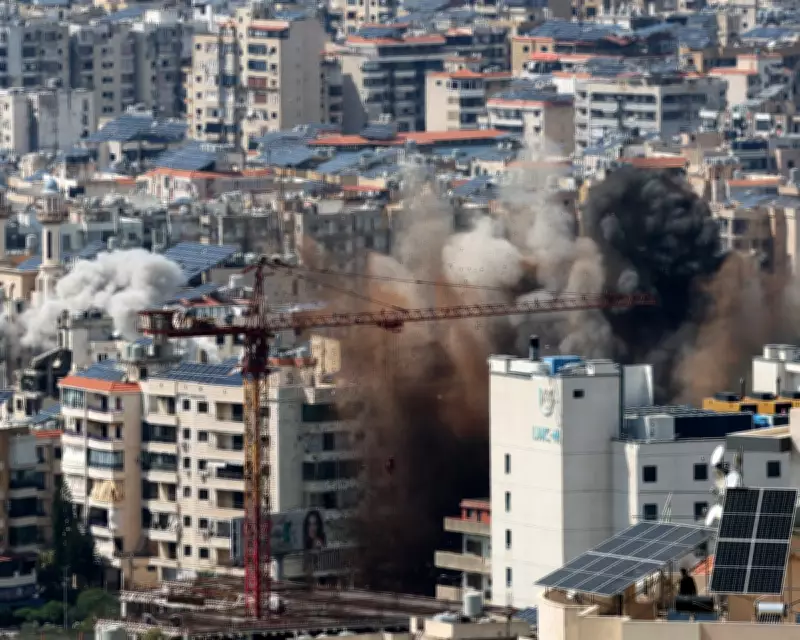
The two-week ceasefire in the Iran conflict, brokered at the eleventh hour on Tuesday, is now under severe threat as Israel and Iran present starkly different interpretations of the agreement. On Wednesday, Israel unleashed its heaviest bombardment of the war, striking over 100 targets across Beirut and Lebanon, resulting in at least 254 fatalities. Concurrently, Iran blocked the passage of oil tankers through the Strait of Hormuz, citing an alleged Israeli breach of the truce.
Divergent Views on Lebanon's Inclusion
The core dispute centers on whether Lebanon is covered by the ceasefire. Iran and Pakistan, the mediators of the truce, insist that Lebanon is included. However, Israeli Prime Minister Benjamin Netanyahu vehemently disagrees, authorizing the extensive military campaign. U.S. President Donald Trump initially remained silent before stating that Lebanon constitutes "a separate skirmish" and is not part of the deal.
UN rights chief Volker Turk condemned the scale of Israel's attacks as "horrific," warning that such actions "defy belief" and place "enormous pressure on a fragile peace." Iran's parliament speaker, Mohammad Bagher Ghalibaf, issued a sharply worded statement accusing Israel and the U.S. of violating multiple provisional ceasefire clauses, particularly criticizing the bombing of Lebanon and U.S. demands regarding uranium enrichment.
Economic and Diplomatic Fallout
Iran's closure of the Strait of Hormuz has immediate global economic repercussions. Following the ceasefire announcement, oil prices had dropped sharply below $100 a barrel, spurring a stock market surge. However, Iran's Fars news agency reported the halt of tankers, trapping hundreds of vessels in the Gulf. The White House dismissed these reports as "false," with Trump demanding the strait reopen "immediately, quickly, and safely."
U.S. Vice-President JD Vance attributed the confusion over Lebanon to a "legitimate misunderstanding," clarifying that the U.S. never promised its inclusion. He noted Israel had offered to moderate its actions in Lebanon to aid negotiations but would not formally include it in the ceasefire.
Political Tensions and Military Posturing
In Israel, opposition leader Yair Lapid criticized Netanyahu for delivering a "diplomatic disaster" rather than the promised conclusive victory, eroding trust with the United States. Netanyahu, however, asserted that Israel still has objectives to complete, "either by agreement or by resuming the fighting."
Meanwhile, Iran's Islamic Revolutionary Guard Corps claimed to have struck regional targets, including U.S. oil facilities in Saudi Arabia's Yanbu port. The United Arab Emirates reported intercepting 17 ballistic missiles and 35 drones fired by Iran post-ceasefire.
Negotiations and Uranium Dispute
Conflicting versions of the ceasefire terms have emerged. Trump initially referenced Iran's 10-point proposal as a "workable basis," but his press secretary, Karoline Leavitt, later called it "fundamentally unserious" and discarded. Trump then emphasized a U.S. 15-point proposal, insisting there would be no uranium enrichment and that both nations would collaborate to address Iran's stockpile of 440kg of highly enriched uranium, which he termed "nuclear dust."
U.S. Defense Secretary Pete Hegseth warned that if no agreement is reached on the uranium stockpile, U.S. forces would "take it out." General Dan Caine, chair of the joint chiefs of staff, stated that U.S. forces remain ready for a return to combat, noting the air campaign had destroyed roughly 90% of Iran's navy and 95% of its naval mines.
Diplomatic Moves and Regional Dynamics
Talks are scheduled to begin this weekend in Islamabad, Pakistan, with a U.S. delegation led by Vance and including envoys Steve Witkoff and Jared Kushner. An Iranian delegation, expected to feature Foreign Minister Abbas Araghchi, will participate. However, the White House had yet to confirm attendance as of Wednesday, with significant gaps remaining between the parties.
Iran has published differing interpretations of the agreement in Farsi and English, particularly regarding uranium enrichment rights. Araghchi confirmed the Strait of Hormuz would reopen during the ceasefire but required shipping to coordinate with Iran's armed forces, maintaining a $2 million per ship toll, with potential revenue sharing with Oman.
Trump's frustration with Western allies' lack of support for the war against Iran has escalated, with Leavitt indicating he would discuss the possibility of the U.S. leaving NATO in a meeting with Secretary General Mark Rutte. Rutte later acknowledged that some NATO countries "failed" during the conflict but praised the majority for their assistance.
As marine traffic through the Strait of Hormuz remains minimal, with only five vessels confirmed crossing on Wednesday, the ceasefire's fragility underscores the deep-seated tensions and divergent goals that continue to threaten regional stability.