
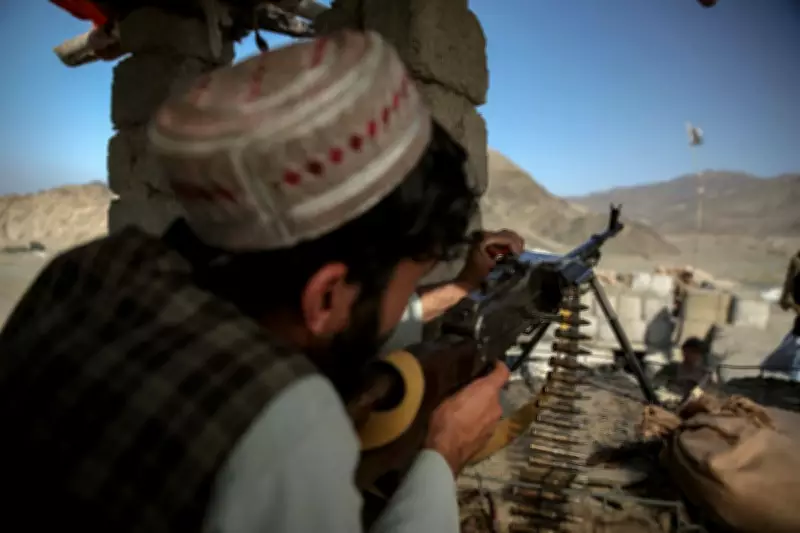
Afghanistan has declared that it successfully repelled attempted airstrikes by Pakistan on the Bagram airbase, a former U.S. military installation located north of Kabul. This incident marks a significant escalation in the ongoing cross-border fighting between the two nations, which has now entered its fourth day of intense conflict.
Escalation of Hostilities
Sporadic clashes have been reported across several provinces in Afghanistan, with both sides providing conflicting accounts of casualties and military engagements. The recent flare-up, which began on Thursday, saw Afghanistan launch attacks along the frontier, prompting Pakistani forces to retaliate with strikes from the border and the air. Pakistan has officially declared itself in a state of "open war" with Afghanistan, signaling a severe deterioration in bilateral relations.
Details of the Airstrike Attempt
On Sunday, the police headquarters of Parwan province, where Bagram airbase is situated, issued a statement alleging that multiple Pakistani military jets breached Afghan airspace at approximately 5 a.m. and attempted to bomb the strategic airbase. According to the statement, Afghan forces responded swiftly using anti-aircraft and missile defense systems, managing to thwart the attack. Pakistan has not provided an immediate response to these claims, leaving the situation shrouded in uncertainty.
Diplomatic Efforts and International Concerns
Diplomatic initiatives aimed at securing a truce have thus far failed, with countries such as Saudi Arabia and Qatar actively engaged in efforts to halt the fighting. The conflict has raised alarms within the international community, particularly due to the region's history as a haven for militant groups, including al-Qaida and Islamic State, which have been attempting to resurface amidst the chaos.
Accusations and Counterclaims
Islamabad has accused the Taliban-led government in Afghanistan of failing to take action against militant groups responsible for carrying out attacks within Pakistan. The Taliban government has firmly rejected these allegations. Many of these attacks have been claimed by the Tehreek-e-Taliban Pakistan (TTP), a militant faction that has intensified its assaults in Pakistan since 2021, coinciding with the Taliban's return to power in Kabul.
Military Actions and Casualty Reports
Pakistan acknowledged conducting airstrikes on key Afghan cities, including Kabul and Kandahar, the latter being home to Afghanistan's supreme leader. In response, there was an increased presence of security forces in Kabul on Sunday, with additional checkpoints established throughout the city center.
Hamdullah Fitrat, the deputy spokesperson for the Taliban government, stated that Pakistani fire has resulted in the deaths of 36 civilians across multiple provinces since Thursday. Pakistan has not commented on these civilian casualty figures. Meanwhile, residents in Afghanistan's Khost and Nangarhar provinces reported ongoing sporadic clashes on Sunday afternoon.
Border Incidents and Heavy Fighting
At the Torkham border crossing, a crucial gateway for Afghans returning from Pakistan, overnight fighting was reported by the Nangarhar province information department. Additionally, a spokesperson for a military unit described heavy fighting overnight in Paktia province. Afghan officials have asserted that Thursday's border offensive was a direct response to earlier airstrikes that killed civilians, which Pakistan claimed were targeted at militants.
Analytical Perspectives and Casualty Claims
Analysts have noted that this week's escalation represents the first instance where Pakistan has focused its airstrikes on Afghan government facilities, a stark departure from previous operations that were purportedly aimed at militant targets. Pakistan's information minister, Attaullah Tarar, reported that 46 locations across Afghanistan have been hit by airstrikes since the operation commenced, claiming the deaths of 415 Afghan soldiers. Earlier, Islamabad stated that 12 of its own soldiers had been killed.
In contrast, Fitrat claimed that more than 80 Pakistani soldiers were killed and 27 military posts captured by Afghan forces. The Afghan government had previously placed the death toll among its troops at 13. It is important to note that casualty claims from both sides are challenging to verify independently due to the volatile nature of the conflict.
This report incorporates contributions from Associated Press and Agence France-Presse, highlighting the widespread coverage and significance of the ongoing hostilities between Afghanistan and Pakistan.




