
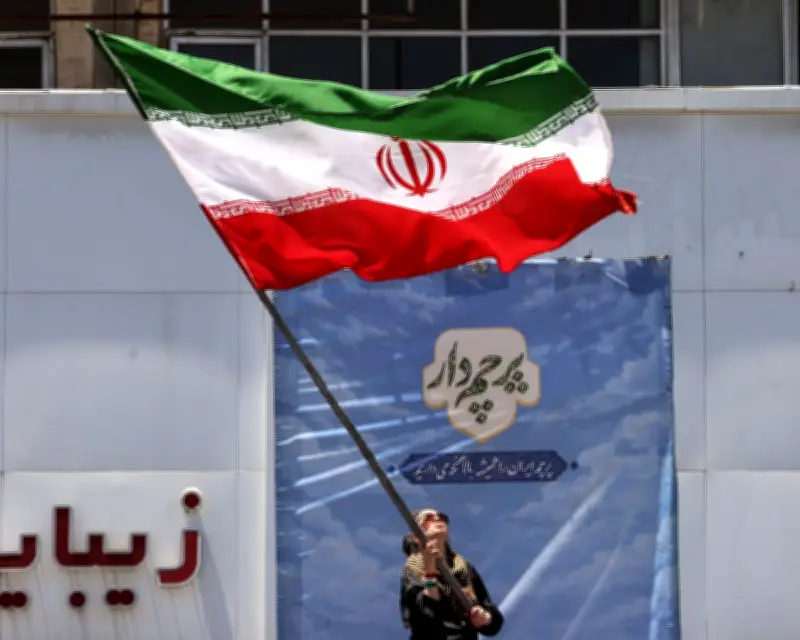
In much of the Middle East, news that the US and Iran had reached a fragile agreement was met with relief tempered by skepticism that any deal would resolve the region's deep-seated problems or prevent a return to war.
Mixed Reactions Across the Region
In Kuwait, a frequent target of Iranian drone strikes during the 15-week conflict, Iyad Joumma, a 37-year-old Jordanian engineer, voiced a common sentiment. While the agreement may allow the region to catch its breath, he said, its success "will depend on the ability of the parties involved to address the root causes of the tensions."
Among a dozen analysts and experts consulted by the Guardian since news of a potential end to hostilities broke, none suggested the interim deal to be signed on Friday would be more than a temporary solution.
"It's just a big Band-Aid and future conflict is likely to come at some point," said Neil Quilliam, a Middle East expert at London's Chatham House.
Details of the Interim Agreement
The memorandum of understanding provides for a 60-day cessation of hostilities. During this period, the two sides will address contentious issues such as Iran's enriched uranium stockpile and nuclear program, sanctions, and the release of billions of dollars in frozen Iranian assets, hoping to reach a final settlement.
Few analysts believe this is likely within such a short timeframe, if at all. They point to the painstaking 18-month process that led to the 2015 nuclear agreement, which Donald Trump scrapped during his first term.
The interim deal commits both sides to further talks, obliges Washington to lift its naval blockade of Iran, and requires Tehran to allow free passage for all shipping in the Strait of Hormuz, which carries a fifth of the world's oil and liquid gas but was blocked by Iran early in the war.
Ceasefire in Lebanon and Gaza Parallels
To Israel's displeasure, a ceasefire has been reimposed in Lebanon as part of the deal and appears to be holding for now. However, several experts noted that such ceasefires count for little, citing Gaza as an example where almost 1,000 Palestinians have been killed since Donald Trump brokered an end to the war last year. Israel occupies over 60% of the territory, Hamas has not disarmed, and little progress has been made toward a second or third phase of the deal.
"Gaza is a case in point. The deal there didn't contend with the past: the war crimes committed. Nor the present: how to disarm Hamas. Nor the future: a pathway to a viable Palestinian state," said Alia Brahimi at the Atlantic Council in Washington.
Brahimi noted that in the Gulf, strategic geography differs. "The Strait of Hormuz is integral to the global economy, as the Iranians have demonstrated. They've shown they can impose cascading stress globally by throwing a few projectiles toward a tanker."
Mkhaimar Abusada, a political science professor at al-Azhar University in Gaza, now in Cairo, agreed: "The ceasefire in Gaza is holding because Hamas knows firing would give pretext for another Israeli ground invasion, but the situation is disastrous."
Israeli and Gulf State Concerns
In Israel, dismay and disappointment prevail over a deal that does not address Iran's ballistic missile arsenal or funding of its so-called Axis of Resistance, which includes Hezbollah, Hamas, Houthis, and Iraqi militias. This could threaten near-future instability.
Danny Orbach, a military history professor at Hebrew University, said Israel sought structural change after the October 2023 Hamas raid. "The structural change is that the Axis of Resistance must no longer threaten Israel. Israel's destabilizing instinct is to tell regional actors you will not have stability until you solve our problem, and that problem is Iran."
The sharpest shock is felt in Sunni Arab Gulf states, where stability behind decades of economic growth has been challenged. Repairing damage from Iranian strikes on Kuwait, Bahrain, UAE, and Qatar will take months or years, and psychological scars will last longer. Washington's unwillingness to accept significant losses sends a clear message.
"A 'superpower' not ready to bear 100 casualties is not a superpower," Orbach said.
H.A. Hellyer of the Royal United Services Institute said Gulf states will seek to contain a newly empowered Iran. "The realization they can't rely on the US is the point of consensus, but they have different views on strategy. The Arab world has legitimate grievances with Iran's power projection, and none are being addressed."
Quilliam described a "new era." "The agreement will hold, and in 60 days we'll see positive headlines and oil and gas flowing, but no major breakthrough. We know Hormuz can be closed again, Iran has struck Gulf states, and whatever Israel and the US can do, Iran will take it. All previous thresholds have been passed."




