
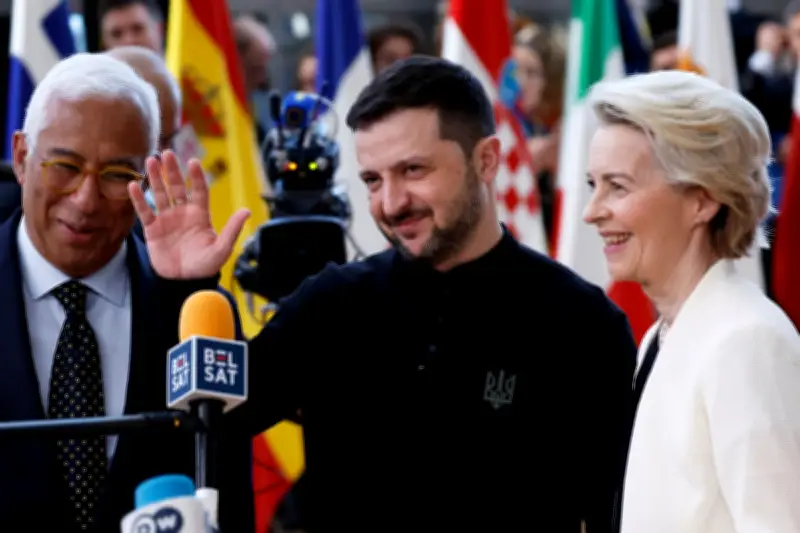
Ukraine and Moldova will take a decisive step towards joining the European Union on Monday, as they embark on the first phase of membership negotiations. The start of substantive negotiations, launched by senior EU officials and ministers from both countries in Luxembourg, will be a highly symbolic moment for the two former Soviet republics. It comes after Russia has intensified its bombardment of Ukrainian towns and cities, while sustaining huge losses for little territorial gain.
Path to Membership
Ukraine and Moldova were quickly accepted as EU candidate countries in 2022, having filed applications days after Russia's full-scale invasion. However, despite a symbolic decision to open talks in June 2024, substantive negotiations were blocked by Hungary's pro-Russian president, Viktor Orbán. The election of a new Hungarian government in April paved the way for EU member states to agree unanimously last Friday to open 'the first cluster', the chapters of the EU rulebook covering rule of law and democracy. Launching this cluster opens the door to talks on other areas, such as the single market, the environment, and economic and social policy.
EU Leaders' Praise
In a joint statement on Friday, EU leaders Ursula von der Leyen and António Costa praised 'the determination, courage and hard work shown by both countries in advancing reforms, even in the face of immense challenges'. They stated that 'enlargement is a strategic choice'. Ukraine's president, Volodymyr Zelenskyy, said: 'Ukraine is doing what is necessary, and it is important that the EU is also keeping its word. The opening of the first cluster is significant political and moral support for our state and our people.'
Reality Check Ahead
Heather Grabbe, a former adviser to the European Commission on enlargement, said the opening of cluster one really matters. 'It's the start of the process of getting a deal for membership. So it's very significant.' Grabbe, also a senior fellow at the Bruegel thinktank, noted that starting talks would also be a reality check for the Ukrainian side. 'You can't short circuit the adoption and implementation and enforcement of the EU laws on Ukrainian territory. And that is going to take a while to do. And it's going to cost administratively.' To join the EU, a country must adopt thousands of European laws and decisions, then gain the unanimous approval of existing members.
Reform Efforts and Challenges
EU officials have praised Ukraine and Moldova's reform efforts. In Ukraine, high-profile arrests, such as Zelenskyy's chief of staff Andriy Yermak, who was named as a suspect in a big corruption investigation last month, are seen as positive signs that authorities are taking anti-graft inquiries seriously. Yermak has denied all allegations. Yet praise is tempered with disappointment that Kyiv has not moved faster on 10 priority reforms agreed last December. EU officials consider Ukraine has only completed 15% of reforms contained in a 10-point plan agreed last December between the EU enlargement commissioner Marta Kos and Ukrainian deputy prime minister Taras Kachka. The plan includes measures to strengthen the independence of the anti-corruption agencies Nabu and Sapo, the adoption of an anti-corruption strategy, and reforms in the appointment processes of judges and prosecutors.
Timeline and Future Steps
Officials believe that with sufficient will, Ukraine could complete technical talks in around four years, while acknowledging that membership is ultimately a political decision. A proposal from German chancellor Friedrich Merz that Ukraine gain 'associate membership' – representation in EU institutions without voting rights, as a step to fully joining – has flopped in other national capitals. However, Ukraine, like other EU candidate countries, is already taking part in some EU policies, suggesting that the idea of 'staged membership' has gained traction.
Security Considerations
Grabbe argued the EU should take a security-first approach to Ukraine, integrating its eastern neighbour into security and defence policy, where EU law is fairly light. She said: 'Given that Ukraine is the most serious security and defence player on the continent, the only one with battle-hardened troops and a serious arsenal of effective weapons on the modern battlefield dominated by drones, the worst thing that could happen for European security is for some future Ukrainian government to turn against the EU and to become Eurosceptic.' She added: 'They're not going to turn towards Russia, but if they were to become disillusioned with the EU, this would be a disaster for European security. The EU needs Ukraine at least as much as Ukraine needs the EU to assure all of our future security.'




