
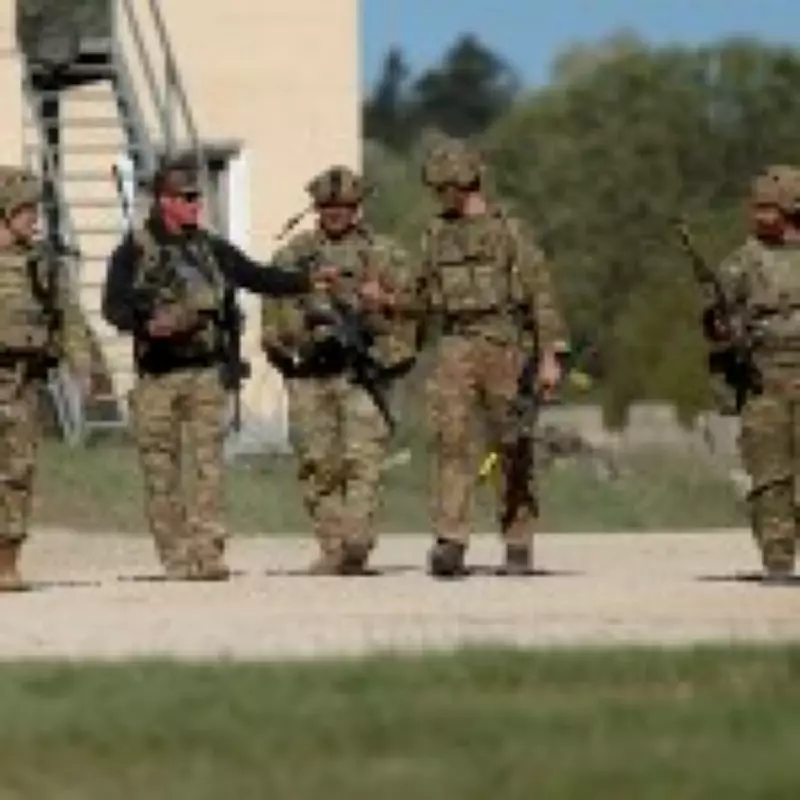
European leaders have reacted with concern to Donald Trump's sudden decision to withdraw thousands of US troops from Germany, calling it a clear signal that Europe must take greater responsibility for its own security. The Pentagon announced last week that 5,000 troops would be pulled out of Germany, with Trump indicating plans to cut further. The move, which blindsided NATO, appears linked to Trump's frustration over European allies' reluctance to join US military operations in the Middle East.
Europe's defense gaps exposed
Experts have long warned that Europe needs to bolster its own defense capabilities and reduce reliance on the United States. Keir Giles, a Russia expert at Chatham House, previously told Metro that a sudden US withdrawal would leave Europe severely lacking in defensive capabilities, making it vulnerable to attack. 'Europe is not in a position to replace the United States in terms of defence, and it will take some time to do so, even if it were to start applying effort in a way we haven't seen so far,' he said.
Russian threat looms large
While US security concerns often focus on the Middle East, experts highlight Russia as the primary threat. Giles noted that to preserve European security, Europe must be more powerful than Russia in key areas to deter Moscow. 'The entirety of Europe is a frontline area as far as Russia is concerned,' he added. Russian-born UK citizen and former BBC journalist Sergei Cristo pointed out that Europe is not doing enough to counter Russian hybrid warfare, which includes political interference, intelligence operations, and election meddling. 'Personally, I don't think NATO is ready,' Cristo said.
EU calls for stronger European pillar in NATO
European Union foreign policy chief Kaja Kallas said that while talk of US troop withdrawal has been ongoing, the timing came as a surprise. 'I think it shows that we have to really strengthen the European pillar in NATO,' she said. Over the weekend, NATO spokeswoman Allison Hart confirmed that the alliance is working with the US to understand the details of its decision on force posture in Germany. European allies and Canada have been aware since Trump returned to office last year that he would pull troops out of Europe, but US officials had pledged to coordinate with NATO allies to avoid a security vacuum.
Underlying tensions with the US
NATO Secretary-General Mark Rutte downplayed the move, noting disappointment on the US side over European support for the war on Iran. France, Spain, and the UK have declined to give US forces unrestricted use of their bases for attacks on Iran. Spain has denied the use of its airspace and bases for the war. In a further sign of friction, Trump has accused the EU of non-compliance with its US trade deal and announced plans to increase tariffs on cars and trucks from the bloc to 25%, a move particularly damaging to Germany.
European Commission President Ursula von der Leyen, without mentioning Trump or the US, highlighted the bloc's recent trade deals with Australia and India, and ongoing negotiations with Mexico. 'With like-minded friends, you have stable, reliable supply chains and Europe has the biggest network of free trade agreements,' she said.




