
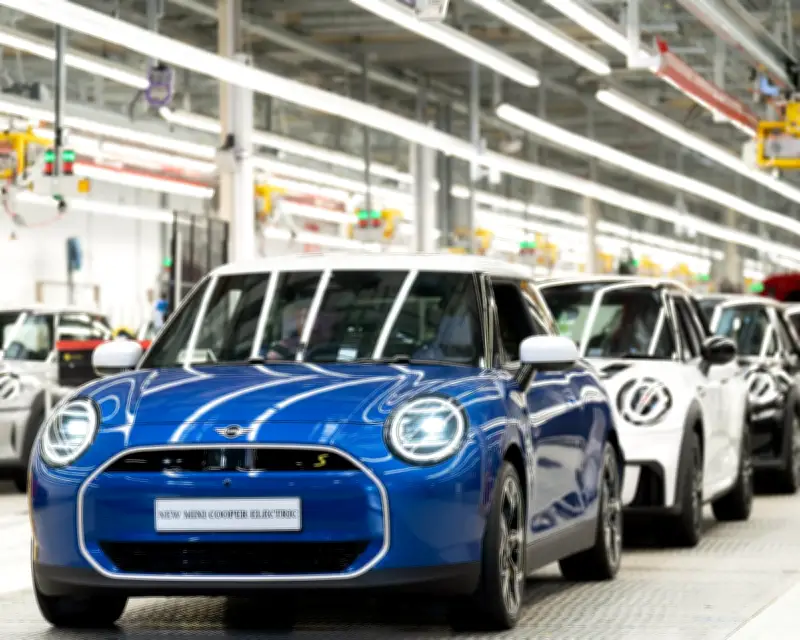
The European Automobile Manufacturers Association (Acea) has called for the UK to be fully included in new 'made in Europe' rules that threaten to shut out British manufacturers from their biggest export market. On Wednesday, Acea urged Brussels to grant 'justified, targeted exemptions' to the UK, Turkey, and Morocco from regulations requiring cars and parts to be made within the EU to qualify for subsidies or public procurement.
Background of the rules
The European Commission drafted the rules under the Industrial Accelerator Act (IAA) to protect the EU's industry from China, whose cheap but heavily subsidised exports have undercut European products. However, the rules threaten to become the most damaging consequence of Brexit yet for British manufacturers because they apply only to EU members.
Acea, seen as highly influential among European governments, stated: 'The European automotive industry operates a deeply integrated value chain with the UK, even post-Brexit. Vehicles, components and batteries made in the UK should therefore hold the same status as those made in the EU27 – with equal access to every policy instrument.'
UK government negotiations
The backing of the powerful lobby group will aid the UK in negotiations with the EU to avoid damage. Britain’s Europe affairs minister, Nick Thomas-Symonds, was meeting the EU’s trade commissioner, Maroš Šefčovič, on Wednesday to discuss progress of UK-EU relations, with the IAA on the agenda.
Mike Hawes, chief executive of the Society of Motor Manufacturers and Traders (SMMT), a UK lobby group, expressed pleasure that the European industry’s position reflected 'the integrated nature of our respective automotive sectors' and aligned with European suppliers’ hopes. 'We trust European regulators will reflect this mutual interest in their final drafts,' he said.
Potential impact on UK industry
Hawes told a conference in London on Tuesday that the rules would 'effectively shut out UK-assembled vehicles from most of the European market.' He argued this would be 'one of the most spectacular own goals in history' because many of Britain’s plants are European-owned, while the UK and EU are each other’s largest markets for cars and parts.
Acea members BMW, Volkswagen, and Stellantis respectively own the Mini, Bentley, and Vauxhall factories in the UK. JLR, Ford, and Toyota also have big manufacturing operations in the UK. Nissan, another member, has reportedly argued privately that it would have to close its Sunderland factory if the rules went ahead. More than half of UK car exports go to the EU.
Several carmakers also have factories serving Europe in Turkey and Morocco. Acea said: 'Excluding the existing factories of Acea members, for instance, would strand European investments and weaken our competitiveness at the worst possible moment.'
Broader trade context
The IAA is seen as a key trade tool the EU wants to deploy to curb the flood of Chinese components, which industry leaders say threatens the sovereignty of European industry. On Tuesday, the EU and China agreed to enter three months of diplomatic talks to try to avert a trade war.
Last month, several European trade groups warned of the potential for indigenous industry to be cannibalised in what is being widely described as 'China shock 2.0' – starkly illustrated by Volkswagen’s proposals to cut as many as 100,000 jobs in Europe. The trade imbalance is now running at €1bn (£860m) a day and is forecast to come close to €400bn in China’s favour by the end of the year.
While Acea is heavily influenced by its German members, the IAA is a French-driven piece of legislation and any changes will need the backing of President Emmanuel Macron. Germany, whose car industry has significant manufacturing within China, was recently urged by the Centre for European Reform thinktank to 'wake up' to the threat of the Chinese. After a summit of EU leaders in June, German Chancellor Friedrich Merz proposed a 'plaza accord' to curb the Chinese. At last month’s G7 summit in France, he blamed an 'artificially low' yuan as a key driver of China’s surplus.




