
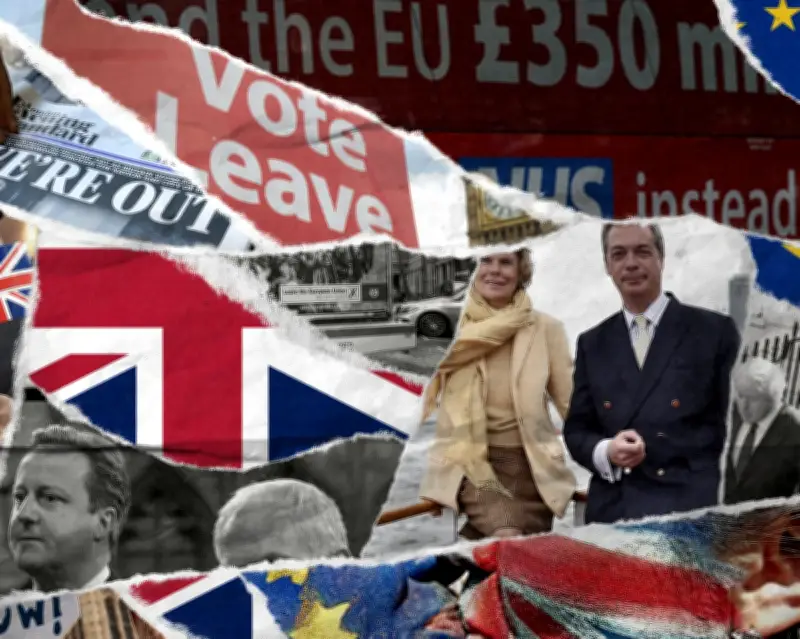
David Cameron announces the referendum date
On 20-21 February 2016, David Cameron announced the EU referendum date: 23 June 2016. The next day, Boris Johnson declared he would campaign for leave. Bernard Jenkin, a senior Conservative backbencher, recalled begging Cameron not to hold an in/out referendum, fearing it would smash the party. Cameron responded that only 50 Conservative MPs might vote leave, a miscalculation Jenkin immediately recognized.
David Lidington, minister for Europe, said the decision was very much Cameron's, though he disagreed. He compared it to chucking red meat to pursuing wolves. Craig Oliver, No 10 communications director, felt the campaign was in trouble from the start, with the Conservative party's heart beating for leave.
Boris Johnson's decision to back leave
Will Walden, Johnson's communications director, described Johnson as genuinely divided, spending the weekend at his Oxfordshire farmhouse being buffeted by Cameron, Osborne, and family. Johnson veered like a shopping trolley, stressed and unsure. At one point, he asked Walden what to do, who refused to make the decision. Johnson eventually announced for leave, a move Walden believes changed history.
Lidington noted Cameron was more upset by Michael Gove's decision for leave, representing a breach of close friendship. Jess Phillips, Labour MP, admitted she underestimated Johnson, seeing him as a fool whose lies were obvious.
Campaigning begins with 'project fear'
From 1-13 April 2016, a government leaflet on Brexit dangers was sent to every household, dismissed as 'project fear' by leave campaigners. Phillips found the remain campaign disorganised and elitist. Ivan Rogers, UK's EU representative, was the gloomiest near Cameron, predicting a knife-edge vote and leave's likely win due to better organisation.
Tom Watson, Labour deputy leader, feared a leave win early on, as Labour MPs reported their constituencies leaning Brexit. Caroline Lucas, Green MP, criticised the remain campaign for being dominated by white establishment men and focusing too much on economics.
Obama's 'back of the queue' comment
On 22 April 2016, Barack Obama said Britain would be at the back of the queue for trade deals if it left the EU. Craig Oliver confirmed the line was discussed with Obama, who used it at a press conference. Paul Stephenson, Vote Leave communications director, said it was the peak of No 10's campaign, but Dominic Cummings and Dominic Raab argued it would backfire.
The £350m bus and Turkey poster
On 11 May 2016, Vote Leave launched a red battlebus claiming the UK sends £350m a week to the EU, which could fund the NHS. Walden said Johnson questioned the figure but Vote Leave wanted people to think it was a lot of money. Lucas found the lies shocking, noting the bus was inescapable media coverage.
On 20 May 2016, Vote Leave claimed Turkey (population 76 million) was joining the EU, a statement Jonathan Faull, a senior EU official, called a lie. Walden revealed Johnson nearly quit over the Turkey poster, as he had Turkish ancestry and was pro-immigration. Johnson was furious, wanting to confront Dominic Cummings.
The Thames flotilla and Jo Cox's murder
On 15 June 2016, Nigel Farage and Kate Hoey sailed up the Thames with anti-EU fishers, met by a remain flotilla led by Bob Geldof. Hoey felt the optics played into leave voters' hands. Rachel Johnson, Boris's sister, acknowledged the remain flotilla was a 'really bad look,' with Geldof flicking V-signs at the working man. She believes the flotilla helped deliver Brexit.
On 16 June 2016, Farage released a 'Breaking Point' poster showing Syrian refugees, hours before Labour MP Jo Cox was murdered by a white supremacist. Craig Oliver called it the most difficult day of his professional life, with three events revealing something deeply wrong. Gawain Towler, Farage's press head, said the poster's focus on immigration in the last week worked strategically.
Jess Phillips was at Cox's house 48 hours before her death, telling her it would be okay. She found out from a news flash while in Spain and couldn't believe it. The murder made MPs feel hunted, and Phillips resented Farage's comment about winning without a single shot being fired.
The great debate and independence day
On 20 June 2016, a BBC head-to-head debate at Wembley arena featured Boris Johnson, Gisela Stuart, and Andrea Leadsom for leave, and Ruth Davidson, Sadiq Khan, and Frances O'Grady for remain. Mishal Husain, the chair, noted the intensity when Johnson said the vote could be the UK's independence day, with a fervour absent on the remain side.
Paul Stephenson said the debates took up huge capacity, and Johnson's 'independence day' line got headlines. Having Gisela Stuart, a German-born Labour MP, broadened the leave campaign's appeal.
Polling day and the result
On 23-24 June 2016, polling day results came in. Paul Stephenson described a feeling in the afternoon that leave was winning, with positive data and high turnout. Walden recalled Johnson predicting a loss before the vote, but when Sunderland's result came in, Johnson leapt off the sofa. He became focused on betting markets, then euphoric and crestfallen when the win was declared.
Tom Watson spent the night with his 11-year-old son, who was perplexed by the result. Robert Peston, ITV political editor, said economics had not been decisive, as Sunderland voted leave despite the Nissan factory. Caroline Lucas heard David Dimbleby say 'we're out' and felt a dagger in her heart, walking over the Thames in mourning.
David Cameron resigns
On 24 June 2016, David Cameron resigned. Craig Oliver argued he should go with dignity, and Cameron asked if he had to resign. Oliver said sadly, yes. Cameron walked outside with his wife Sam, emotional, and later met Boris Johnson and Michael Gove, who looked shocked. Walden said Johnson felt genuine concern for Cameron, and the magnitude of the decision dawned on him when cyclists trapped his car, banging on the windows.




