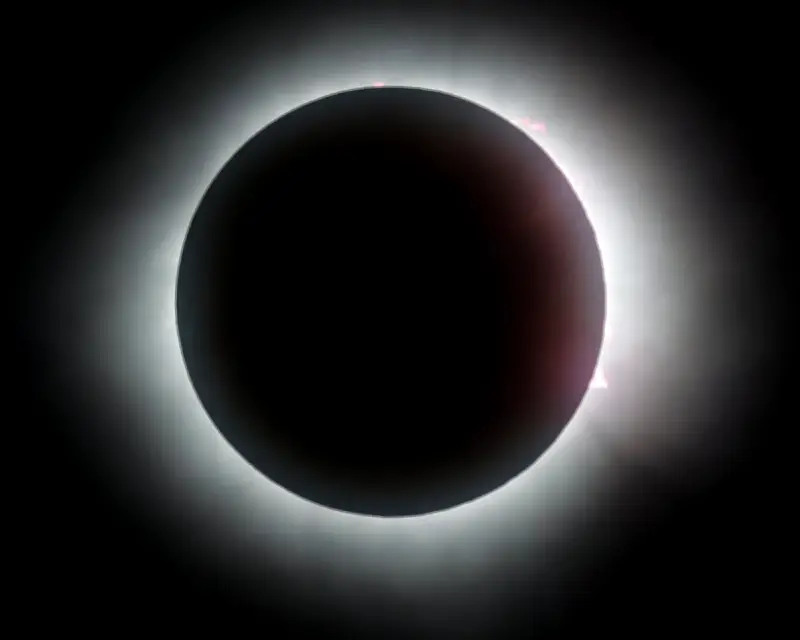
On Wednesday afternoon, two Nasa aviators will board a research plane at Keflavik airport in Iceland, climbing to 50,000 feet (15,000 metres) to intercept the moon's shadow racing across the ocean at over 2,000mph (3,200km/h). The mission aims to photograph the sun during the total solar eclipse, extending the observation time from 2 minutes 18 seconds on the ground to nearly 3 minutes by flying at 460mph along the eclipse's path.
Chasing the Eclipse from the Stratosphere
The WB-57 aircraft, based on the English Electric Canberra bomber, will fly from Iceland towards Greenland, then bank south along a curving course 40 miles off the coast. The pilot will time the flight to reach the point of greatest eclipse exactly as the shadow catches up, allowing the onboard cameras to capture the occluded sun in multiple wavelengths.
Cary Klemm, a sensor equipment operator at Nasa's Johnson Space Center, who has flown eclipse missions before, described the experience: “The big difference is that in the cockpit of an aircraft at 50,000 feet, it’s very bright in the sun. There are no clouds above you, and then all of a sudden, you’re hit with this slam of shadow.” He added, “You feel the temperature drop off; you’ll notice that you need more light from your instruments, and it’s kind of a weird, eerie shadow that you’re surrounded by. It wraps around the view in the cockpit.”
Scientific Payload: Capturing the Sun's Corona
Four cameras in the nose cone will take dozens of pictures per second, focusing on large plasma loops called prominences and explosive events known as nanoflares. These observations are only possible when the sun's disc is blocked out, revealing the faint corona. Dr Amir Caspi, principal investigator at Southwest Research Institute, said, “I’m super-excited. Solar eclipses give us an opportunity to do science we couldn’t do at any other time.”
Nanoflares, despite their name, release energy equivalent to thousands of atomic bombs each, and are key to solving the mystery of why the corona is over 1,000,000°C while the sun's surface is only 6,000°C. Aircraft are ideal for these observations because ground-based cameras face cloud cover and atmospheric interference, while space-based cameras have data transmission limits. “As you can imagine, this is terabytes of information,” Caspi noted.
Historical Precedents and Future Implications
This mission follows a legacy of airborne eclipse observations. In 1923, the US navy sent biplanes with little success. In 1973, scientists modified a Concorde prototype to chase an eclipse for 74 minutes over the Sahara. The data gathered helps scientists understand space weather—the energetic particles and radiation that threaten astronauts, satellites, and power grids. Caspi emphasized, “Understanding space weather is critical for us as a technological species, and it starts with understanding the processes at the sun.”
Beyond science, eclipses offer a profound human connection. Caspi reflected, “What percentage of humanity has ever witnessed a total solar eclipse? It’s a fraction of a fraction of a per cent. If you’re part of that rare group, you’re connected to the Earth and the sun and the solar system. It’s mind-blowing. It makes you feel very special, but also very small because you are this little mote in the universe.”