
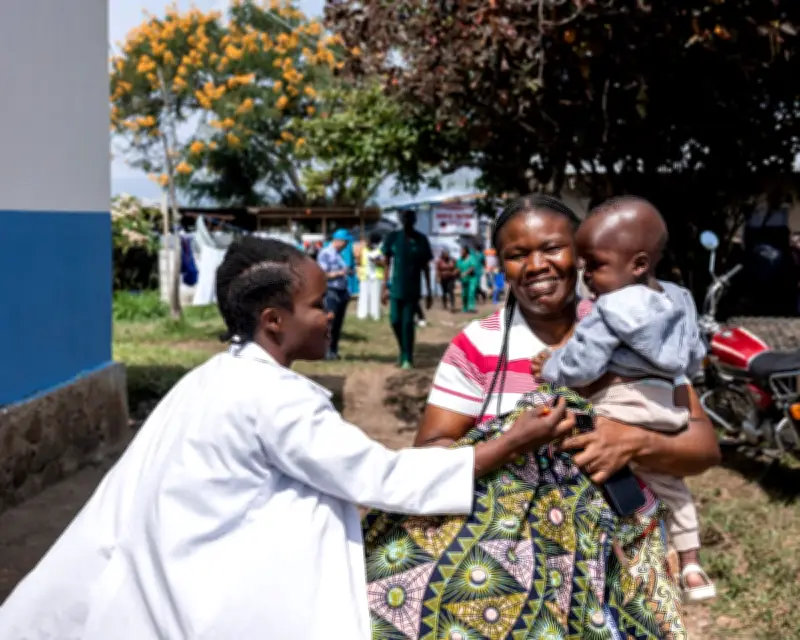
First patients have been enrolled in a record-breaking Ebola treatment trial in the Democratic Republic of the Congo, testing two experimental drugs against the Bundibugyo strain of the virus, for which there is no approved vaccine or treatment. The trial, set up just six weeks after the outbreak was declared a public health emergency of international concern by the World Health Organization on 17 May, aims to reduce mortality rates.
Record pace for research
Scientists said the speed of establishing and starting the trial is unprecedented. Patients were enrolled six weeks after the WHO declaration. As of 9 July, there had been 1,792 confirmed cases and 625 deaths from the Bundibugyo strain, which is still in its expansion phase, according to the WHO.
Neema Haba, a mother of three and banana seller in Bunia, the capital of Ituri province, expressed impatience: "I hope these drug trials proceed quickly. Financially, we are being driven to the brink by this outbreak and nothing is going right. We are struggling to provide for our children."
Challenges in outbreak response
The response relies on identifying cases, isolating them, and tracking contacts. About 75% of known contacts are being traced, but low trust in authorities and a highly mobile population hinder efforts. Some frontline workers stopped work in protest at lack of pay. Ovide Maliabo, a driver for a burial team in Rwampara, said: "At one point, we narrowly escaped being lynched. It's a shame that we aren't being financially supported." Bahati John, head of the team, added: "Honestly, since we started working on 15 May, with all the insults we've had to put up with, we haven't seen a single penny. We are the breadwinners of our families, and our families are suffering." DRC officials said payments had been made, but it is unclear if activities have fully resumed. The closure of Bunia's airport hampers the response, including the supply of banknotes.
The Partners treatment trial
The Partners trial tests two drugs: remdesivir, an antiviral by Gilead Sciences, and MBP134, a monoclonal antibody by Mapp Biopharmaceutical. Patients are randomly allocated to receive either drug, a combination, or standard supportive care. Both are given intravenously: MBP134 as a one-off infusion, remdesivir as 10 days of therapy.
Prof Laurens Liesenborghs of the Institute of Tropical Medicine, Antwerp, working on the trial in Ituri, said: "These two drugs actually have been proven to work against the Bundibugyo virus in animal models. They showed great efficacy, but now we need to test it in humans. Basically, what we want to see is if they indeed can lower mortality." Bundibugyo typically kills about one in three infected, lower than the Zaire strain's death rate.
Expected impact and design
Researchers will compare death rates between groups. "Any improvement is good," Liesenborghs said. "But it needs to be statistically detected, so we need to see a substantial drop." In trials of monoclonal antibodies against Zaire Ebola, death rates fell from 50% to 35%. "Hopefully we will see something in the order of that magnitude." The trial design allows adding other treatments. A result likely needs 700 to 1,000 patients enrolled. WHO said enough remdesivir and MBP134 have been donated for 1,200 patients. Patients of any age, including pregnant and breastfeeding women, can enrol. "We always think of risk-benefit," Liesenborghs said. "Here the benefit is potentially very high because you offer a potentially life-saving treatment to someone who has a very high chance of dying."
Rapid setup and future trials
Prof Amanda Rojek, international principal investigator for Partners at the University of Oxford, said: "It's just fantastic we've managed to get started so quickly." Strong scientific leadership in DRC was vital. "If we look back at west Africa [2014-16 outbreak], where it took us over a year to start clinical trials, we're very proud of the team led by INRB that we've managed to achieve that in kind of six weeks." The focus is on keeping the trial simple, similar to the Recovery trial during Covid. Partners is sponsored by WHO, with funding from Wellcome Trust, FCDO, and UKRI.
Prof Yap Boum of Africa CDC said: "What limits an outbreak is our capacity to provide care, our surveillance capacity and our ability to isolate people. These trials will enable us to access treatment, and when we treat people, it also sends a message to the community." Another trial is due to begin this week, testing whether obeldesivir can prevent disease in contacts of Bundibugyo cases. Africa CDC said that trial needs around $18m, with $6m committed to date.




