
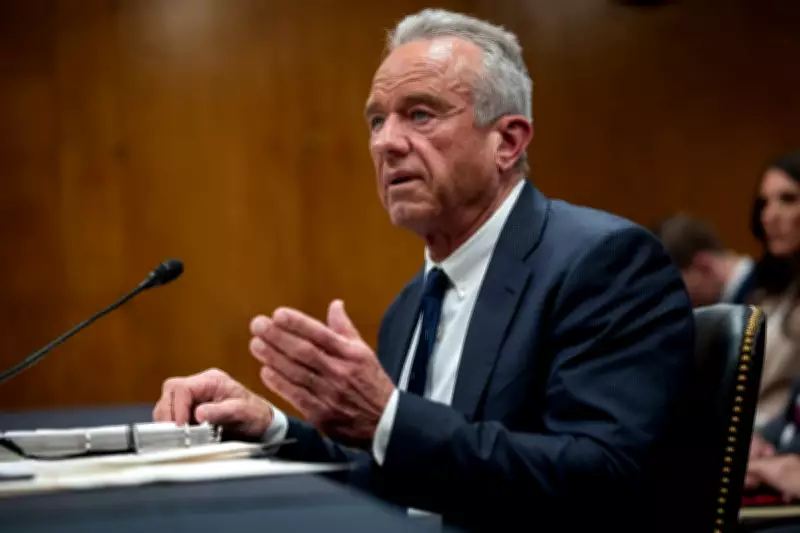
Health Secretary Robert F Kennedy Jr encountered rigorous interrogation from multiple US senators during a Wednesday hearing that centered on the administration's response to the measles outbreak and the proliferation of vaccine misinformation. The session before the Senate finance committee grew particularly tense as lawmakers scrutinized Kennedy's long-standing positions on immunization and public health communication.
Senator Wyden Leads Criticism on Vaccine Messaging
In his opening statement, Senator Ron Wyden launched a direct critique of Kennedy's approach to vaccines, accusing him of exploiting his influential platform to sow doubt among parents and undermine medical professionals. "When it comes to vaccines, Robert Kennedy has used this once-in-a-lifetime platform to make parents doubt themselves and doubt their doctors," Wyden asserted. He further charged that the secretary had "ducked, bobbed and weaved without taking the responsibility of saying what needs to be said: vaccines save lives in America."
Measles Outbreak Takes Center Stage
The discussion intensified when focusing on the measles outbreak, with Wyden challenging Kennedy directly over his perceived detachment from responsibility. Public health experts have argued that Kennedy failed to vigorously promote vaccination during the crisis, instead highlighting unproven treatments like steroids as the virus crossed state lines.
Kennedy, however, maintained his innocence regarding the outbreak's origins. "I had nothing to do with the measles outbreak here," he reiterated. "We have limited our outbreak better than any country in the world." He pointed to higher case numbers in neighboring Mexico and Canada as evidence of superior US management.
Recent statistics underscore the severity of the situation. The United States recorded 2,288 measles cases last year—the highest number since the disease was declared eliminated in the country twenty-five years ago. An additional 1,748 cases have already been reported this year, raising alarms among experts that the US could lose its hard-won elimination status.
Flu Deaths and Vaccine Recommendations Questioned
Senator Michael Bennet shifted the focus to vaccine recommendations, noting that 2025 witnessed the highest number of childhood flu deaths in modern American history. Bennet pressed Kennedy on whether he still believed that "the flu vaccine is destroying children's brains" or that there was "zero evidence that the flu vaccine prevents any hospitalizations or any deaths."
Kennedy responded cautiously, stating, "We're making sure that we follow the science." When Bennet asked if he now considered the measles vaccine vital for children's health, Kennedy affirmed, "That's my position. We promote the measles vaccine."
Accusations of Misinformation and Policy Shifts
Senator Ben Ray Luján accused Kennedy of "pushing vaccine misinformation" that predated his tenure and demanded a plan to reduce measles cases and improve MMR vaccination rates. Kennedy's reply—"We promote the MMR. We advise every child to get the MMR"—marked a seemingly stronger stance compared to his previous mixed messaging.
This apparent pivot coincides with the Trump administration subtly stepping back from earlier positions that vaccines posed significant public health risks. The shift aligns with declining Republican poll numbers ahead of the November midterm elections and sustained criticism from the medical community.
Notable Absences and Political Context
Republican Senator Bill Cassidy, a vocal vaccine supporter, notably avoided the topic during his questioning of Kennedy. Cassidy had backed Kennedy's confirmation after receiving assurances that federal vaccine guidelines would be upheld—assurances that ultimately went unfulfilled. Cassidy now faces a challenging primary in Louisiana next month, where Donald Trump has endorsed one of his opponents in a rare move against a fellow Republican.
Medicaid Funding and AI in Healthcare
Kennedy also reiterated that the administration is not reducing Medicaid funding, citing a Congressional Budget Office projection showing spending rising from $668 billion in 2025 to $981 billion in 2036—a 47% increase. However, this increase would have been larger had congressional Republicans not passed the One Big Beautiful Bill Act last summer. A recent White House budget proposal for 2027 suggests the Department of Health and Human Services could face a $15 billion cut, 12% less than this year.
Artificial intelligence in healthcare emerged as another topic, with Senator Maria Cantwell inquiring about AI's role in potentially cutting or denying Medicare claims. Kennedy acknowledged that the technology, intended to detect fraud, had "probably kinks in the system" and pledged that HHS would work to "try to straighten that out." He noted that some states were expanding AI use in diagnostics, billing, and management, describing these applications as "resourceful and imaginative."
Ongoing Disruption at the CDC
Fourteen months into Kennedy's tenure, the Centers for Disease Control and Prevention continues to experience significant disruption. Approximately 80% of senior leadership roles remain unfilled, leaving no permanent leadership to guide policies affecting millions of Americans. This vacancy hampers the agency's ability to coordinate day-to-day efforts against infectious diseases, heart conditions, and cancer screening.
Current and former senior CDC officials report that bureaucratic delays and paperwork backlogs have slowed productivity across several areas. Disruptions in data collection have further impeded the agency's operational effectiveness, compounding the challenges faced by the nation's leading public health institution.




