
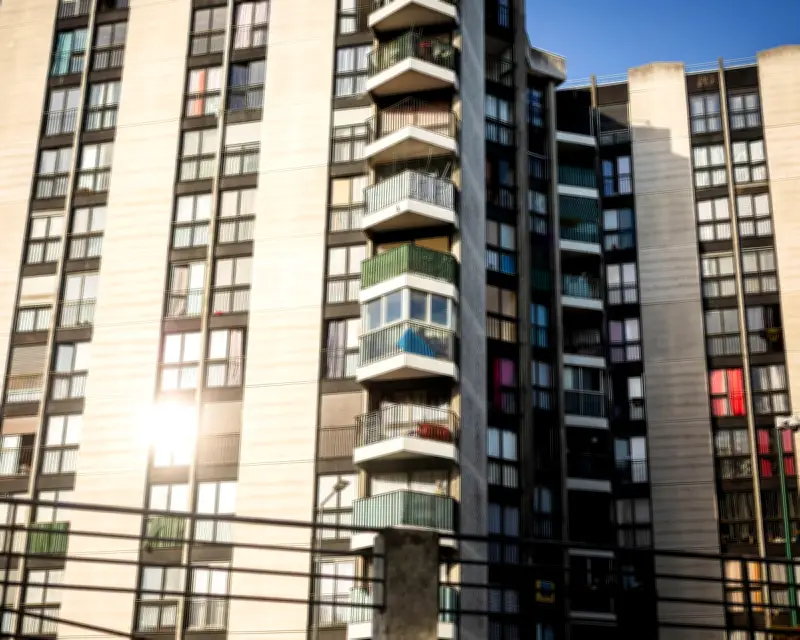
France is experiencing its highest temperatures on record, with more than 44 million people under a red alert as daytime temperatures exceed 40C in many areas. The extreme heat has exposed a severe climate inequality, as low-income housing estates suffer the worst from heat-trap homes.
Living conditions become unbearable
Samira, a 35-year-old single parent living in a seventh-floor flat in Ris-Orangis, south of Paris, described her desperation. "Yesterday I sat down and cried, I thought I'm going to die," she said. Her flat, like millions in France, is poorly insulated and lacks outside window shutters. "Blazing sun hits my windows all day – I can't breathe, I feel dizzy, there is no air."
She can only use a fan for short bursts due to electricity costs and gets only two hours of sleep a night. Her 10-year-old son Issam attends one of the 1,800 schools closed due to dangerous heat. "My classroom on the top floor reached 40 degrees inside," he said. "It was too hot to have lessons, so we just played games."
Widespread impacts of the heatwave
The heatwave has led to higher air pollution, increased hospital admissions, school closures, and train cancellations. Power cuts affected thousands of homes from Brittany to the southeast, leaving people unable to use fans or electric blinds. French nuclear energy output was reduced due to limited cooling water, and hundreds of thousands of poultry have perished.
Half of all French homes have insufficient protection from high temperatures, according to a report by the NGO Fondation pour le Logement. About 66% of French people struggle to tolerate the heat in their homes. Maïder Olivier, head of climate advocacy at the NGO, said France has a "massive and worsening problem of heat-trap housing."
Climate inequality grows
Olivier noted that climate inequality in France is growing, with low-income suburban housing estates suffering the worst. "One of the aggravating factors is having no possibility of escape," she said. Many residents on heavily concreted estates lack green space, work in high temperatures without air conditioning, travel on crowded hot buses, and cannot afford holidays.
In Grigny, one of the poorest towns in the greater Paris area, Aboubakar, 60, wept as he stood below his fourth-floor flat. "I'm suffocating," he said. "I can't afford to buy a fan. There are no shutters on my flat. At night I can't sleep, it's like a furnace." He said the heatwave affected his mental health, worsening other problems.
Youth and segregation
Inès Seddiki, founder of Ghett'up in Seine-Saint-Denis, said young people from suburban housing estates are particularly suffering. "They are not causing the climate crisis but they are the least protected from its consequences," she said. She noted a lack of medical facilities and that the heatwave exposed racism in society, as young people from the banlieue seeking respite at the seaside were labeled an "invasion."
Several towns in the richest area west of Paris, including Neuilly-sur-Seine, banned access to their municipal swimming pool for anyone from other towns. Noah, a 22-year-old student living in a top-floor flatshare under a badly insulated zinc roof, said: "There's no air, we can never sleep more than four hours. We have tiny balcony space so we've put a children's paddling pool on it and sit in there. What else can we do?"




