Enfield has recorded 111 confirmed measles cases in 2026, making it the hardest-hit borough in England, according to UK Health Security Agency (UKHSA) data. The outbreak, which began in February, spread across London and the West Midlands, driving most of England's measles infections in the first half of the year.
Across England, 1,003 measles cases have been confirmed so far in 2026, already surpassing the 960 cases recorded throughout all of 2025. Health officials also confirmed the deaths of two young children in June and an adult with an underlying health condition in July.
Vaccination rates in Enfield far below national average
In Enfield, only 61.9 per cent of children – roughly three in five – had received both MMR doses by their fifth birthday. This is well below England's average of 83.8 per cent and the World Health Organization's target of 95 per cent coverage for herd immunity. The low uptake has been linked to the sustained outbreak.

Nationally, monthly cases peaked at 215 in May, then fell to 154 in June, 50 in July and 29 in August. Unvaccinated children under 10 account for most infections recorded this year.
Cases spread beyond London
Outside London, Birmingham has recorded 81 confirmed cases. There have also been clusters in Hertfordshire, Yorkshire, Greater Manchester, Merseyside, Lancashire, Kent and Essex. The UK had previously achieved measles elimination, but outbreaks returned in 2023 amid declining vaccination rates. In 2024, England recorded 2,911 laboratory-confirmed cases – its highest annual total since 2012.
Dr Vanessa Saliba, consultant epidemiologist at UKHSA, said: “The outbreak in Enfield which started around February and spread to other parts of London and the West Midlands drove most of the measles cases in the first half of this year. Cases peaked in May and thankfully there have been much fewer in more recent weeks.”
Uptake stabilising but gaps remain
There are some signs that vaccination uptake across England may be stabilising. Among five-year-olds, 92.1 per cent have received at least one dose of a vaccine protecting against measles, mumps and rubella, while 83.8 per cent have received both doses. Those figures are slightly higher than the previous year's rates of 91.8 per cent and 83.7 per cent respectively. However, uptake in Enfield shows how far some areas remain below the national average.
Dr Saliba said: “The decade long decline in MMR vaccine uptake in England is very concerning and has led to the resurgence of measles seen since late 2023. A disease as infectious as measles will find those unvaccinated, so there is no room for complacency.” She warned that measles can quickly return to areas where childhood vaccination rates are low, and vaccinating a child also helps protect vulnerable people, including babies under one and those with health conditions.
“Two doses of the MMR or MMRV vaccine is the best way to protect your child from this nasty disease that can lead to them ending up in hospital. Tragically, measles leaves some children with serious long term health issues and, while rare, can cause deaths,” Dr Saliba added.
The MMRV vaccine protects against chickenpox as well as measles, mumps and rubella. The NHS is offering its second dose earlier, at a new 18-month appointment, to help improve uptake. Dr Saliba added: “We can only stop measles outbreaks occurring when we ensure children in all areas and communities receive two doses before they start school. Older children and adults who missed vaccinations can catch up at their GP practice whatever their age.”
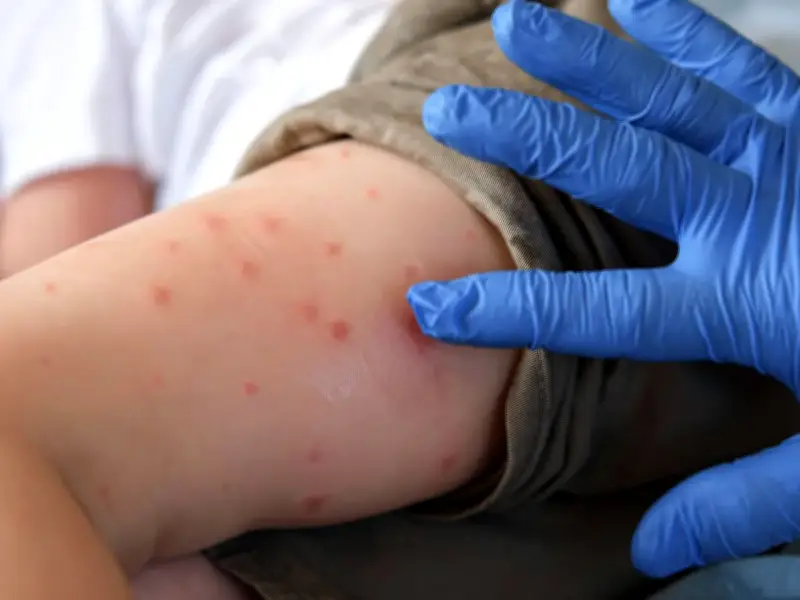
Measles symptoms include a high fever, coughing, sneezing and red, sore, watery eyes. A rash usually appears after these early symptoms. Most people start to feel better after about a week, but measles can cause serious complications affecting the lungs or brain. Babies and people with weakened immune systems are at greater risk. UKHSA surveillance data only identifies locations once an area reaches 10 laboratory-confirmed cases, so an area without a published case count is not necessarily free of measles; at least 25 council areas have reached that threshold, but the exact locations of more than 200 cases have not been published.