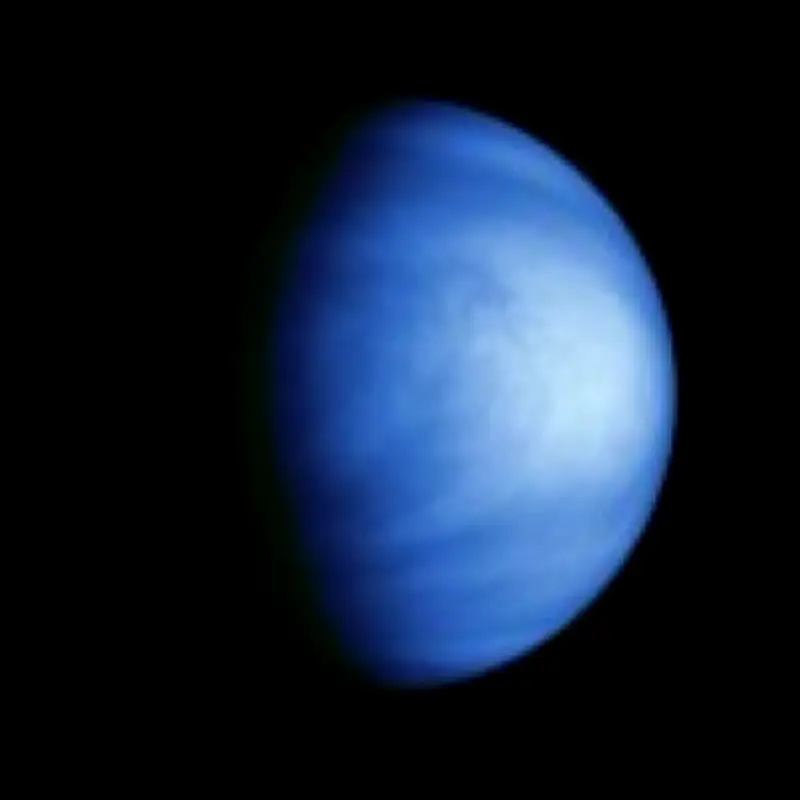
Scientists now believe that if life exists on Venus, it likely originated from Earth, transported through space on asteroids and comets. This panspermia theory was explored in a new study presented at the 2026 Lunar and Planetary Science Conference (LPSC) by researchers from the Johns Hopkins University Applied Physics Laboratory (JHUAPL) and Sandia National Laboratories.
Panspermia and the Venus Life Equation
The study used the Venus Life Equation (VLE), a framework developed by Noam Izenberg and colleagues in 2021, to assess the likelihood of life existing in Venus's atmosphere. The VLE breaks down the probability of life into multiple factors that, when multiplied, provide an estimate of the likelihood that life exists. The researchers first examined whether organic material could survive the journey through space, noting that previous computer simulations and analyses of meteorites found on Earth have shown that organic material can survive interplanetary travel.
Surviving on Venus is more challenging, but some layers within Venus's cloud deck exhibit moderate temperatures and pressures that could support microbial life. The team focused on how fireball meteorites behave when entering Venus's atmosphere, considering factors like atmospheric explosion and fragmentation into smaller pieces capable of remaining suspended within the clouds.

Billions of cells transferred over time
The team estimated the number of bolides capable of transporting material from Earth or Mars into Venus's cloud layers. Their findings suggest that hundreds of billions of cells may have been transferred from Earth to Venus over time, with a similarly large number potentially remaining viable. According to the model's best estimate, around 100 cells are dispersed into Venus's clouds each year, and approximately 20 billion cells could have been transferred from Earth over the past one billion years.
“If future astrobiology missions were to discover life on Venus, there’s a strong chance we are not meeting a new alien species – but our long-lost microbe cousins from Earth,” the researchers noted.
Implications for astrobiology
The study adds weight to the panspermia hypothesis, suggesting that life could be transferred between planets more easily than previously thought. It also highlights the importance of considering Earth as a potential source of life on other planets. The findings could influence the design of future missions to Venus, which are planned to search for signs of life in the planet's clouds. The researchers emphasized that their modeling provides a framework for understanding the likelihood of interplanetary microbial transfer and its implications for astrobiology.