
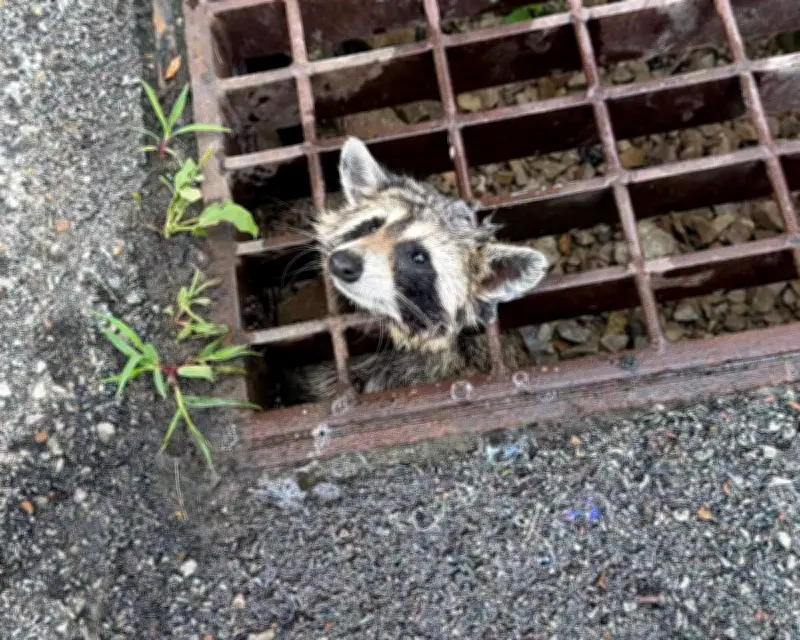
A raccoon trapped in a storm drain in rural Pennsylvania, US, was rescued after firefighters used hydraulic "jaws of life" equipment to lift the grate and cut away metal bars. The raccoon scampered off unharmed. A local resident first tried to free it with washing-up liquid and water before firefighters were called.
Surprising Discoveries in Extreme Habitats
Scientists found an Andean leaf-eared mouse living at the summit of a remote volcano in the Andes, nearly 7,000 meters above sea level. In a habitat with scarce oxygen, sub-zero temperatures, and toxic plants as the main food source, the mouse appears to be thriving. "Evolution never ceases to surprise us," said one of the researchers.
In Costa Rica, a robber fly, also known as an "assassin fly," was photographed in Puerto Jiménez. These aggressive aerial predators intercept and capture other insects in flight and have been known to attack humans when threatened. Costa Rica covers just 0.03% of Earth's landmass but harbors nearly 5% of all estimated species, making it one of the most biodiverse countries.
Conservation Success Stories
A harpy eagle chick was documented as part of the National Program for the Conservation of the Harpy Eagle in Santa Rosa del Sara, Bolivia. This birth is the second recorded in Bolivia within a year and represents a significant step forward for the conservation of one of the largest eagle species in the Americas.
In northern Greece, a European wildcat was photographed blending into a forest near Grevena. Brown bear numbers in the area have risen steadily due to conservation measures, with a 2025 survey counting about 900 bears – nearly double the total recorded six years earlier. The Arcturos bear sanctuary in Nymfaio provides a refuge for bears rescued from captivity or found injured in the wild.
Northern bald ibises, whose population fell below 100 in Turkey during the 1970s, are multiplying again thanks to long-term conservation efforts. A photographed ibis was placed in a cage at a protection station in Sanliurfa, where it will live until the breeding season begins in February, when it will be released back into nature.
Climate and Environmental Impacts
A ringed seal resting on a sand spit on Banks Island in the Arctic won the New Scientist Editors award in the Earth photo awards 2026. Rapidly melting sea ice has left the seal stranded on the landward side. Thawing permafrost releases sediment carrying mercury into the ocean, and traces of this toxic metal have been found in seal fat. These contaminants threaten marine life and disrupt the ocean's chemistry and food chain, also risking the health of humans who rely on marine animals for food.
In Islamabad, Pakistan, vets gave water to an owlet at the Margallah wildlife rescue centre, which is seeing more birds suffering from dehydration or heatstroke. In Antalya, Turkey, two loggerhead sea turtles named Inci and Mercan were released into the sea after being fitted with satellite tracking devices. They are monitored as part of a research project examining their migration habits and adaptations to the climate crisis.
Other Highlights
A darter dragonfly rested on a water lily during the Inter-Garden Weigh-Off at Kew Gardens, London, UK. The friendly competition challenges botanical gardens worldwide to see whose Victoria boliviana water lily leaves can hold the most water. The largest leaf of the species ever recorded spanned 3.2 meters.
In China, a blue-throated bee eater, a national second-class protected wild animal, was photographed diving into water to cool off in Nanchang. Milu deer, declared extinct in the wild in China due to hunting and habitat loss, were reintroduced from European zoos in 1985. Their population has rebounded, and Jiangsu Province now serves as the largest wild sanctuary for them in the world.
Flamingos cooled off in shallow lakes of the Zwillbrocker Venn wetlands in north-western Germany. The nature reserve hosts greater flamingos, as well as Chilean and American species believed to be descendants of escaped former captive birds.
Other images include an egret tending to chicks in Ajmer, India; a white stork perching on a lamp-post at sunset in Debrecen, Hungary; a monkey exploring earthquake rubble in Catia La Mar, Venezuela; a northern Pacific rattlesnake hunting in south-western Oregon, US; a pelican in St James's Park, London; butterflies on wildflowers in Sarıkamış, Turkey; and a deer racing along the beach in Pacific Grove, California.



