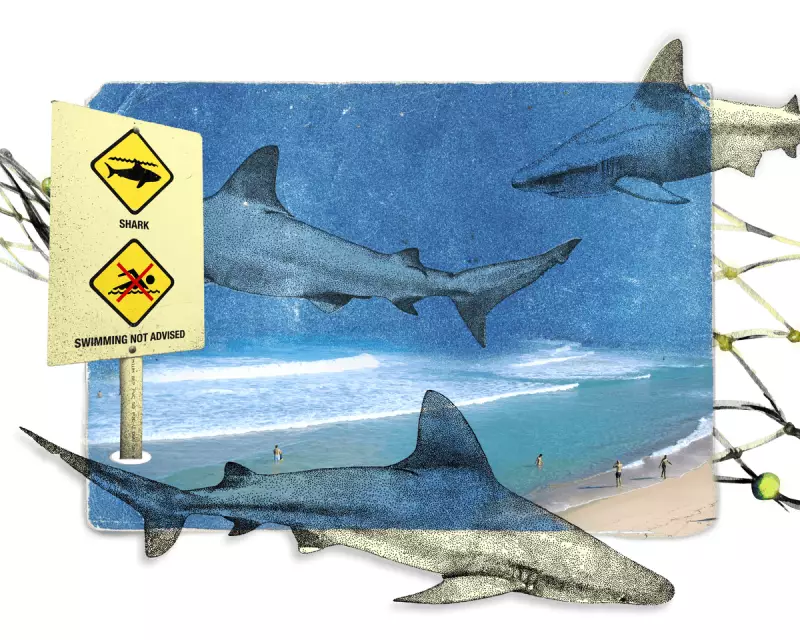
A series of alarming incidents has shaken beachgoers in New South Wales, with four people attacked by sharks within a 48-hour period. Three of these attacks occurred at popular Sydney beaches, prompting widespread closures and urgent warnings from authorities for people to stay out of the water.
The Recent Attacks: A Timeline of Events
The unsettling run of incidents began on Sunday afternoon. A 12-year-old boy was bitten by a shark near Nielsen Park in Sydney's east while jumping off rocks with friends. He remained in hospital on Tuesday following the traumatic event.
The following day, Monday, saw two further attacks. In the morning, a shark bit a large piece from an 11-year-old boy's surfboard. Later that evening at North Steyne, a male surfer suffered a bite described as causing life-changing injuries. A fourth incident occurred further north on the state's mid-north coast, where a surfer escaped serious injury after being bitten.

In response, all of Sydney's northern beaches were closed, with authorities strongly advising the public to avoid entering the water.
Identifying the Predator: The Role of Bull Sharks
Fisheries scientist and shark expert Dr Amy Smoothey, from the NSW Department of Primary Industries and Regional Development, analysed images of the bites. She confirmed that bull sharks were responsible for all four incidents, identified by their distinct broad, overlapping triangular teeth in the upper jaw.
According to the Australian Shark Incident Database, bull sharks account for roughly 16% of all recorded shark bites since the early 19th century, and are responsible for a quarter of fatal incidents. Tiger sharks and wobbegongs are responsible for a similar number, while great white sharks are cited in more incidents overall.
Dr Smoothey notes that bull sharks, which can live up to 50 years, prefer water above 19C. They typically arrive in Sydney waters in October, with numbers peaking in January and February, before migrating north to Queensland around April or May.
"There is no evidence that bull sharks are more aggressive than any other shark," Smoothey stated. "But it is their capabilities that exposes us to them." These capabilities include electroreception, the ability to detect tiny electrical currents and movement in the water, making them effective hunters even in poor visibility.
The 'Perfect Storm' of Conditions
Experts point to a confluence of factors creating a high-risk environment. Intense rainfall over the weekend, with some areas receiving over 50mm in hours, played a key role. This flushed large amounts of fresh, dirty water onto the coast, creating murky conditions that attract smaller fish to feed.
Emeritus Professor Rob Harcourt, a shark ecology expert at Macquarie University, described the combination of heavy rainfall and the time of year—when bull sharks are present—as a "perfect storm" for such incidents.
"For bull sharks, the likelihood of a bite is tightly linked to freshwater inflows," Harcourt explained. This is rooted in their ecology; as pups, they spend years in estuaries, making them tolerant of lower salinity. Tracking data shows tagged bull sharks in Sydney quickly move to areas of turbid water after heavy rain, following aggregations of fish.
Shark bite expert Dr Daryl McPhee from Bond University emphasised that the sharks were almost certainly not hunting people. "They are well adapted to feeding in those murky waters," he said, suggesting the bites were likely investigatory or cases of mistaken identity during feeding.
Long-Term Trends and Staying Safe
While the recent cluster is shocking, Dr McPhee notes a longer-term trend of increasing shark bites in NSW, particularly among surfers on Sydney's northern beaches. Incidents involving surfers rose dramatically from just four between 1980-1994 to around 60 between 2000-2019.
Drivers for this increase may include recovering whale populations (providing more food for great whites), more people in the water, and rising ocean temperatures from global heating, which may keep bull sharks in Sydney waters for longer periods.

"Thankfully though, the risk of a shark bite is still very low," McPhee reassured. "We might think the risk is higher than it actually is because we have seen these three incidents in only about 24 hours."
To lower the risk, authorities across Australia recommend a common set of guidelines:
- Swim close to shore and between the flags at patrolled beaches.
- Avoid swimming at dusk, dawn, and after heavy rainfall.
- Stay away from river mouths, estuaries, murky water, and areas used by fishers.
- Swim with others and avoid having pets in the water with you.
Dr McPhee also debunked a common myth: "It is an 'urban myth' that the presence of dolphins meant there would not be sharks close by." He advises avoiding areas with diving birds, concentrations of fish, or dolphins, as these indicate activity that can attract sharks.