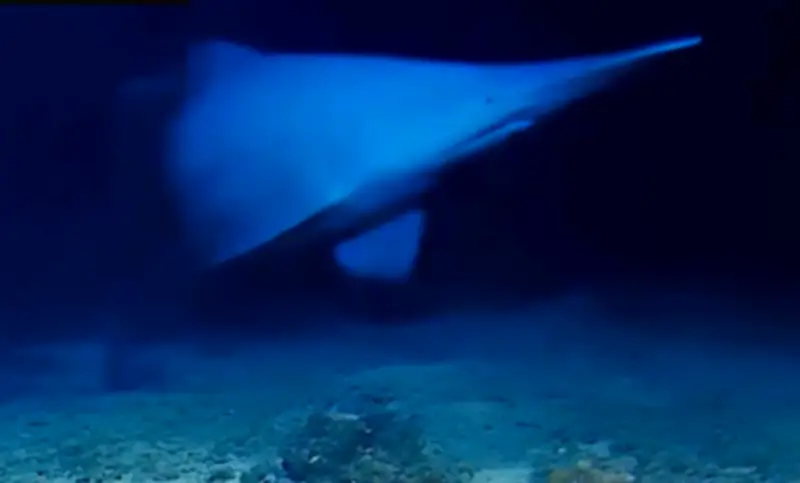
The rare goblin shark, with a face that even a mother would struggle to love, has been observed alive in its natural deep-ocean habitat for the very first time. Researchers from Australia and the United States captured the elusive creature on video during separate expeditions in the Pacific Ocean.
First Live Sightings
Prof Alan Jamieson, director of the Minderoo-UWA Deep-Sea Research Centre, described goblin sharks as having an almost mythological quality, similar to the colossal squid. These sharks are almost never seen alive, with previous sightings limited to accidental captures on fishing lines.
“They’ve captured the imagination of so many people, but we’ve never really seen them alive,” Jamieson said. “We actually know virtually nothing about them.”
Australian scientists filmed the shark during an expedition to the Tonga Trench in 2024 aboard the R/V Dagon. Meanwhile, researchers from the University of Hawaii observed another individual near Jarvis Island. The two sightings, published together in the Journal of Fish Biology, occurred thousands of kilometres apart.
Bizarre Anatomy
“It’s the most bizarre animal,” said Jamieson, a co-author of the study. “They have this incredible mouth that kind of protrudes down from the head, and does a kind of slingshot feeding thing.”
He noted that when alive, the goblin shark’s mouth is fully retracted inside its head, giving it a very pointy appearance rather than the protruding jaws seen in preserved specimens.
The footage, just over 20 seconds long, was obtained after more than 50 days of continuous filming during the voyage.
Expanded Range
Previously, goblin sharks were believed to inhabit the western coast of the US, Australia, Japan, and narrow regions in the Atlantic and Indian Oceans. These new findings expand their known geographic range to include the central Pacific.
“It’s a classic case of a deep sea animal that has very low abundance, but an absolutely massive geographical range,” Jamieson explained.
The individual filmed in the Tonga Trench was nearly 2,000 metres deep, making it the deepest recorded sighting of a goblin shark.
Ancient and Ugly
Prof Culum Brown, an expert in fish at Macquarie University, called goblin sharks “arguably the ugliest shark on the planet.”
“They are ridiculously horrendous to look at,” Brown said. “Not even their mother would love their faces.”
He described their long noses and bizarre protrudable jaws, which shoot forward to grab prey detected by their snout. “It’s like something out of a horror movie.”
The common name “goblin” comes from a Japanese legendary creature with a long nose and red shiny cheeks. Brown noted that goblin sharks are an ancient species that have remained relatively unchanged for about 125 million years.
These sharks have a long flabby body that can reach up to seven metres in length, with small fins. “Like many deep sea creatures, they probably have a really slow metabolism and probably wander around at a very slow pace,” Brown added.