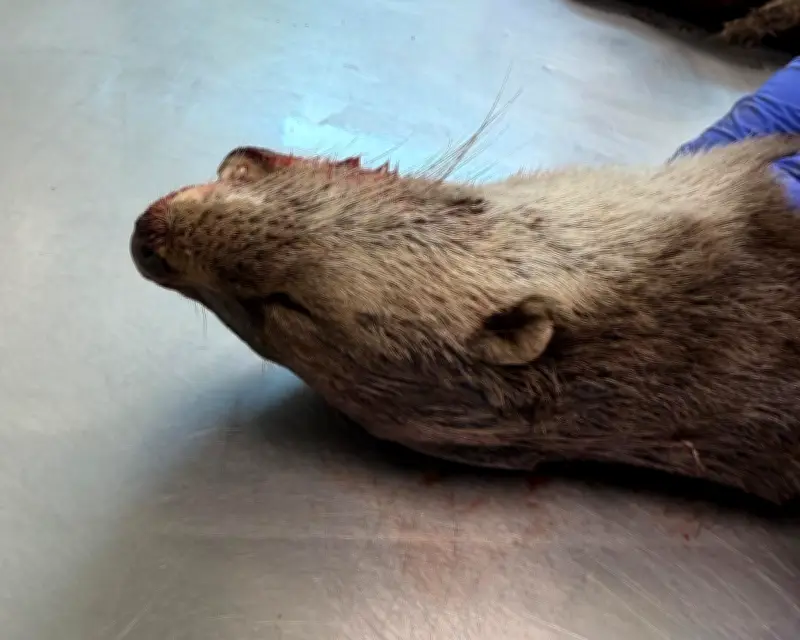
‘I take the rare opportunity to look closely at her cat-like whiskers, the white patch under her chin and the round black pads of her webbed feet.’ Photograph: Gwyneth Lewis
Country diary: The grisly beauty of an otter postmortem
Cardiff: I still remember my first otter sighting, on a bog in the mid-90s. This, in a lab on a stainless steel table, is something else
Otter No 4,888 was found at the side of the road near the River Cefni on Anglesey in November 2024. The collector froze her body and sent it, as every dead otter in the UK should be, to Cardiff University’s Otter Project for a postmortem. The vast majority of the 200 or so animals dissected here annually are roadkill.
On one of the hottest days of the year, we put on lab coats, gloves and masks. Otter No 4,888 is laid out on the stainless steel table. Aside from a mark on her hind left leg and some bleeding from the nose, this young female’s body looks intact. I take the rare opportunity to look closely at her cat-like whiskers, the white patch under her chin, and the round black pads of her webbed feet.
My first otter sighting was very different. In the mid-1990s, when chemical pollution meant otters were far more rare, I went into Cors Caron (Tregaron Bog). As I crossed the peat dome, there on the bank of the Teifi was an otter in broad daylight. Its narrow head and broad hips were quite different from a mink’s outline. Astonished, I watched it mooching around, aware of the favour I’d been granted.
I returned to Cors Caron in March with Jake White of the National Peatland Action Programme, to inspect the artificial holts that have been built. We saw otter runs in Molinia grass, giving the animals cover, and spraint (droppings) probably containing fish eggs and looking like caviar. It smells like violets, mown grass or jasmine tea. We disturbed a fox at the holt’s entrance and heard what could have been a pup, but that day the otters were hiding.
Back in the lab, we check otter No 4,888’s genital-anal area (where otters aim in a fight) for wounds, but she was free of them. Once her chest was opened, though, a pool of blood the colour of blackberry juice under the vault of her ribs showed catastrophic internal injuries. There was a mass on her pancreas, which might have been cancerous, and this was retained for further testing. She smelled of the sea. I left feeling sad for this otter, but exhilarated by her beauty, inside and out.
Under the Changing Skies: The Best of the Guardian’s Country Diary, 2018-2024, is available now at guardianbookshop.com