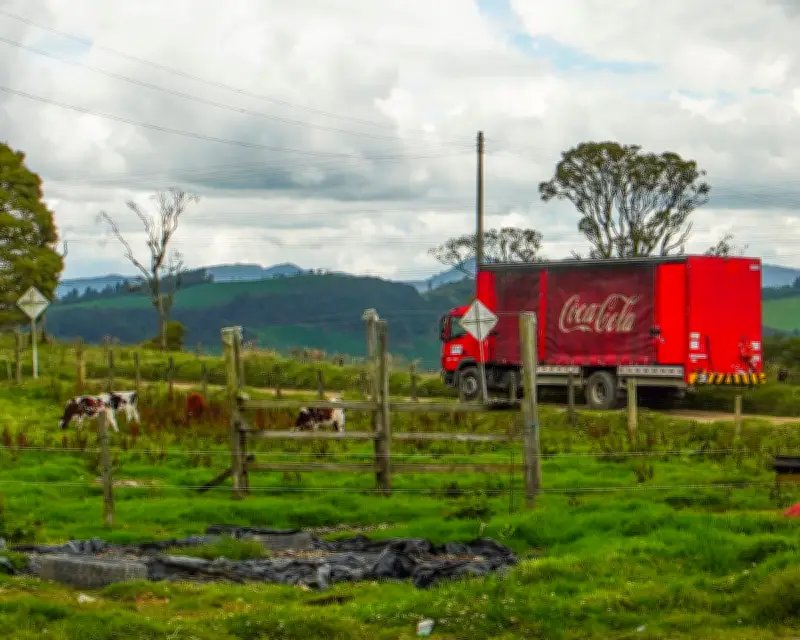
Coca-Cola Femsa was allowed to continue pumping water for its bottling plant during a severe drought while residents of La Calera faced shortages and rationing. Photograph: Alfie Pannell/The Guardian
‘This is what I was born for’: the drought-ridden Colombian town that took on Coca-Cola Femsa – and won
While La Calera faced severe water rationing, local springs were being drained by the drinks giant’s franchise. So the residents fought back
When a severe drought struck La Calera near Bogotá, many of its residents lost their water for drinking, cooking and farming and faced up to 15 days of strict water rationing each month. Yet the area is home to Chingaza reservoir, which supplies about 70% of the drinking water for Colombia’s capital.
As the drought stretched from April 2024 to April last year, people began to look more closely at how their water was being managed.
“With rationing, people started to reflect a bit about where the water was coming from: ‘Why is there no water in my house, if we always had it on tap?’” says Javier Cifuentes, a local councillor and campaigner for water rights in La Calera.
Attention soon turned to Indega, a subsidiary of Coca-Cola Femsa – the world’s largest Coca-Cola bottler – which was still filling thousands of water bottles a day to sell under the popular Agua Manantial spring water brand, which is sold across Colombia.
News that the plant was continuing to extract water during the drought sparked uproar in La Calera. “They asked us – the people – to ration water but not the companies,” says Alexander Hernández, a local resident.
After a bruising campaign, in which he and his fellow activists faced intimidation and abuse, including death threats, Cifuentes says, they secured a rare victory for the environmental cause in Latin America: in April this year, the local authorities slashed Indega’s water concession to the lowest level since it began in the 1980s.
La Calera’s battle began more than a year and a half ago. The town is one of 11 municipalities in the Chingaza national park. Despite being a historically water-abundant area, the Chingaza reservoir system was depleted from 2023 to 2024 by a particularly extreme El Niño weather pattern, leaving it only 15% full – the lowest level ever recorded. That year was one of the five strongest El Niño events on record, and research suggests global heating has intensified such patterns.
In investigating Indega, the community discovered that the company not only had privileged access to water, but also paid just 120 pesos for a cubic metre to pump and sell water, while households in La Calera are charged between 697 and 3,720 pesos (15p-78p), depending on their income.
“This is a multinational company that has been extracting resources for 40 years practically without paying for them,” says Hernández.
Outrage over Indega’s water usage turned to action, as members of the community united to oppose the company’s request to renew its concession ahead of a December 2024 expiry date. In October 2024, with the help of Cajar, a legal non-profit organisation, local leaders became parties to the concession’s renewal process.
Among them was Herminia Cristancho, who heads the female-led Association of Hamlets in La Calera. Over the past 40 years, she says she has witnessed dozens of corporations extracting precious water from Chingaza.
“They stay until they wipe out everything, then they leave and find a new victim in another country,” she says. “They don’t care about the state in which they leave us.”
Under Colombian law, she was able to access hundreds of documents related to the Coca-Cola Femsa subsidiary’s water use and petition the regional autonomous corporation (CAR) – the local government body that manages water concessions – to hold a public meeting.
Cristancho and other leaders spent many hours poring over the complex papers and with Cajar’s help drafted a letter of opposition to the renewal, arguing that Indega’s use of seven springs depleted the San Lorenzo basin, whose levels had dropped significantly during the drought.
In response, Indega commissioned a study that concluded the springs it used were replenished by rainwater and existed independently of the San Lorenzo basin. The report was dismissed by CAR authorities and campaigners as technically flawed.
Community leaders spearheaded social media and political pressure campaigns to bring the problem in La Calera to a national audience. Cifuentes, who is also a leader of the local Muisca Indigenous people, says: “The Muisca people have always protected the water in this territory, and it is thanks to the Muisca people that there is still water left.”
Not everyone in La Calera opposes the concession, however. Some people living in rural areas around the Indega plant say it brings employment and investment in local infrastructure.
Cristancho and Cifuentes argue that the Coca-Cola Femsa subsidiary embarked on a charm offensive shortly after locals challenged the concession, with efforts such as painting the local school, installing water filters and pledging to re-pave the roads.
Discord over the concession has sparked a bitter feud in the town, with Cifuentes and Cristancho facing personal attacks for their activism, including death threats.
Cifuentes says that on 27 March last year, a hooded man dressed all in black came up to him with a pistol in his hand. “He told me, ‘You don’t know who you’re messing with,’” Cifuentes recalls. “‘Keep fucking around and we’ll come for you and your family,’” Cifuentes recalls. “‘We know where you live.’”
The activist has no evidence that the threats were sanctioned by or related to Coca-Cola Femsa or its subsidiaries, which did not respond to a request for comment. Yet violence targeting environmental activists is a real concern in Colombia, which recorded the world’s highest number of murdered land defenders between 2012 and 2024.
After reporting the threat to the police, Cifuentes was issued a government protection unit, but that did not deter his enemies. On two occasions last November, his vehicle was followed by masked men on motorbikes, forcing his bodyguards to perform evasive manoeuvres to escape.
Posts on social media have also accused the water defenders of corruption and false activism, while pamphlets distributed at a town hall meeting in May 2025 called Cifuentes a “fake Indigenous drug addict”.
Cristancho has also faced intimidation, including silent phone calls and abusive text messages. She says she felt a “brutal fear” at the meeting as members of the crowd yelled obscenities at her and attempted to drown out her speech with vuvuzelas, a deafeningly loud plastic horn.
The land defenders fought on, keeping their pressure campaign alive through mural paintings, marches and public workshops.
Finally, in April this year, the CAR decided to renew the concession but slash Indega’s water extraction rate from 3.23 to 1.9 litres a second. It also reduced the number of springs the company could exploit from seven to four, halved the concession length from 10 to five years and can now temporarily suspend the concession in case of severe drought.
The decision was a milestone for Colombia, where victories for land defenders are few and far between. “For the first time, we succeeded in getting the country to open a debate on water use,” says Cristancho, hailing the widespread media attention brought to the issue and unprecedented community participation.
Yet Cristancho notes that concerns remain, specifically about how authorities will monitor Indega’s water use. For Cifuentes, who continues to live under state protection, the case is simply the “first step” in an existential battle to protect water resources.
“We will keep fighting until not a single millilitre of water in the Chingaza is exploited by a multinational corporation,” Cifuentes says. “This is what I was born for.”