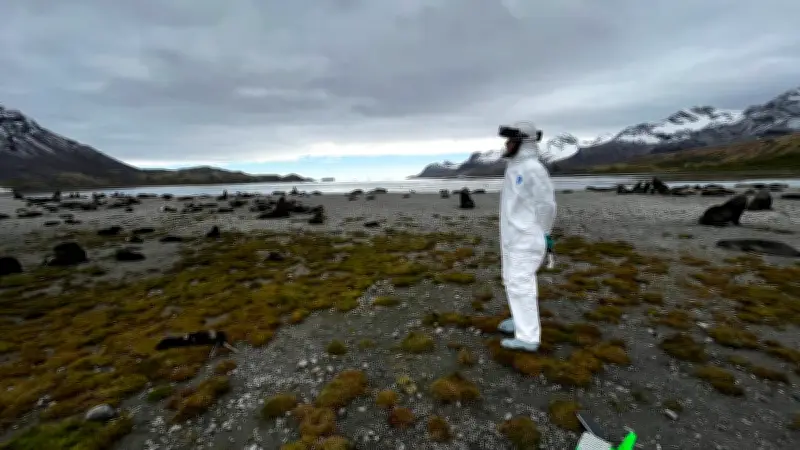
Scientists have confirmed that the H5N1 bird flu virus has reached Australia, marking its arrival on every continent. The deadly strain, which has killed millions of birds and mammals globally, was detected in three petrels and a skua found dead or sick on southern Australian beaches in early April 2025. Two more suspect cases are under investigation.
Global spread and Antarctic impact
The H5N1 variant emerged in Europe in 2020 and has since devastated wildlife worldwide. In the United States, more than 200 million poultry birds have been culled. In South America, tens of thousands of seals have died. The virus reached the subantarctic in late 2023, and by early 2024, it was found in South Georgia's seal population.
Dr. Jane Younger, an ecologist at the Institute for Marine and Antarctic Studies at the University of Tasmania, led an expedition to South Georgia six months ago. She described overwhelming scenes: hundreds of giant petrels feasting on dead fur and elephant seals. "We saw an adult female fur seal. It had freshly died and the pup was still trying to suckle. The male was still trying to defend her," Younger said. "It was this little family unit … that was upsetting."
On Heard Island, 6,500 km east, scientists from Australia's Antarctic program discovered 13,000 dead elephant seal pups alongside hundreds of other dead seals and birds, including penguins. Disease tests were positive.
Risk to Australia's unique species
Australia's wildlife is especially vulnerable. About 50% of its bird species and 87% of its land-based mammals are endemic, meaning they exist nowhere else. Dr. Fiona Fraser, Australia's threatened species commissioner, said, "These endemic species are highly valued by Australians and have enormous cultural value to our First Nations people. Any loss of these species is a tragedy for the world."
Prof. John Woinarski, an ecologist at Charles Darwin University, has analyzed the risk. More than 150 bird species are considered at "very high risk" of extinction or major population declines if infected. Over 10 mammals, including the Australian sea lion, Tasmanian devil, platypus, and rakali, are also high-risk. "It is turbocharging the pathway to extinction," Woinarski said.
Potential for rapid spread
Prof. Brendan Wintle, a conservation biologist at the University of Melbourne's Biodiversity Council, warned that the virus could spread across most of Australia within six to 12 months and recur for three to five years. He urged the government to create captive populations of threatened species as insurance. "We need insurance policies," Wintle said. "There has been such low funding for risk assessments and management of conservation that we are quite poorly prepared."
Waterbirds are especially at risk. Prof. Richard Kingsford, an ecologist at the University of New South Wales, has monitored waterbirds for 40 years, noting a 70% decline since the 1980s. He said good rains have drawn birds to the country's interior, but an expected El Niño pattern will dry out inland areas, pushing birds to the coasts where they may encounter infected migrants. "I worry about our waterbirds because they have been declining for years. There could be a massive whammy coming their way," Kingsford said.
Human risk remains low
Since 1997, H5N1 has caused about 500 deaths in 25 countries, mostly among poultry workers. For context, about 1,700 people died from influenza in Australia last year. The risk to the general public is considered low.