Australia's Unlikely Rise as the World's Corpse Flower Capital
In a remarkable botanical achievement, Australia has established itself as the global epicenter for corpse flower cultivation, boasting collections that now surpass 250 plants across multiple generations. This unprecedented concentration of Amorphophallus titanum specimens represents what experts believe to be the largest assemblage of these endangered plants anywhere on Earth.
The Stinky Spectacle Captivating the Nation
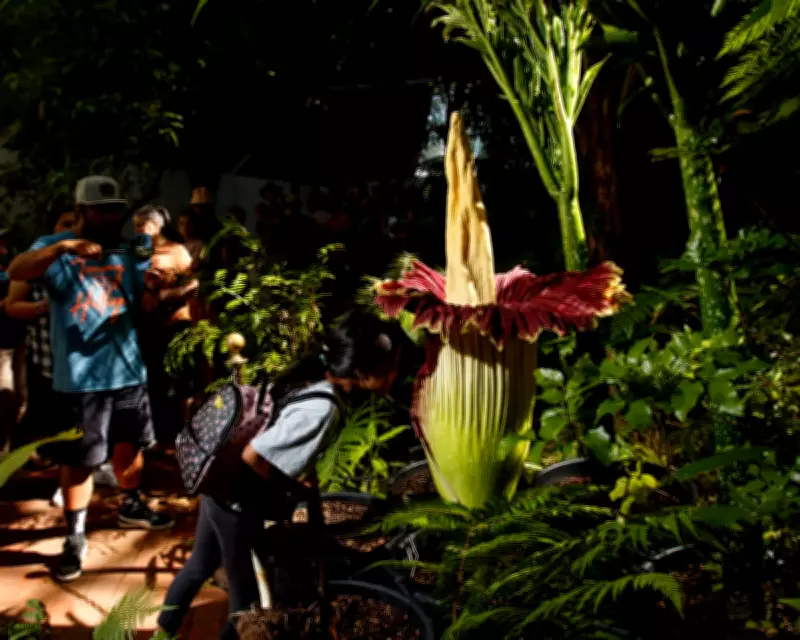
What was once an extraordinarily rare event has transformed into a recurring national phenomenon. Throughout 2025, more than a dozen corpse flowers bloomed across Australia, captivating audiences with their enormous size and notoriously foul aromas. From Sydney's infamous Putricia to Canberra's Morpheus, Cooktown's Big Betty, and Cairns' Spud, these botanical celebrities have drawn thousands of curious spectators eager to experience their unique sensory spectacle.
"Australia now experiences one of the highest frequencies of corpse flower blooming events worldwide," explained Matt Coulter, senior horticulture curator at the Botanic Gardens of South Australia. "Our country ranks among the top three locations globally for these occurrences, as our plants have reached maturity and entered their most productive flowering periods."
Adelaide's Unlikely Success Story
Perhaps most surprisingly, Adelaide has emerged as the undisputed propagation capital for these equatorial rainforest natives. Despite the South Australian city's characteristically hot, dry summers—conditions seemingly incompatible with plants native to Sumatra's humid jungles—the region has achieved extraordinary cultivation success.
The state's collection originated from seeds acquired in 2006, with specimens like Smellanie demonstrating remarkable vitality through multiple flowering cycles. Coulter's propagation efforts, utilizing both leaf cuttings and pollination techniques, have expanded the collection exponentially. Smellanie's most recent bloom reached an impressive 2.13 meters in height, releasing an aroma variously described as reminiscent of fermenting cabbage, potent blue cheese, or well-worn athletic socks.
The Science Behind the Stench
Corpse flowers represent one of horticulture's most challenging and unpredictable subjects. These plants typically require 10-12 years to accumulate sufficient energy for their initial bloom, with subsequent flowers appearing at three-to-five-year intervals—though timing remains notoriously inconsistent.
The plants' underground tubers, known as corms, can reach weights up to 75 kilograms as they store the enormous energy reserves needed for flowering. Even when a bud emerges, gardeners cannot determine whether it will develop into a leaf or flower until it reaches 10-15 centimeters in length. Sometimes, insufficient tuber strength prevents the flower from opening entirely.
"These are exceptionally demanding plants," Coulter noted. "Their requirements fluctuate dramatically throughout the year—periods demanding abundant water and nutrients alternate with phases requiring complete dormancy."
Public Fascination Reaches Fever Pitch
The Australian public's enthusiasm for these malodorous marvels has reached unprecedented levels. In Sydney alone, nearly 27,000 visitors queued to experience Putricia's distinctive fragrance, which one observer compared to "the rich stench of a public bin on a 40-degree day." John Siemon, horticulture director at the Botanic Gardens of Sydney, described the atmosphere as "akin to having the Olympics back in town."
Siemon attributes much of this popularity to the practice of assigning personalities and names to individual plants. "Although botanically inaccurate to assign gender—since these plants possess both male and female organs—creating personas like Putricia, Baby Stink, and Stinkerella helps overcome what we call 'plant blindness' and fosters public engagement," he explained.
Conservation and Future Prospects
Australia's success extends beyond imported species to include native corpse flower varieties like the elephant yam and cheeky yam from northern regions. Carol Davis, acting nursery general manager at the Australian National Botanic Gardens in Canberra, noted that while these native species produce smaller flowers, they share the same basic structure and pollination strategy.
"The distinctive rotting aroma represents a highly evolved strategy to attract pollinators like beetles and flies that typically seek decaying organic matter," Davis explained.
With mature collections now established nationwide, experts anticipate increasing flowering frequency in coming years. Sydney's Putricia has three genetically identical siblings from leaf cuttings, with three already having bloomed. "There's every possibility the fourth clone might flower within the next twelve months," Siemon revealed.
As Australia solidifies its position as a global hub for corpse flower conservation and display, the question of where and when the next bloom will occur remains part science, part horticultural intuition, and part fortunate timing. What began as a botanical curiosity has blossomed into a national phenomenon, proving that sometimes the most captivating attractions are those that appeal to our noses rather than our eyes.