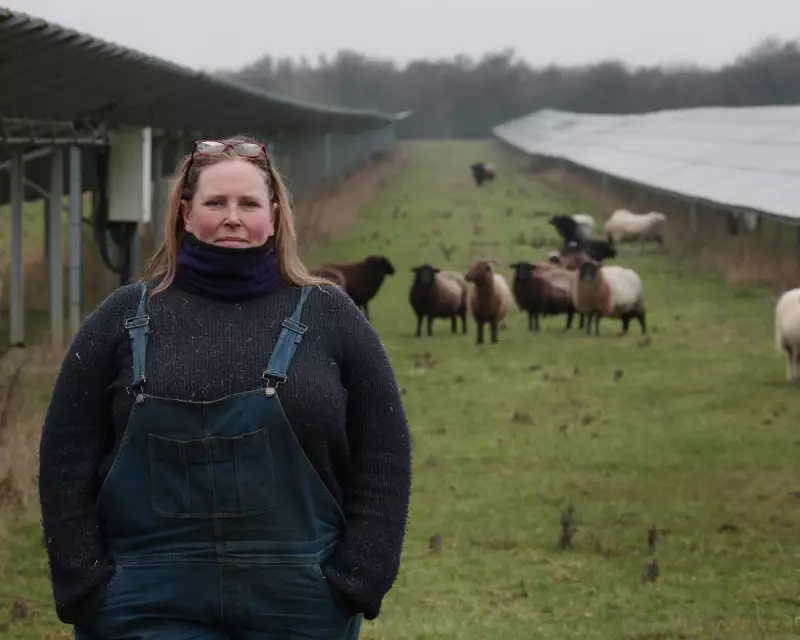
On a windswept field in Lincolnshire, farmer Hannah Thorogood surveys her flock as they graze contentedly beneath rows of gleaming solar panels. This innovative practice, known as solar grazing, is transforming her prospects in an industry where access to affordable land is a formidable barrier.
A Critical Lifeline for Modern Farmers
Hannah Thorogood, a first-generation farmer, started with just 18 acres and 20 sheep. Today, thanks to the free grazing opportunities provided by solar farm operators, she manages 250 acres and a flock of over 200 sheep. "Solar grazing has given me a massive leg-up," she states, highlighting a trend gaining momentum across the United Kingdom.
Dr Liz Genever, another farmer based in south-east Lincolnshire, reports a similar experience, having tripled her sheep numbers. She calculates that fully utilising the local solar site's potential could increase her income from sheep from £20,000 to £60,000 annually. "There's been a massive acceleration in the last five years," Genever notes. "It's a really important opportunity for sheep farmers."
The Mechanics of a 'Triple-Win'?
Solar grazing is the practice of using sheep to manage vegetation on solar farms. The panels require maintained grassland underneath, which traditionally involves costly mowing or herbicide spraying, with bills reaching up to £50,000 per year per site. Sheep provide a natural, low-carbon alternative.
They slip between panel legs, nibble grass in hard-to-reach spots, and work in all weathers, eliminating the need for diesel-powered machinery. The arrangement is touted as a triple-win: farmers gain access to land, solar companies cut maintenance costs, and society benefits from increased renewable energy and continued agricultural use of the land.
Emilien Simonot of Lightsource BP, which runs one of the UK's largest sheep-grazing programmes, champions this view. Professor Alona Armstrong from Lancaster University's Energy and Environmental Science department agrees, stating, "This sort of multiple land use is vital." Early research even suggests sheep grazing in the partial shade of panels may produce higher-quality wool.
Scepticism and Caveats
However, the narrative is not universally accepted. Fraser Key, a fourth-generation farmer who hosts a solar farm, is both an advocate and a sceptic. While he acknowledges solar grazing is "a very good thing" and has even built a business charging shepherds to use his land, he warns of broader risks. "The drive to cover agricultural land with panels is dangerous. We can't decimate the agricultural community in the process," he cautions.
Nicola Noble of the National Sheep Association recognises the "valuable opportunity" for new and smaller farmers but warns it can sometimes become a public relations exercise for energy companies seeking planning permission, with promised grazing deals never materialising.
Environmental consultant Guy Parker adds that while grazing can benefit wildlife, maximising stocking densities for agricultural output can "minimise the biodiversity value" of a solar farm site.
Shelter, Security, and a Future
Back in Lincolnshire, for Hannah Thorogood, the practical benefits are clear and immediate. "The sheep improve soil quality, increase pasture diversity and mean the land doesn't need spraying," she explains. The site offers unexpected advantages: "The land is secure, because there are cameras everywhere... The panels give the sheep shelter in snow and extreme heat."
Solar grazing will not single-handedly solve the deep-seated issues in British farming, from high land prices to supermarket pricing pressures. But for an increasing number of farmers, it provides something invaluable: a viable foothold in a challenging industry, turning the spaces beneath the UK's renewable energy infrastructure into pastures of new opportunity.