
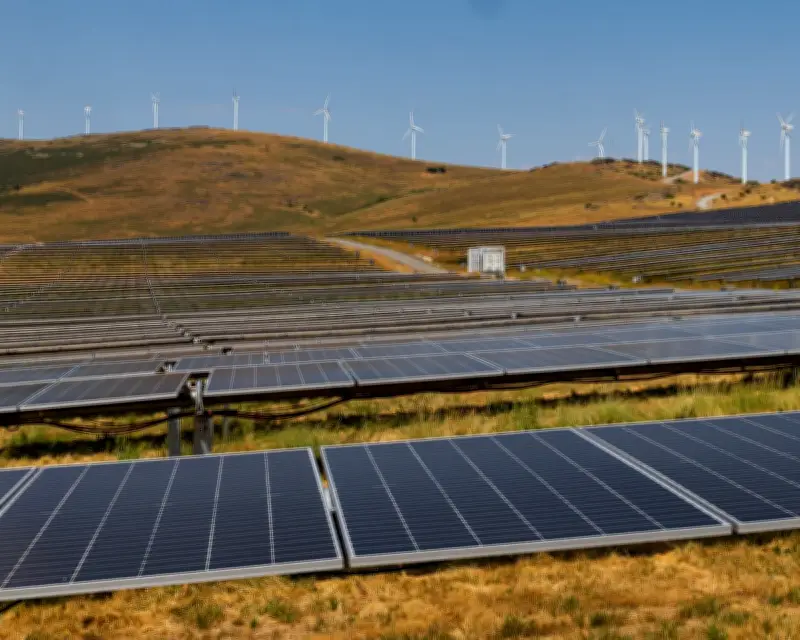
A solar farm and wind turbines in Ávila, Spain, illustrate the country's renewable energy growth. Wind and solar generated 33% of Spain's electricity in 2021, rising to 42% by 2025.
Spanish Households Save €10 a Month Thanks to Renewables Expansion, Report Finds
A thinktank report reveals that Spanish households save €10 a month on electricity bills due to wind turbines and solar panels installed in the last five years. Ember, a climate thinktank, found that typical energy bills would be 19% higher if electricity costs remained as tightly coupled to gas prices as in 2021.
Spain's strategic expansion of renewables since Russia's invasion of Ukraine in 2022 has shielded households from recent fossil fuel price rises caused by the Iran war. Chris Rosslowe, an analyst at Ember and lead author of the report, noted that a 60% rise in gas prices barely affected Spanish electricity bills, which even decreased slightly in April. This contrasts sharply with the previous gas crisis when bills climbed immediately.
Burning fossil gas is among the most expensive electricity generation methods in Europe, excluding health costs from carbon emissions. Gas influence on Spanish electricity prices fell from 52% of hours in 2021 to 9% in the first five months of 2026. In Italy, with Europe's highest wholesale electricity prices, gas influences prices 75% of the time.
The report found that Spanish electricity prices rose about 50% in early 2021, aligning with European gas prices, but remained largely unaffected by higher gas prices in 2026. Volatility in wholesale gas markets only caused higher price peaks during periods of high gas consumption.
Mar Reguant, an energy economist at Northwestern University, not involved in the report, confirmed similar findings from her research. She praised Spain's ambitious policy for leveraging favorable conditions, including strong wind, unbeatable solar, and pre-existing pumped hydropower storage. She stated that Spain and Portugal greatly benefit from their early transition, having acted smartly in a privileged position.
Wind and solar generated 33% of Spain's electricity in 2021, rising to 42% by 2025. In other European countries like Germany, which increased wind and solar share from 28% to 45% in five years, consumer benefits were more muted as they displaced coal and nuclear.
The analysis used data from March and April 2026, modeling a regulated tariff for about one-third of Spanish households. It accounted for balancing costs during periods of excess or insufficient renewable generation but excluded hidden societal costs like health impacts from fossil fuel pollution.
Dr. Diego García Gusano, a senior energy planning researcher at Tecnalia, not involved in the analysis, noted that gas-fired plants still set prices during key hours, and frequent low-price periods weaken investment signals for further renewables. He emphasized that slow storage deployment and limited demand flexibility intensify this situation, preventing efficient absorption of excess renewable generation. He concluded that while Spain is less exposed to gas shocks than other countries, it is not immune, and more is needed to make the renewable bet structural rather than circumstantial.



