Oxford Scientist's $100m Super-Simulator Aims to Revolutionize Global Economic Planning
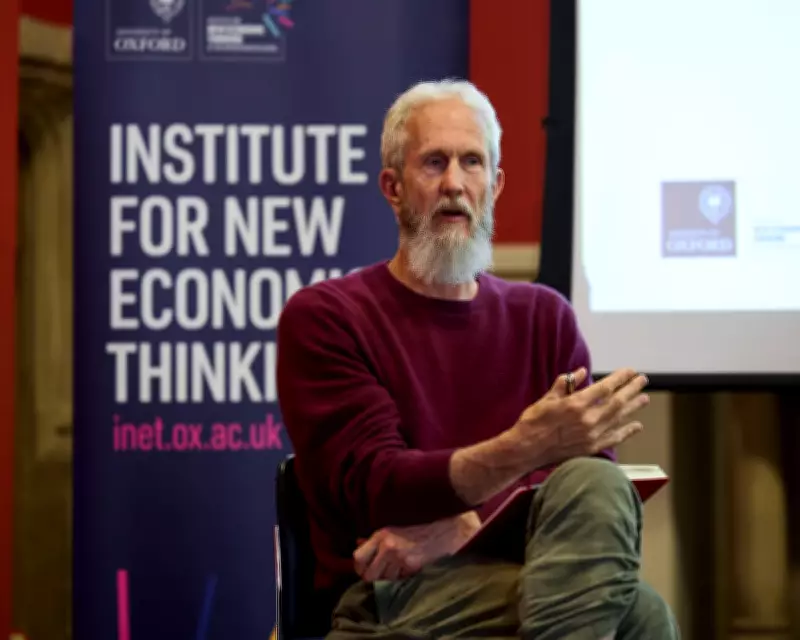
Professor Doyne Farmer, a renowned complexity scientist at Oxford University, has unveiled an ambitious plan to transform economic forecasting with a super-simulator of the global economy. This innovative model, which could be built for what he calls the bargain price of $100 million, aims to address critical failures in traditional economics, particularly in tackling the climate crisis and preventing financial disasters.
Farmer envisions a system where every company is individually represented, making realistic decisions that adapt to economic changes. From this intricate complexity, forecasts of unprecedented clarity would emerge, offering transformative insights. He states, "We want to do for economic planning what Google Maps did for traffic planning, so we can give anybody who has an economic question an intelligent and useful answer."
From Roulette to Wall Street: A Polymath's Journey
Farmer's proposal might sound far-fetched, but his track record suggests otherwise. In the 1970s, he and friends beat casinos at roulette using the first wearable digital computer. In the 1990s, he outsmarted Wall Street with an automated rapid-trading company later sold to UBS. Now, at 73, his 50-year career spanning cosmology, chaos theory, and theoretical biology has led him to this pivotal challenge.

He argues that traditional economic models are either too simplistic for useful forecasts or too complex for current computers. Complexity economics offers a viable path, leveraging advances in computing power and data analysis. For instance, the 2008 global financial crash cost about $10 trillion. Farmer believes that with his model, central banks could have foreseen the disaster and acted sooner, potentially saving trillions.
Tackling the Climate Crisis with Data-Driven Insights
Farmer has set his sights on the climate crisis, citing it as the biggest problem facing the world today. He criticizes existing economic models for their poor track record in predicting renewable energy trends, noting they consistently underestimated rollout speed and cost reductions. In reality, costs have plunged, and adoption has been rapid.
To address this, his team is developing a complexity model focused on the energy sector. This model includes all 30,000 energy companies and their 160,000 assets, such as oil rigs and power stations, based on a 25-year dataset. "We're literally modelling the decision-making of all the energy companies in the world," he explains, with each company represented by a separate digital agent. This approach aims to simulate the global energy system to optimize the transition to green energy.
Overcoming Fundamental Flaws in Mainstream Economics
The new complexity models address two core issues with mainstream economic approaches. First, traditional models assume perfect, rational decision-making by economic actors, which becomes computationally impossible with millions of agents. Complexity models simplify this by using rules like imitation or trial and error, reflecting real-world behavior more accurately and reducing computing needs.
Second, mainstream models assume equilibrium, requiring external shocks to explain crashes. In contrast, complexity models naturally generate economic cycles, such as booms and busts, through internal dynamics as agents learn and adapt. Farmer attributes the persistence of ineffective models to academic stagnation since the 1960s, limited computing power historically, and a mathematical rather than practical focus in economics.
A Race Against Time for Global Impact
With a sense of urgency, Farmer aims to develop the full complexity model of the global economy within 10 years, ideally sooner. He believes it will empower politicians and business leaders to make informed decisions, accelerating the transition to a green economy and avoiding pitfalls. "It's a very exciting endeavour – stay tuned," he says, while humorously noting, "if somebody wants to give us millions of dollars to help build these models, we've got our hat out."
This groundbreaking initiative promises to revolutionize how we understand and manage the global economy, offering hope for more effective climate policies and financial stability in an increasingly complex world.