
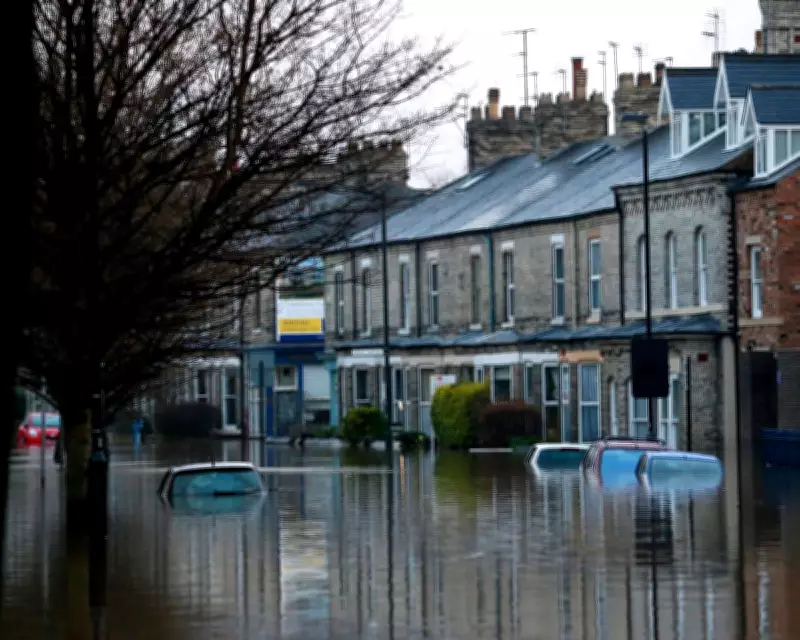
A new analysis by the National Housing Federation (NHF) reveals that eight in ten homes at high risk of flooding in England are now located in urban areas. The research identifies 839,000 homes in towns and cities as being at high risk of surface water flooding, a threefold increase since 2018. Social housing tenants are disproportionately vulnerable to the financial impact of flooding, according to the NHF.
Most Affected Areas
Constituencies in Thurrock, Basildon, Bootle, Sefton, and Southport have the highest proportion of at-risk homes. Areas of London, including Hackney, Barking, and Tottenham, also feature in the top ten and have the highest proportion of social housing tenants.
Risk Definition and Causes
According to the Environment Agency (EA), a home is considered at high risk if it has at least a one in 30 chance of being flooded each year. Extreme rainfall, ageing infrastructure, and rapid urbanisation are fuelling the problem. Surface-water flooding occurs when rainwater cannot be dispersed through normal drainage systems or soak into the ground, leading to increased flooding in urban areas. The EA forecasts that the number of properties at risk is likely to treble over the next 50 years.
Impact on Social Housing Tenants
The NHF emphasizes that social housing residents are more exposed, less protected, and least able to absorb the financial shock when floods hit. In the ten worst affected urban constituencies, an average of one in four households lives in social housing. Social tenants are less likely to have contents insurance due to costs, leaving them more vulnerable to financial losses. About one in three of the poorest households in England have contents insurance compared with nine in ten homeowners.
Alistair Smyth, director of policy and research at the NHF, stated: "With surface-water flooding a fast-growing threat in towns and cities, this poses a direct risk to people and families living in social housing. Our climate is changing faster than our infrastructure can handle, and social housing residents are more exposed, less protected and least able to absorb the financial shock when floods hit. While housing associations operating in higher risk areas are investing significant time and resource into protecting residents, this is a national risk that needs a national response."
Personal Stories
Ann Hoyles, 64, a social housing tenant, described how her bungalow in Warrington was ruined by a flood on New Year's Day last year. She has health issues, including arthritis, and had spent her life savings renovating the property and garden, considering it her "forever home." She said: "I had heard of flooding in that area before but I was told the problem had been sorted. And with social housing you don't get many options of what you can refuse, so I took it. I lost everything. The water was contaminated so it ruined everything. I'm on crutches so I couldn't walk out and had to be rescued in a boat. It was a nightmare, I couldn't sleep as I had no idea where I was going to live." Although she could afford contents insurance, she opted for the cheapest cover, which led to issues when claiming.
Paul Warburton, director of housing services at Torus housing association, which owns her home, said the association spent £500,000 dealing with the cost of that flood, only a few years after a previous flood in the same area. "Half a million pounds – that's a lot of new bathrooms we could have installed, new homes we could've built. And social housing is a precious commodity, there's such massive demand." He added that flooding is becoming one of the biggest financial challenges the organisation faces, with properties costing more to insure and additional costs for hotels, subsistence, and moving furniture. The last flood took 52 homes out of action for 12 months. "We've had flood warnings on a number of sites, so every time it rains we dread it. If this keeps happening we're probably going to end up with about 100 properties that no one wants to live in, and then what do we do with them?"
Calls for Action
Tracey Garrett, chief executive of the National Flood Forum charity, called for a "step change" in how water is managed in urban areas where drainage systems have become overwhelmed by climate change. "Every week we hear from people whose homes have been inundated with filthy water, often containing sewage, and many have been flooded multiple times," she said. She expressed concern that those living in rented or social housing, and on lower incomes, are being hit hardest. "These households are often located in higher-risk areas but have the least ability to adapt or protect their homes. Many are experiencing repeated flooding, with little clarity on who is responsible for fixing the problem or how long-term solutions will be delivered. Often people are afraid to speak out or report flooding due to feeling that doing so may affect their tenancy."
The NHF urges a national response to address the growing threat of surface-water flooding in urban areas, highlighting the need for investment in infrastructure and support for vulnerable residents.



