
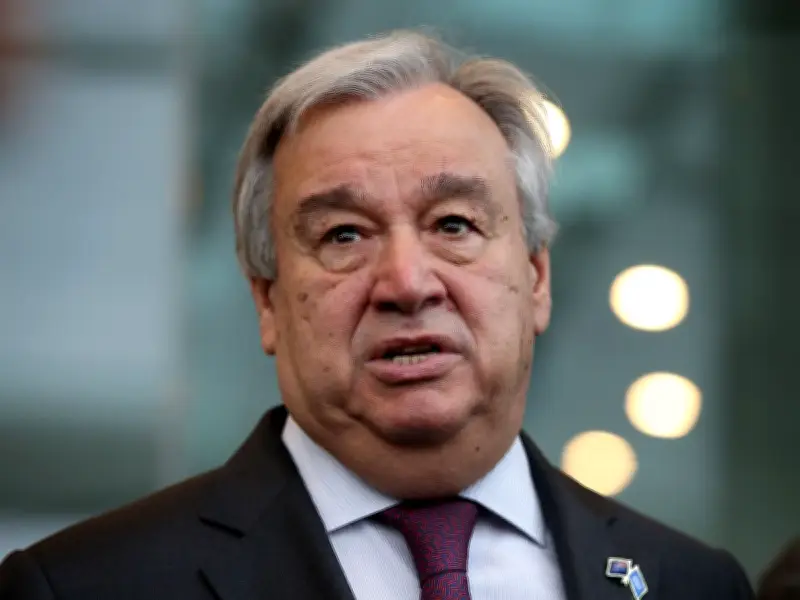
United Nations Secretary General Antonio Guterres declared that London is 'cooking' as the city endures a severe heatwave, issuing a stark warning that countries cannot continue to rely on fossil fuels amid the escalating climate crisis. Speaking at London Climate Action Week on Tuesday, Guterres referenced Charles Dickens' novel 'A Tale of Two Cities' to describe the dual crises of climate change and energy insecurity.
Guterres highlights 'tale of two crises'
In his address, Guterres stated: 'Crisis brings clarity and here in London – the city of Dickens – it is clear that our world is facing a 'tale of two crises'. A climate crisis is pushing us deeper towards higher temperatures and closer to catastrophic tipping points and an energy crisis exposing the folly of a world hooked on hydrocarbons.' He emphasized that both crises share the same destructive origin: fossil fuels.
The heatwave gripping the UK has broken records, with temperatures expected to surpass the June record set in 1976 by several degrees. The extreme heat has raised concerns about its impact on health, schools, workplaces, and transport. Guterres warned that climate chaos is 'accelerating before our eyes' and that the arrival of the El Nino weather phenomenon this summer risks 'blowing the house down' as it compounds the effects of climate change.
Call for clean energy transition
Guterres argued that the twin crises 'demand the same answer' – a fast, fair transition to clean energy, along with increased adaptation, resilience, and climate justice for those already suffering from climate impacts. He outlined seven steps for countries to break free from fossil fuels, including immediate action to cut methane emissions. He launched a global 'call to action on methane,' noting that aggressive cuts could produce visible temperature relief within a generation, as methane is 80 times more powerful than carbon dioxide but breaks down faster in the atmosphere.
He also announced an AI environmental transparency initiative, urging technology companies to disclose their carbon, water, and land footprints and commit to powering data centres with renewable energy by 2030. 'I am calling on every major AI company to measure and publicly disclose the full environmental impact of its systems – carbon, water, and land footprints – and to commit to powering every data centre with renewable energy by 2030,' Guterres said.
Warning on Paris Agreement targets
Guterres noted that scientists now say average annual temperatures will exceed the 1.5°C threshold set by the 2015 Paris Agreement. 'The task before us is to strictly limit the overshoot, shorten its duration, and bring temperatures down below 1.5°C as fast as possible,' he said. 'Every fraction of a degree matters. Every moment counts. Because the higher and longer the overshoot, the greater the risk of crossing planetary tipping points that trigger irreversible change.'
He pointed to a briefing by the UN Scientific Advisory Board outlining the impacts of passing critical limits, including coral reef collapse and loss of ice sheets that lock in sea-level rise.
Energy crisis and fossil fuel dependency
Guterres said the Middle East conflict has 'unleashed the mother of all energy shocks,' creating debt, food, and development crises for poorer countries. 'These twin crises have once again exposed the limits of an outdated model of development – a model powered by fossil fuels, where a single conflict can upend global energy supply, and a single chokepoint can send prices soaring,' he said. 'The lesson is clear – this model has no future.'
He called on governments to tax oil and gas companies' windfall profits, remove harmful subsidies, deliver climate finance to poorer nations, and protect scientific independence. During a question session, Guterres said the US government 'does not control the world' regarding climate action, adding that the private sector has a fundamental role to play. 'For economic reasons and for security reasons, I think it is inevitable the transition to renewables. Obviously some political leaders can delay a little bit that revolution but they will be unable to stop it,' he concluded.



