
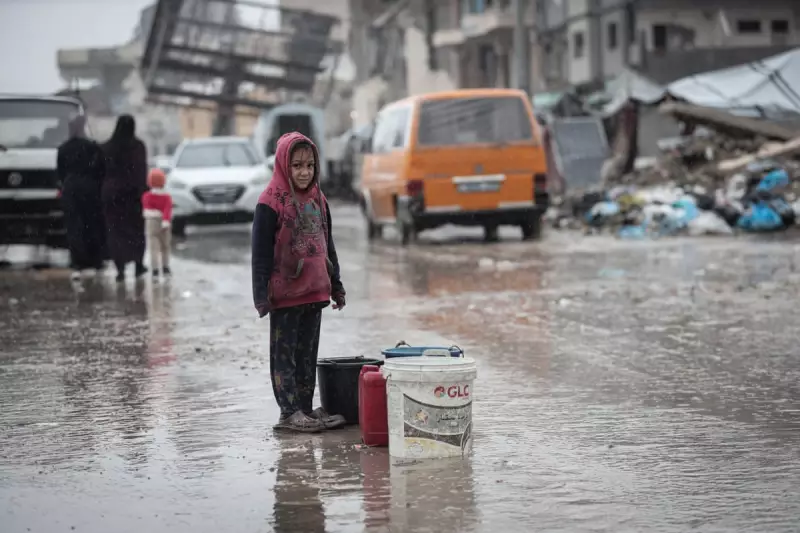
In Gaza, the onset of the season known as Al-Arba'iniya – the 40 coldest and most severe days of winter – has laid bare a desperate humanitarian catastrophe, where the elements now pose as grave a threat as conflict.
A Walk Home in a City of Tents
On a stormy Thursday evening in Gaza City, the journey home became a stark lesson in the new reality. What began as a light drizzle swiftly transformed into a relentless downpour, forcing a stop for shelter beside a makeshift tent. There, a young boy sat trying to sell homemade cookies, their plastic wrapping already sodden. The scene was a silent testament to the pervasive cold that seeps into every aspect of life.
Walking along al-Wehda Street, the only sounds were the hammering rain and the whistle of the wind. Rows of tents stood silent. Using a mobile phone torch to navigate, thoughts turned to the families inside: children curled under wet blankets, parents struggling to provide warmth. The guilt of reaching a personal apartment with a solid roof was immediate and haunting, a stark contrast to the exposure faced by hundreds of thousands.
The Storm's Fury and a Preventable Toll
The night brought the storm's full fury. The violent flapping of plastic sheeting and the crash of loose corrugated metal were punctuated by the panicked screams of children. For over two weeks, cold, wind-driven rain has soaked tents, flooded camps, and turned earth to mud. Where this might elsewhere be 'bad weather', in Gaza it is a life-threatening condition of exposure.
The danger is concrete. On the Sunday before Christmas, Gaza's civil defence recovered the bodies of two children from a collapsed, war-damaged building in the north, rescuing five others. Such collapses are not new attacks but the result of structural weakness finally undone by winter rains. Earlier in December, eight-month-old Rahaf Abu Jazar died from exposure to the cold in Khan Younis.
Visiting a camp near home revealed the fragile state of existence: plastic sheets sagging under water, sodden mattresses, and perpetually damp clothing. Each detail underscored how close the cold and rain are to claiming the health and lives of a displaced population.
Education and Resilience Amidst Abandonment
For a university lecturer in Gaza, the crisis is deeply personal. Students attempt to attend online classes from tents or overcrowded shelters with poor connectivity, all while coping with profound loss and exhaustion. Routine academic processes become daily moral negotiations, contingent on a student's safety, warmth, and access to shelter.
Nights are spent worrying if they are dry or if the wind has torn through their shelter. Even for those in remaining apartments, there is no heating. Warmth depends on layers of clothing and shared blankets, many of which have already been given to those who lost everything.
Humanitarian agencies state that over a million people in Gaza are living in shelters. Aid, including winterised tents, blankets, and heating fuel, has been critically insufficient. Recent distributions of tarpaulins and bedding to thousands of families are seen as short-term fixes, unable to protect against prolonged exposure. The consequences are rising cases of hypothermia, respiratory illness, and infections.
A Political Failure in the Season of Refuge
This suffering is underscored by its preventability. Winter is not unforeseen. The people of Gaza view the lack of adequate shelter, the restrictions on timber, insulation materials, and prefabricated units not as misfortune but as political and humanitarian abandonment. Local initiatives to improvise solutions are severely limited by what is allowed to enter.
The timing coincides with Christmas, a season symbolising warmth and care for the vulnerable. In Palestine, this symbolism is tied to a narrative of displacement and seeking refuge. In Gaza today, that story is being lived in painful, literal terms.
If international concern holds any urgency, winter makes it impossible to look away. The need is not for statements or promises, but for immediate action: materials, access, and the delivery of proper shelter. The students, children, and families of Gaza deserve nothing less.



