
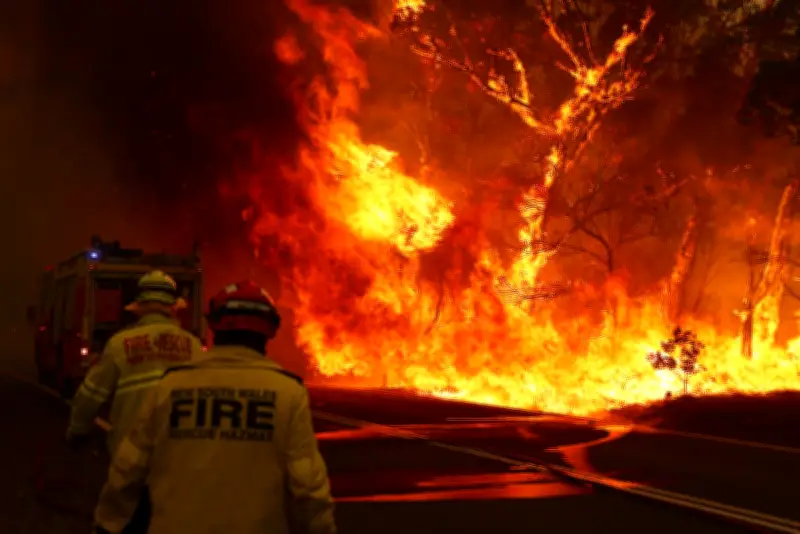
As the UK and Europe battle deadly wildfires, Australia's extensive experience with bushfires offers crucial lessons. Jan Harris, 67, who lost her home in a 2018 bushfire in Reedy Swamp, New South Wales, expressed heartbreak watching the scenes overseas: "It is so heartbreaking for people. They have such a hard road in front of them."
UK and Europe face unprecedented wildfires
This week, the UK recorded its worst outbreak of wildfires ever, with evacuations in north Wales. Fires have swept through Spain, Portugal, and France. Near Paris, about 900 homes were evacuated as a blaze of "exceptional" scale burned in a Unesco-listed forest, with arson suspected. In Spain's Andalucía fires, seven Britons were among 13 dead. Major fires are also burning in the US and Canada, coinciding with extreme heatwaves—a pattern becoming familiar as the climate crisis extends and worsens fire seasons globally.
Australia's preparation and survival plans
Bushfires have always been part of the Australian landscape, with Aboriginal Australians using fire for millennia. Rural residents live with the threat routinely: permanent road signs show daily fire risk, households have "bushfire survival plans," and public radio broadcasts alerts. Before fire seasons, reminders urge clearing gutters, pruning branches, and ensuring water supplies. Ben Shepherd, superintendent at Fire and Rescue New South Wales, says: "Australia has some of the most bushfire-prone land in the world. We have always pushed the view that this is about shared responsibilities. The public has to understand the risk and what they can do to alleviate it." Daily bushfire warnings range from "no rating" to "catastrophic," when fire services advise leaving the area, preferably the night before.
Harris's story: a wall of flames in two minutes
Harris recalls 18 March 2018, when the clock showed 12:34 pm, with "unbelievable winds" and 38°C heat. Her husband John insisted they leave as flames charged toward their house. Despite standard preparations—cleared gutters, working hoses, extra water tank—the fire's speed overwhelmed them. "It went from just a whiff of smoke to a wall in less than two minutes," she says. She grabbed only her diabetic son's insulin. They escaped via a four-wheel drive track to a pub. The house and 64 others were lost. Two years later, during the black summer fires that claimed 33 lives, over 3,000 homes, and burned an area almost twice the size of England, they evacuated twice. Almost 3 billion native animals were killed or displaced.
International cooperation and climate change
Australia's expertise has led to regular sharing of personnel and equipment with the US and Canada. One of Australia's large air tankers recently helped fight fires on the US west coast, followed by nearly 70 personnel. Shepherd notes: "Around the world we are seeing conditions we haven't seen before. The more we all learn from each other, the better it is for us all around the globe." Greg Mullins, a firefighter for almost 40 years and former commissioner of Fire and Rescue New South Wales, has warned European fire chiefs since 2004. "I was a bit of a lone voice at the time. But everything was drying out. This is what has been predicted for decades. Heatwaves are priming the landscape for fire." He highlights that fighting forest fires differs from urban fires: in towns, roads and water are accessible, but on moors and in forests, fires can go undetected for hours. Climate change has lengthened Australia's fire season and increased high-risk days. Dr Grant Williamson, wildfire expert at the University of Tasmania, says: "There is strong evidence that fire weather is increasing globally under human-driven climate change. Fires are and will continue to burn hotter, particularly in temperate and Mediterranean zones. 43% of the 200 most damaging wildfires occurred in the last decade."
Rebuilding and advice for others
The Harrises rebuilt with insurance money, this time with a bushfire-rated home: 50 metres of cleared area, extra water tank, no wood exterior, gutter guards, firefighting pump, and a wide passing area on their 500-metre drive. Still, Harris would leave again: "If we'd stayed another 10 minutes last time, we wouldn't be alive." Her advice: "We often don't spend enough time just sitting with what's happened. It's frightening and heartbreaking. Yes it was financially difficult but we could navigate that, but at huge emotional cost. If there's psychological help, take it. People say what you have lost are just things—that's true, but they were my things. When an authority asks you to evacuate, if we choose not to, are we then asking them to come and save us? That's a really big ask. As much as I am mournful for what we have lost, I am pretty happy to be here."



