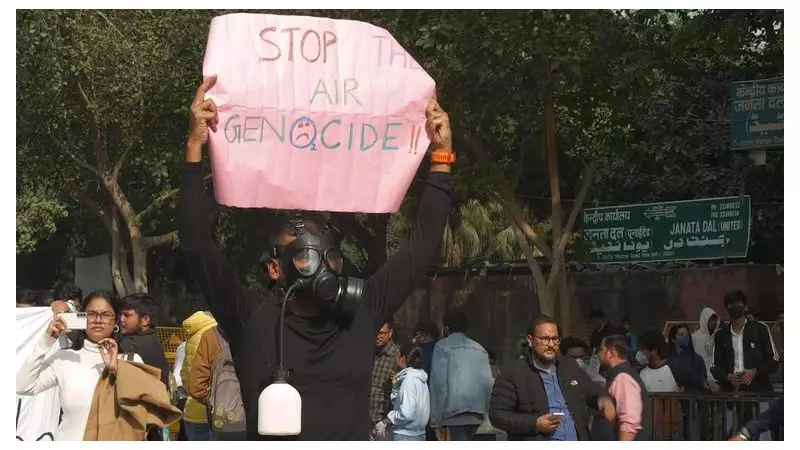
In the heart of India's capital, a public health catastrophe is unfolding silently yet relentlessly. The very air that millions breathe in Delhi has become the nation's most prolific killer, claiming more lives than terrorism, riots, epidemics, and natural disasters combined. Despite urgent pleas from citizens and health experts, calls for stringent government intervention continue to meet a wall of political silence.
A Capital Choking on Poison
"The air is absolutely poison," states Bhavreen Kandhari, a leading activist in the clean air movement. "In the last two years we've not had even one single good day in spite of the monsoon rain." Her frustration is palpable as she speaks from Jantar Mantar, a protest site just a stone's throw from the Indian parliament, which recently began its winter session without addressing the crisis.
Delhi holds the grim title of the world's most polluted capital. The causes are a complex web: vehicle emissions, industrial pollution, power plants, construction dust, household energy use, and seasonal farm fires all contribute to a deadly atmospheric soup. This lethal cocktail includes carbon monoxide, nitrogen dioxide, and, most dangerously, fine particulate matter known as PM2.5.
PM2.5 particles are less than 2.5 micrometers in diameter – 30 times thinner than a human hair. This minuscule size allows them to penetrate deep into lung tissue and even enter the bloodstream. Medical professionals warn of severe consequences, including respiratory and heart disease, cognitive decline, reproductive issues, and a significant reduction in life expectancy.
The Staggering Scale of the Crisis
Since the onset of winter, Delhi's air quality index has consistently registered as 'very poor', 'severe', or 'hazardous' – readings that dwarf the World Health Organization's safe limits. The crisis, however, is no longer confined to the city. It blankets the entire Indo-Gangetic plain, affecting hundreds of millions of people.
The statistics are harrowing. A 2022 report in The Lancet medical journal found that air pollution from fossil fuels caused 1.72 million deaths in India. Furthermore, a recent UN Environment Programme report warned that 99% of the global population is exposed to unsafe air, with over 90% of pollution-related deaths occurring in low and middle-income nations like India.
Data from the Centre for Research on Energy and Clean Air reveals the extent of the problem: in 2025, 150 out of 256 monitored Indian cities exceeded nationally recommended PM2.5 levels. Government responses have been criticised as temporary and grossly inadequate, often limited to banning certain vehicles or halting construction when pollution peaks. More damningly, authorities have been accused of manipulating data, including spraying water near monitoring stations to artificially improve readings.
Root Causes and a Defiant Farming Community
One of the primary seasonal drivers of the smog is the centuries-old practice of stubble burning. Farmers in neighbouring states set fire to crop residue to quickly clear fields for the next sowing cycle, sending vast plumes of smoke across the region. Although India's Supreme Court has banned the practice, imposing fines and ordering arrests, defiance is widespread.
"It's up to the government to arrest us, they can put us in jail. We will eat in jail," says Ram Singh, a farmer from Haryana, as he lights his field. He argues that struggling farming families are unfairly blamed, while rich industries pollute with impunity. Given agriculture's central role in India's economy and politics, the government remains hesitant to enforce measures that could upset the powerful farming community.
A Medical Emergency with No Escape
For frontline healthcare workers, the crisis translates into a daily avalanche of patients. Dr Alok Ranjan, a GP at MMG District Hospital in Ghaziabad, sees over 300 patients daily during winter, with pollution-related breathing problems increasing numbers by 50%.
"Air pollutants have many elements that are carcinogenic, like lead, mercury, cadmium," Dr Ranjan explains, with queues of patients stretching down the corridor. "These are toxic and harmful for our bodies and metabolism. Air pollution has an effect on all organs of our body. Our life expectancy has reduced while morbidity increased. All I can say is stay away from bad air, but that's not possible."
Doctors and activists have labelled the situation a form of slow poison and a silent genocide. Their desperate appeals for decisive action from a parliament sitting barely a mile from major protests are, for now, falling on deaf ears. The people of Delhi and northern India are left with an impossible directive: to avoid the very air they must breathe to survive.