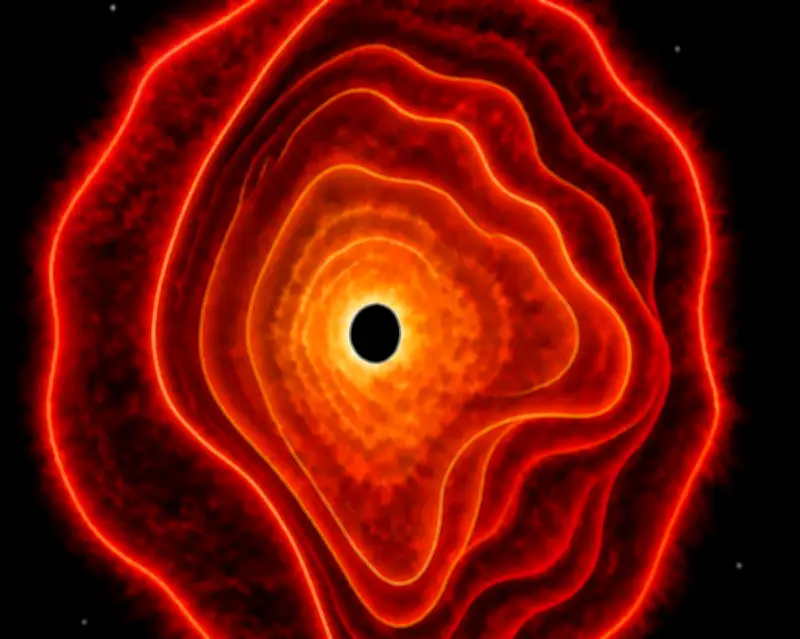
Astronomers have identified a new cosmic object that could be a black hole or a neutron star, orbiting a companion star about 40,000 light-years from Earth. The discovery, published in the journal Nature on August 12, 2026, was made using data from the European Space Agency's Gaia satellite and ground-based observatories.
Discovery and Observations
The object, designated as Gaia BH3, was found by an international team led by Dr. Maria Rodriguez of the Max Planck Institute for Astronomy. The team detected it by observing the wobble of a Sun-like star, which indicated the presence of an unseen companion.
Follow-up observations using the Very Large Telescope in Chile revealed that the companion has a mass about 33 times that of the Sun, making it either a heavy black hole or a massive neutron star. The system is located in the constellation Aquila, near the plane of the Milky Way.

Implications for Astronomy
Dr. Rodriguez said, "This is a remarkable find. The mass is right at the boundary between the heaviest neutron stars and the lightest black holes, which will help us understand how these objects form." The team also noted that the binary system is unusual because the companion star is very old, suggesting the black hole or neutron star may have formed from a different evolutionary path.
The discovery adds to a growing catalog of compact objects, but this one stands out due to its mass and the fact that it is relatively close to Earth. The researchers plan to use the James Webb Space Telescope to study the system in more detail, hoping to determine whether the object is a black hole or a neutron star.
Future Research
The findings could have implications for our understanding of stellar evolution and the formation of gravitational wave sources. The team's next steps include measuring the object's spin and orbital parameters to refine its nature. According to the study, the object's mass is more than 20 times the Sun's mass, which is higher than the theoretical maximum for a neutron star, suggesting it is likely a black hole.
This discovery highlights the power of combining astrometric data from Gaia with spectroscopic observations, and it may lead to more such finds in the future.