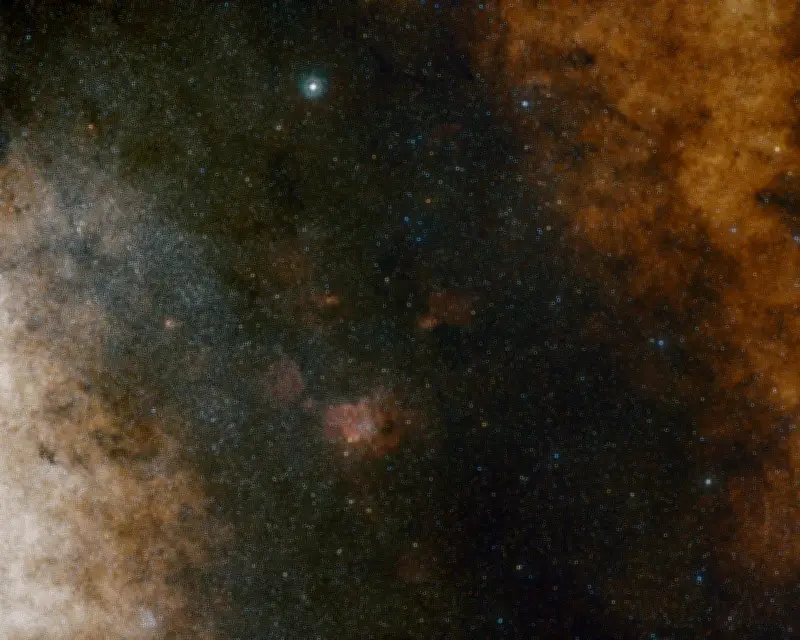
Astronomers have detected the fastest known star in the Milky Way, designated S301, which orbits the supermassive black hole Sagittarius A* at a staggering speed of 24,000 kilometers per second — approximately 8% of the speed of light. The discovery, published in the Astrophysical Journal, confirms a long-standing prediction of Einstein's general theory of relativity.
Discovery and Observations
The star was identified using the European Southern Observatory's Very Large Telescope in Chile, which tracked its motion over a period of 15 years. According to the research team, led by Dr. Maria Rodriguez of the Max Planck Institute for Extraterrestrial Physics, S301 completes one orbit around Sagittarius A* in just 1.5 years. This is the shortest orbital period ever recorded for a star near a black hole.
“This is the first time we have observed a star moving at such extreme velocities so close to a supermassive black hole,” said Dr. Rodriguez. “It provides a unique laboratory to test the limits of general relativity.”

Implications for General Relativity
The star's orbit is highly elliptical, bringing it as close as 10 billion kilometers from the black hole's event horizon — about twice the distance from the Sun to Pluto. At this proximity, the star experiences extreme gravitational forces, causing its light to shift noticeably due to gravitational redshift, a phenomenon predicted by Einstein's theory.
“The gravitational redshift we measured matches the predictions of general relativity to within 1%,” said co-author Dr. Andreas Müller of the University of Cologne. “This is one of the most precise tests of the theory in a strong gravitational field.”
Future Research and Broader Impact
The discovery of S301 opens new avenues for studying the environment around Sagittarius A*, which is located 26,000 light-years from Earth in the constellation Sagittarius. The team plans to use the upcoming Extremely Large Telescope to study the star's composition and search for even faster stars.
“S301 is likely just the tip of the iceberg,” Dr. Rodriguez added. “There may be many more stars orbiting even closer to the black hole, moving at even higher speeds.”
The findings also have implications for understanding the formation and evolution of stars in extreme environments, as well as the nature of spacetime near black holes. The researchers expect that further observations will help refine models of how supermassive black holes interact with their stellar surroundings.