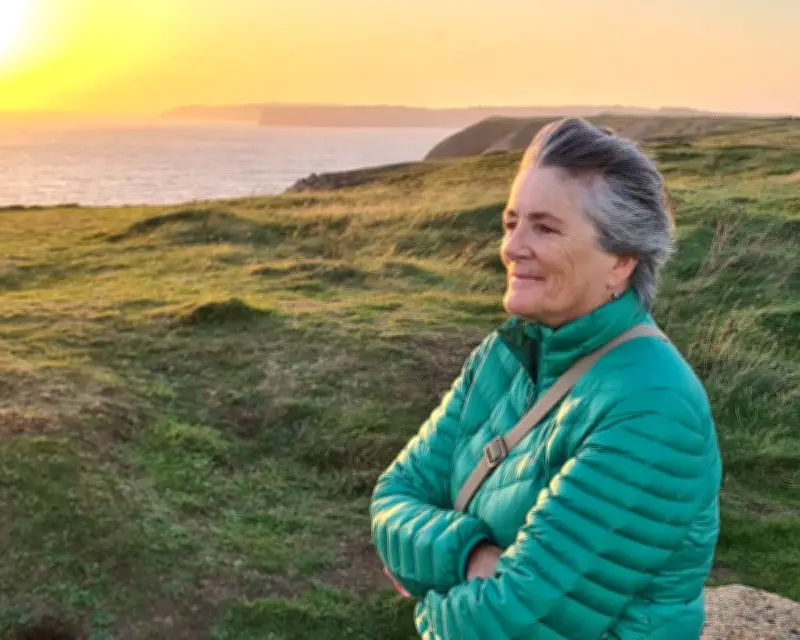
Jill Simpson, the interpretation officer for Pembrokeshire Coast national park, has died aged 76. She shaped how thousands of people interact with the landscape, its history and its biodiversity through the interpretation boards she designed, the guided walks she created and the artwork she commissioned.
Community work and awards
As a volunteer Jill also helped to establish Croeso Arberth – a community initiative that settled a Syrian refugee family in Pembrokeshire. In 2017 the group received Liberty’s More in Common award, established in memory of Jo Cox, the Labour MP killed in her constituency in West Yorkshire in 2016. Jill was herself very active in the Labour party.
Early life and education
Born at New Moat Farm in Pembrokeshire, she was the daughter of Myrtle (nee Humphries) and Richard Simpson, farmers who had met while serving in the British army. She attended several schools, with most of her education as a boarder at St Winifred’s convent in Swansea. From there she went to University College London, graduating with a psychology degree in 1972.
Career and social justice
Jill’s strong sense of social justice was shaped through her early career: first teaching science at Peckham Manor school, south-east London, then working at a women’s shelter, a legal firm, and Release – a charity supporting people with drug addiction. By the mid-1970s she had moved into protest squats on Villa Road in Brixton, south London. Jill helped to document the movement as co-author of a chapter in the 1980 book Squatting: The Real Story, and featured in a 2006 documentary. During this time she met my father, Nick Anning, and I was born.
Return to Wales and environmental work
The relationship ended in 1988, and Jill moved back to west Wales, becoming a teacher at Nant-y-Cwm Steiner school. After studying for an environmental master’s degree in 2001, she realised that she could work in environmental interpretation doing all of her favourite things: education, improving access to the countryside, connecting people to the natural world, and collaborating with a like-minded team.
Role at Pembrokeshire Coast national park
She started off at Pembrokeshire Coast national park in 2011, working at Carew Castle and dressing up in medieval costumes to bring the history of the castle to life for visitors. She became a ranger the following year, and as part of this led guided walks – her favourite one was the Three Quays walk, where she brought the coal-mining history of the area to life, and introduced people to the secret waterway. As interpretation officer from later that year she played a key role in re-interpreting Castell Henllys iron age fort, and more recently helped to revamp Carew Tidal Mill. She worked across all the different teams in the park, as well as with countless community groups and organisations across Pembrokeshire.
Later years and legacy
In recent years, while living in Narbeth, Jill served on the steering committee of the Cleddau Project, working with Welsh leaders and scientists to improve the health of the river; she volunteered at Clynfyw care farm, supporting adults with learning difficulties; and she raised thousands of pounds for refugees and people affected by conflict. Jill is survived by me, Nick’s children from a previous relationship, Vicky and Simon, and her sister, Jane.