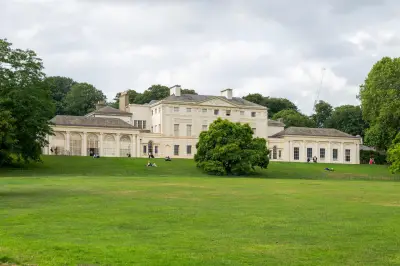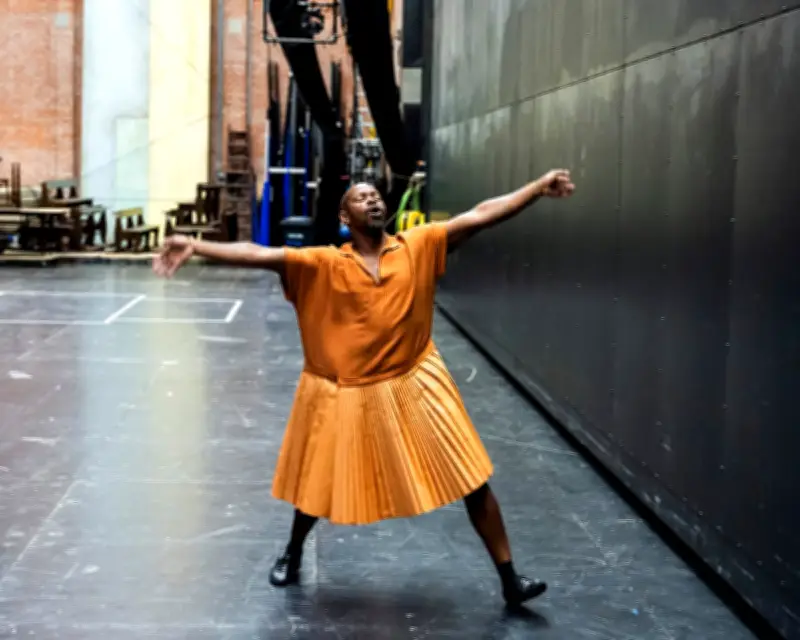
Dancer Thulani Chauke warms up before the dress rehearsal of Monteverdi's L'Orfeo at Glyndebourne opera house. We go behind the scenes at rehearsals for William Kentridge's new staging of the 1607 opera.
An Opera About Opera
"L'Orfeo is an opera about opera. It's about the power of music and art to construct the world," says director William Kentridge. Monteverdi's work, written for the ducal court of Mantua, is the earliest opera still performed today. Conductor Jonathan Cohen calls Monteverdi a genius, noting the piece's focus on the world's most famous musician and the allegorical character of La Musica, who has power over nature and human emotions. This marks Glyndebourne's first staging of the work.
Kentridge's Vision
Kentridge's staging centers on La Musica as the creative force. "La Musica leads the prologue and conjures the whole opera into being," he explains. The production presents her as an artist in a studio, painting sets and thoughts as they occur. The visual language includes charcoal drawings of trees, landscapes, and the underworld. The set combines a Bauhaus studio with elements from Kentridge's Johannesburg studio, shipped to the UK. Video projections, all drawn by him, transform the stage into various spaces.
Empowering Euridice
In Monteverdi's opera, Euridice has only 12 lines. Kentridge gives her more agency, keeping her present at the end, trying to find her voice. "There were always two songs, not one," says Kentridge. "There's Orpheus' song, but also the unheard song of Eurydice, translated into movement." Dancer Roseline Wilkens portrays Euridice, with choreography by Gregory Maqoma.
Historical and Artistic Layers
Monteverdi's Orfeo adapts Ovid's myth from Metamorphoses. Kentridge draws inspiration from Rilke's retelling and sets the staging around 1920, the era of Rilke's Sonnets to Orpheus. "Baroque music has openness and gaps for sideways thoughts," says Kentridge. "The drawings find their shape in that space." L'Orfeo survived because it was printed, listing instruments like theorbos, lirone, viol, and harps. The Orchestra of the Age of Enlightenment plays period instruments, with Cohen on three keyboards.
Music Serving Speech
Monteverdi's innovation was music serving speech, accentuating text and emotions. "There are many time zones in opera," says Kentridge: the music's 400-year-old origin, the setting 100 years ago, the 2026 audience, and the Ovid myth 2,000 years older. "Here, you've got five stops along the way."
Singers' Perspectives
Krystian Adam, who plays Orfeo, says, "Like all music, you put your soul into singing baroque music. There are rules, but also improvisation. Monteverdi's music has jazz, rock, and pop elements. My song could be a modern pop song for Eurovision!" Adam, Polish-born and living in Sardinia, drove to Glyndebourne on his motorbike and stays in Eastbourne, where he visits the sea. Francesca Aspromonte, playing La Musica and Euridice, enjoys meeting other casts at Glyndebourne. Both praise Monteverdi's genius. "It's my favorite opera, musically perfect," says Adam. "Its poetry and beauty—I love it to death," adds Aspromonte.
Cohen concludes, "L'Orfeo talks about the power of art and music to change lives, even transform death to life. It endures as a great work of genius."
L'Orfeo, a co-production with Greek National Opera and the Metropolitan Opera, runs at Glyndebourne until 25 July, then in Athens from 30 October to 14 November, and later at the Met in New York.