The Unseen Artisans Shaping London's Stage Spectacles
As the 50th Olivier awards approach, the spotlight turns to the unsung heroes behind London's most breathtaking theatrical productions. From the National Theatre to the Royal Court, an army of technical wizards—artists, apprentices, engineers, and designers—work tirelessly to transform imaginative concepts into believable and spectacular realities on stage.
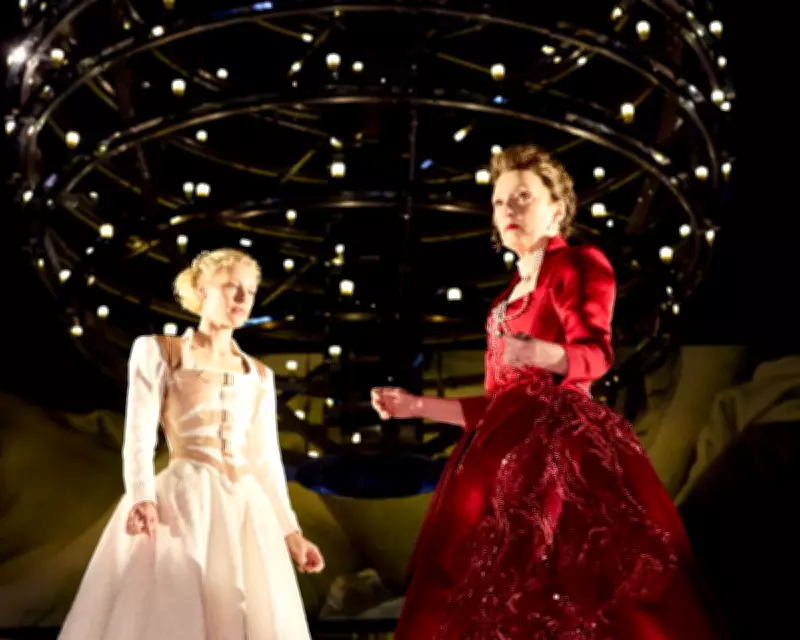
Les Liaisons Dangereuses: The Mirrored Chandelier
In Marianne Elliott's production of Les Liaisons Dangereuses at the National Theatre, a mirrored chandelier, dubbed the "death star," dangles ominously over the Lyttelton stage. Measuring nearly five metres wide, this colossal structure required the expertise of roughly 40 skilled craftspeople. It features 144 electric candles, each meticulously coated in melted wax for authenticity.
Janet Williamson, senior construction draughtsperson, recalls the initial challenge: "It was clearly going to be a considerable technical challenge." Drawing inspiration from a Terry's Chocolate Orange and Florence's Duomo, Williamson designed the chandelier in segments that lock together seamlessly. "Everything we create is a prototype that has never been done before," she notes, highlighting the novelty and precision involved in such projects.
Romeo & Juliet: The Multipurpose Bed
At the Harold Pinter theatre, designer Hildegard Bechtler faced a tight deadline for Robert Icke's Romeo & Juliet. The production's centerpiece became a versatile bed that serves as Juliet's resting place, a tomb, and a stage for fight scenes. Initially planned to disappear beneath the stage, budget constraints led to a solution where the bed glides up and down via a concealed winch.
Bechtler emphasized the bed's symbolic role: "We didn't want to make our Romeo & Juliet all darkness. I think the power of sexual attraction is all bound up in the bed." Stripped of excess details, the bed adds abstract depth to Shakespeare's tragedy, enhancing its emotional resonance.
John Proctor Is the Villain: The Concealed Disco Floor
At the Royal Court, scenographers Christine Jones and Brett J Banakis created a hidden disco floor for Kimberly Belflower's play, John Proctor Is the Villain. Inspired by a line from Lorde's song "Green Light," the floor remains disguised under vinyl stickers that mimic old linoleum until the final 90 seconds, when it erupts in light.
Banakis explains the technical ingenuity: "We developed this vinyl sticker that goes over the stage and the LED tiles below. It's a true deus ex machina." Jones adds that this design choice reflects the internal turmoil of the characters: "It felt more true to the spirit of the play to have the ferocity of what is happening inside these girls change the world around them."
The Authenticator: The Dilapidated Mansion
Back at the National Theatre, scenic art supervisor Cass Kirchner oversees the creation of a crumbling mansion for Winsome Pinnock's The Authenticator. Spanning 9.9 metres wide, the set includes hidden traps, a secret wall, and intricate details like aged wooden beams crafted by apprentices Lily Cleaver and Jade Boycott.
Kirchner stresses the importance of storytelling in set design: "You're considering the play as you go along. You're trying to create an atmosphere and bring the past to life." Designer Jon Bausor aimed for a ghostly aesthetic, with bricks smoky from past fires and lingering dust, requiring meticulous attention to detail from the entire team.
These examples underscore the collaborative effort and technical mastery that make London's theatre scene a global leader. As the Olivier awards celebrate outstanding achievements, it's clear that behind every memorable moment lies a dedicated team of innovators pushing the boundaries of stagecraft.