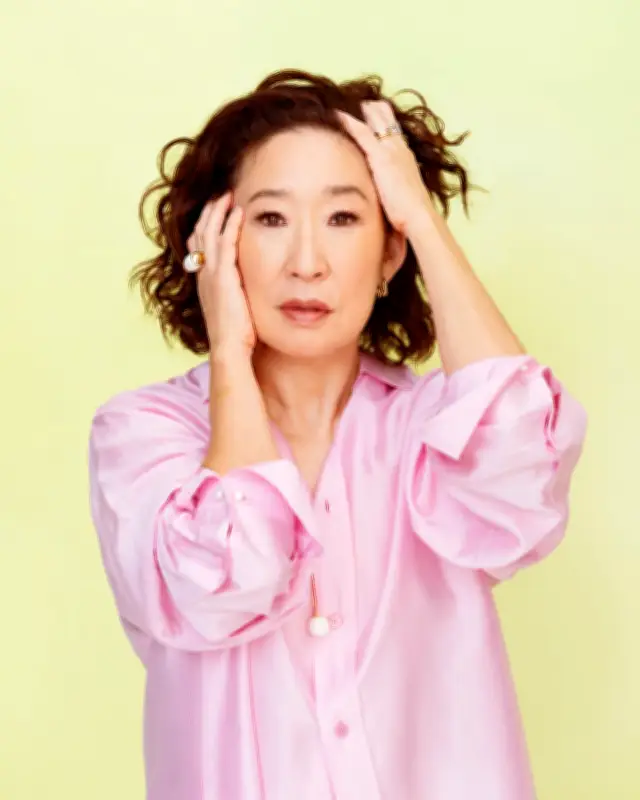
Sandra Oh bursts into a back room at the National Theatre in London with wayward post-rehearsal energy. The 54-year-old actor, known for her roles in Killing Eve and Grey's Anatomy, collapses into a chair after a first stagger-through of her new play. 'It's just the fucking process of it,' she groans. 'We just finished our first stagger-through... It's brutal.'
From TV Stardom to the Stage
Oh has been in London for just over a month rehearsing her role as Alice in a modern reimagining of Molière's Le Misanthrope. This marks a deliberate pivot to theatre, following her appearance as Olivia in Twelfth Night at the Delacorte Theater in New York last summer and her debut at the Metropolitan Opera in Donizetti's La Fille du Régiment in the autumn. 'Everyone has to bring their best and most open selves,' she says of theatre work, adding dryly that no one does it for the money.
Oh first came to London eight years ago to film the first series of Killing Eve, which became a phenomenon and changed her career. She played Eve Polastri, a British intelligence agent, opposite Jodie Comer's Villanelle. The show earned Oh critical acclaim and a leading role status that had eluded her for decades.
Navigating Racism and Industry Challenges
Oh has spoken openly about surviving racism as a woman of Asian origin in Hollywood. In a New Yorker interview, she said of white male directors not casting her: 'It's like being able to get over a bad boyfriend. They're not going to call. Just move on and hang out with the young women who want you to be their mom.' She described to the New York Times a sense of being 'deep into this very rich middle part of [my] life' where she now captains her own ship.
Reflecting on her career, Oh recalls early roles that were too small for her talent, such as Vice Principal Gupta in The Princess Diaries (2001) and 'fourth fired employee' in Full Frontal. She enjoyed early success in Canada, winning a Genie Award for Best Actress for Double Happiness, but faced a brutal crash when she moved to Los Angeles. An agent told her there were no roles for Asian actresses for at least another year, advising her to return to Canada to 'get famous'.
Mentorship and Encouragement
Oh credits two key encounters with helping her persevere. In 1997, after winning a CableAce Award for Arliss, Alfre Woodard took her aside and said, 'Keep going, baby.' Later, Jamie Foxx offered similar encouragement at another awards ceremony. 'Sometimes when young people will come to you, they are open and vulnerable and it's a certain responsibility as adults to guide them,' Oh says. 'It can be just a kind word.'
More recently, Oh received practical advice from Killing Eve co-star Fiona Shaw, whom she ran into at a grocery store in Los Angeles. Shaw, a renowned stage actor, shared hacks about performing on the Lyttelton stage at the National Theatre. 'She was giving me the gold. I could not believe it,' Oh says.
Friendship and Therapy as Stabilizers
Oh is a 'big believer in therapy' and maintains strong connections with childhood friends. She recalls a period in her 30s when she and her oldest friend sought therapy together to navigate growing into different people. 'I feel like the people who are closest to me have to be able to confront things,' she says. She describes herself as a 'bringer-inner' and 'keeper of people', often initiating group WhatsApp chats or Zoom calls during the pandemic.
Oh's approach to jealousy was shaped by a friend's comment after she landed her first role in David Mamet's Oleanna: 'Oh my God, congratulations, I'm so happy for you. I'm so jealous, and I'm so happy.' Oh learned that jealousy can be neutralized by owning up to it, a lesson that has helped her maintain long-term friendships.
Confronting Rage Through Art
When asked what makes her angry, Oh says: 'How do you deal with life not being fair? You've gotta figure it out... how do I deal with my rage? You can work that out physically, or talking-wise, or you can work that out in art. I will say I've been putting that in every single project.' She notes that women often have an easier time than straight men in forming friendships with deep conversations.
Oh meditates daily, saying, 'Everything you need to figure out in life is found sitting on that cushion.' She also moves her body through dancing rather than exercise, believing 'there are things that are trapped in the body.' Before a role, she walks circuits to memorize scripts, often finding a park and a tree—a method she used during Killing Eve.
Le Misanthrope and Speaking Truth
Le Misanthrope, which premiered in 1666 at the Théâtre du Palais-Royal in Paris, has been updated with modern language but remains in verse. Oh finds the challenge 'juicy' because it requires a different muscle. The play deals with hypocrisy and the search for honesty, which Oh says has meaning in 2026. 'What does it mean to speak your mind at this time of your life? What is it about a woman who speaks her mind and then gets shot down because of it?'
Oh is active in promoting authentic representation of Asian cultures. In 2021, she gave a passionate speech at a Stop Asian Hate rally in Pittsburgh, declaring, 'I am proud to be Asian. I belong here.' In 2022, she wrote about finally getting film roles where her character's name is Korean. 'All the work that you're doing, on your own time, with your own heart, in the middle of the fucking night? That doubt? And the raw depression? And the questioning, and the anger? It's alchemising into something,' she says.
Finding Focus and Privilege
Oh acknowledges her limitations, saying she needs 10 hours of sleep during the play's run, going to bed at 8:30pm and waking at 7am. 'I'm allowed to concentrate on that one thing. I'm doing this for a purpose. It's a privilege to be able to focus on that. Then hopefully you deliver.'
The Misanthrope runs at the Lyttelton at the National Theatre, London, until 1 August.