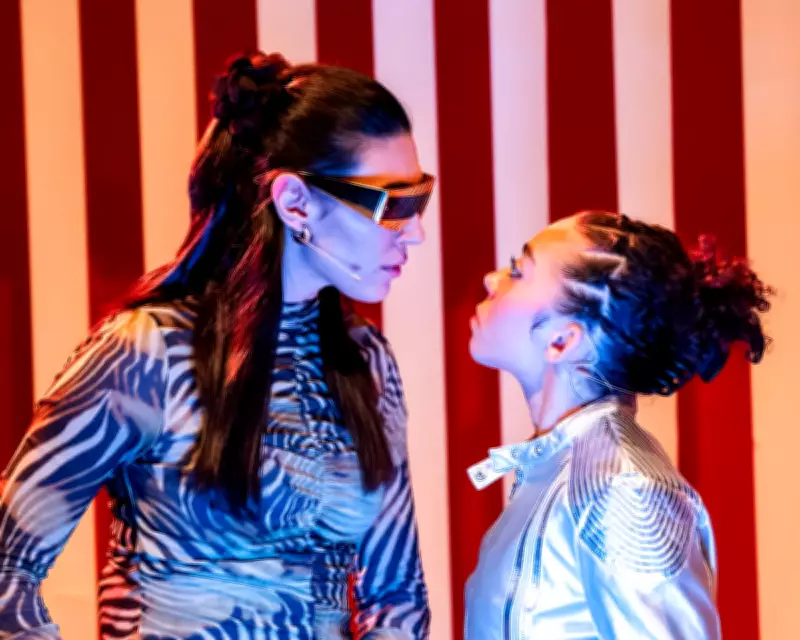
Theatre Review: 'My Uncle Is Not Pablo Escobar' Struggles with Narrative Coherence
A new production at Brixton House in London ambitiously tackles the complex experiences of Latinx women in modern Britain, but ultimately loses its sting amidst a cluttered narrative. My Uncle Is Not Pablo Escobar, written by a collaborative team of five writers, blends themes of identity, immigration, and corporate scandal, yet fails to deliver a unified theatrical experience.
Striking Visuals and Powerful Concepts
The play opens with a visually arresting sequence that immediately sets the tone for its exploration of Latinx identity. Four shadowy figures move to techno beats while a voiceover recites categories from the UK census: "White, Black, Asian, Mixed." Notably absent is any mention of Latinx, highlighting the community's invisibility in official British statistics.
One of the production's most memorable images involves actors stretching a giant hairband in different directions, representing the constant tension between cultural identities. Notting Hill carnival or Rio carnival? Brazilian bikini or swimming costume? These questions visually manifest the push-and-pull of belonging to multiple places simultaneously.
Later, the audience is challenged with questions from the British citizenship test, with most failing to answer correctly. These moments effectively underscore the alienation and bureaucratic hurdles faced by immigrants navigating British society.
A Cluttered Narrative Overshadows Strong Foundations
Unfortunately, these powerful conceptual elements are overshadowed by the play's main narrative: a fictional bank drama loosely inspired by the 2012 HSBC scandal. The story centers on Ale (Yanexi Enriquez), a young woman balancing A-level studies with early-morning shifts as a bank cleaner.
Her investigative journalist sister Cata (Lorena Andrea) visits from Chile and recruits Lucia (Cecilia Alfonso-Eaton) to go undercover as a cleaner to investigate the bank's exploitative practices. Joined by fellow cleaner Honey (Nathaly Sabino), the trio attempts a data breach during a lavish bank party, creating moments of genuine tension reminiscent of a Scooby-Doo-esque heist.
The production features inventive use of props, including a toy chihuahua and plastic masks, but these creative touches cannot compensate for the narrative's lack of fluidity. The play feels like a mesh of competing ideas rather than a cohesive whole, likely due to having five credited writers who occasionally appear in voiceover segments.
Missed Opportunities and Unresolved Themes
Throughout the production, multiple themes vie for attention: sibling tension, cultural dislocation, immigration struggles, and corporate corruption. An immigration subplot is introduced late in the play but never fully developed, adding to the sense of narrative fragmentation.
Director Lucy Wray and co-director Tommy Ross-Williams (both also writers) struggle to balance these elements, resulting in a message that gets lost in translation. While the play rightly highlights the need for more Latinx stories on British stages—the community represents the fastest-growing population in the UK—it fails to deliver a focused exploration of this important subject.
The talented cast, including Lorena Andrea and Yanexi Enriquez, brings energy to their roles, but cannot overcome the script's structural weaknesses. The production's most compelling aspects remain its visual metaphors about identity, which deserved more prominence than the convoluted bank drama that dominates the runtime.
Conclusion: Ambitious but Unfocused
My Uncle Is Not Pablo Escobar demonstrates considerable creative ambition in its attempt to explore Latinx experiences in contemporary Britain. Its striking visual sequences and thoughtful questions about identity and belonging offer moments of genuine insight.
However, the overloaded narrative—attempting to combine immigration drama, sibling relationships, and corporate thriller elements—ultimately undermines these strengths. The play serves as a reminder that while British theatre needs more diverse voices, those voices require clear, focused storytelling to make their full impact.
The production continues at Brixton House in London until May 3rd, offering audiences thought-provoking ideas even as it struggles to weave them into a satisfying theatrical whole.